

Flight allows for fast and safe travel over long distances, as well as timely transportation of goods and emergency services. The aerospace industry operates in a variety of settings which create a basis for competitiveness and advancement of the field. These settings include domestic and foreign governments, defense and security, space exploration, research, and public and private travel. Individuals working within the aerospace industry occupy roles in manufacturing, sales, design, maintenance and transportation.
Aerospace Industry Disciplines
Two main disciplines make up the aerospace industry:
- Aeronautics | The study of flight
- Astronautics | The study of travel beyond the earth's atmosphere
Aeronautical Engineers work with aircraft. They are involved primarily in designing aircraft and propulsion systems and in studying the aerodynamic performance of aircraft and construction materials. They work with the theory, technology, and practice of flight within the Earth's atmosphere.
Astronautical Engineers work with the science and technology of spacecraft and how they perform inside and outside the Earth's atmosphere. This includes work on small satellites such as CubSats and traditional large satellites.
Roles and Workforce Needs
A variety of technologies, science and industries are needed to produce the products, services, and scientific understanding that make up the aerospace industry. According to the U.S. Department of Labor, production and professional jobs account for more than half of the jobs in the industry including engineers, scientists, technicians, computer programmers, pilots, mechanics, graphic arts and administrators to name a few.
Engineers and other scientists work on the development and production of safe, efficient equipment. Their work includes:
- Studies of the atmosphere and space
- Improvement of the usefulness, performance, speed, safety and efficiency of combat, aeronautical and space vehicles
- Development and operation of vehicles capable of carrying instruments, equipment, supplies and living organisms through space and throughout the atmosphere
- Defense research that involves surveillance, tracking and other systems allowing users to maintain visual, audio, and long-range contact.
Aerospace companies can be defense contractors, commercial companies or both. Many companies provide both defense products (missiles, aircraft, electronics) as well as commercial products such as commercial aircraft or satellites.
Industry Sectors
Products of the aerospace industry can be separated into three sectors:
- Space | Space challenges the frontiers of higher speeds and safer, more efficient operations of air and spacecraft. Engineers tackle questions such as: Will the engine fire as planned? Will the power source continue to produce electricity?
- Military | Aerospace technology is a vital part of the national security of the United States. The Department of Defense contracts with private aerospace companies to procure the manufacturing, scientific, research, and engineering resources to promote national security.
- Commercial | Whether for passenger or freight use, commercial aircraft makes up the largest portion of the aerospace industry's sales. Business needs and the traveling public continue to fuel the growth of the industry.
Career Opportunities at a Glance
- Aerospace Engineer
- Avionics Systems Test Engineer
- Computational Fluid Dynamic Engineer
- Computer Engineer
- Computer Analyst
- Cyber Analyst
- Flight Controller
- Electrical Engineer
- Embedded Systems Engineer
- Launch Engineer
- Materials Test Engineer
- Manufacturing Engineer
- Mechanical Design Engineer
- Quality Assurance Engineer
- Stress Engineer
- Structural Design Engineer
- Systems Engineer
- Production Engineer
Sample job titles based on 2020 - 2025 Auburn Engineering graduates responses to the Auburn University First Destination Survey.
- Aeroject Rocketdyne
- Airbus
- Boeing
- Ball Aerospace
- Delta Air Lines
- Federal Aviation Administration
- GE Aviation
- GKN Aerospace
- Gulfstream Aerospace
- Honeywell
- Leidos Dynetics, Inc.
- Lockheed Martin
- Missile Space Intelligence Center
- National Aeronautics and Space Administration (NASA)
- Northrop Grumman
- Redstone Arsenal
- RTX: Raytheon
- Torch Technologies
- United Launch Alliance
- United States Air Force
- United States Army
- SAIC
- SpaceX
Pathways to Aerospace Experience
- Aero and Astro Robotics Club
- American Institute of Aeronautics and Astronautics (AIAA)
- Arnold Air Society
- Design Build Fly
- Launch and Propulsion Society
Search for opportunities with sample hiring organizations + companies recruiting through
Support for your co-op and internship search
- Interest to Industry Meetings: Navigating Your Co-op or Internship Search
- Meet with a career coach
- Complete a Professional Experience Interest Form
Confirmed an upcoming opportunity?
- Advanced Flow Diagnostics Lab
- Immersive, Interactive, & Intelligent (3i) Space Dynamics Lab
- Polymers Mechanics Research Lab
- Vehicle Systems, Dynamics, and Design Lab
Find out more about how to gain research experience
- Aerospace Industries Association of America (AIA-Aerospace)
- Aircraft Electronics Association (AEA)
- Air and Space Forces Association (AFA)
- Aircraft Owners and Pilots Association (AOPA)
- American Institute of Aeronautics and Astronautics (AIAA)
- General Aviation Manufacturers Association
- Society of Professional Engineering Employees in Aerospace
Navigating the Hiring Process
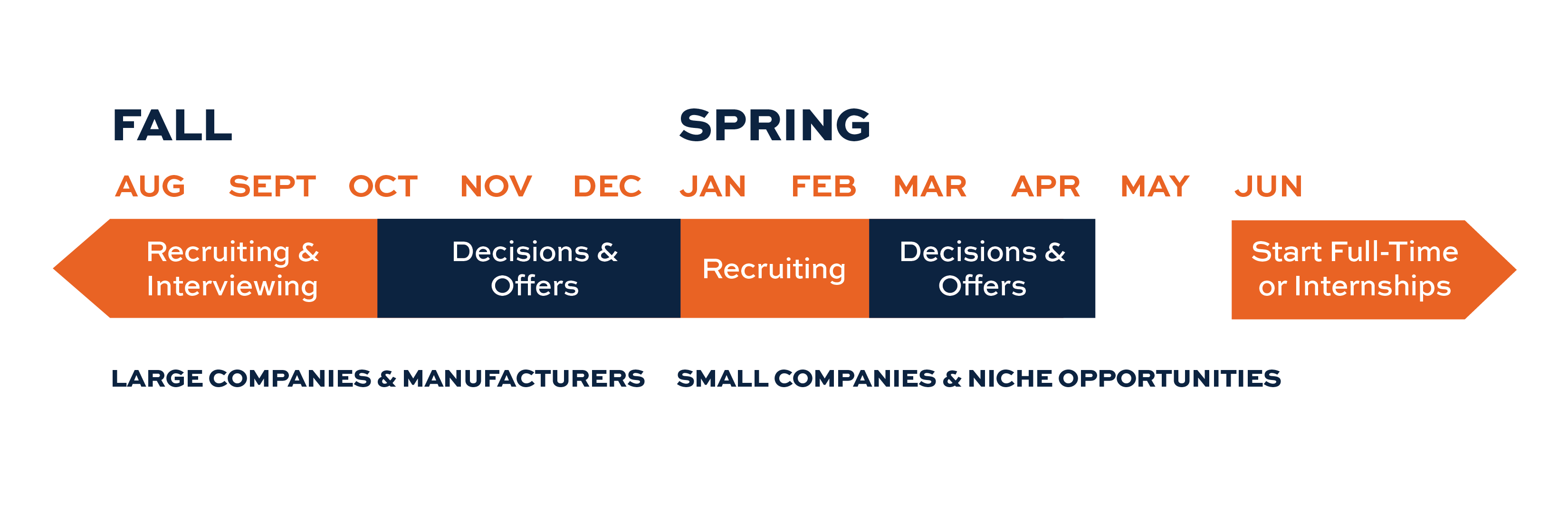
Depending on the type of employer and the role, recruitment timelines vary. Governmental organizations, large companies, and manufacturers recruit most heavily in the fall for positions starting in the spring or summer. Opportunities still exist beyond the fall but are often more niche opportunities with smaller companies. Additionally, companies will hire throughout the year depending on the needs and demands of their projects or government contracts.
Seek opportunities to connect with employers at fall events such as the fall Engineering Career Fair, as well as at employer table talks, employer-in-residence, Ask Alumni Anything chats and student organization meetings. Search for posted opportunities on Handshake and other sources referenced below.
Some roles within the Aerospace industry require screening for specific qualifications, particularly those associated with military, space, and government contracts. Following the interview process, candidates are often offered a conditional job offer that is subject to completion of a suitability and security clearance process, designed to examine your life history to measure your loyalty to the United States, strength of character, trustworthiness, honesty, reliability, and soundness of judgment. The security clearance process is lengthy and previously obtained clearances make full-time candidates even more desirable. Be mindful of how your behaviors and online presence and interactions can impact your candidacy for roles within this field.
Check the CDCR Career Calendar for the
Navigating U.S. Government Security Clearances Workshop
Alumni and Networking in the Industry
- Allen Craven, '08 and '11 Mechanical | Apache Structures Team Lead | US Army DEVCOM Aviation & Missile Center
- Emily Zieman, '04 Aerospace | Risk Management Lead | NASA
- Holly Giroux, '03 Chemical | Director of Quality Assurance | Toray Composite Materials America
- Jessica Haack, '12 Materials | Nondestructive Evaluation Engineer | Boeing
- Carol Jenkins, '81 Industrial & Systems | Principle Systems Engineer | MTSI
- James Spivey, '16 Mechanical | Procurement Engineering Manager | Lockheed Martin
- Robert Champion, '86 Aerospace | Director of Spacecraft and Vehicle Systems Department | NASA Marshall Space Flight Center
- Thomas K. Mattingly, '58 Aeronautical | Astronaut and Lt. Commander
- Walt Woltosz, '69 Aerospace | Words+,Inc. Founder | Board of Trustees Member Auburn University

You can access alumni such as these to learn about career paths, skills for the industry, and build your network through LinkedIn. Create an account and build your profile, then search for Auburn alumni by major, company, location, or other criteria on the Auburn University LinkedIn page. Chat with an Engineering Career Coach on strategies for networking and reaching out to connect.