

Center for Bioenergy and Bioproducts (CBB)

Director, Center for Bioenergy and Bioproducts
About the Center
Established in 2007, the Auburn University Center for Bioenergy and Bioproducts (CBB) is a hub for innovation that leverages the state’s vast reserves of renewable forestry and agricultural biomass. With a mission to identify bioenergy and bioproduct opportunities in the Southeast, the CBB is positioned to address barriers to the widespread development of alternative fuels, reduce the nation’s dependence on foreign energy sources, and advance statewide economic development.
Interdisciplinary research capabilities include catalyst characterization, biomass characterization, liquid fuel characterization, pilot-scale gasification and gas conditioning, and catalytic liquid fuel synthesis. These capabilities allow industry partners to utilize locally available biomass to produce fuels, chemicals, and materials in a sustainable manner.
With laboratory space inside the Center for Advanced Science, Innovation and Commerce and the Biological Engineering Research Laboratory at the Auburn Research Park, the CBB is poised to meet these challenges for years to come.
-
Collaborators include the Forest Products Development Center, Auburn University’s Departments of Chemical Engineering and Biosystems Engineering, the National Center for Asphalt Technology, and the USDA Forest Service.
-
Specific focus areas include thermal and biochemical conversions, biomass production logistics, syngas cleaning, catalyst development, and sustainability.
-
Awarded a $1 million grant from the USDA’s National Institute of Food and Agriculture in 2023 to test the efficacy of a dual-function biochar substrate that captures excess phosphorus in soils and releases it slowly to meet plant needs.
-
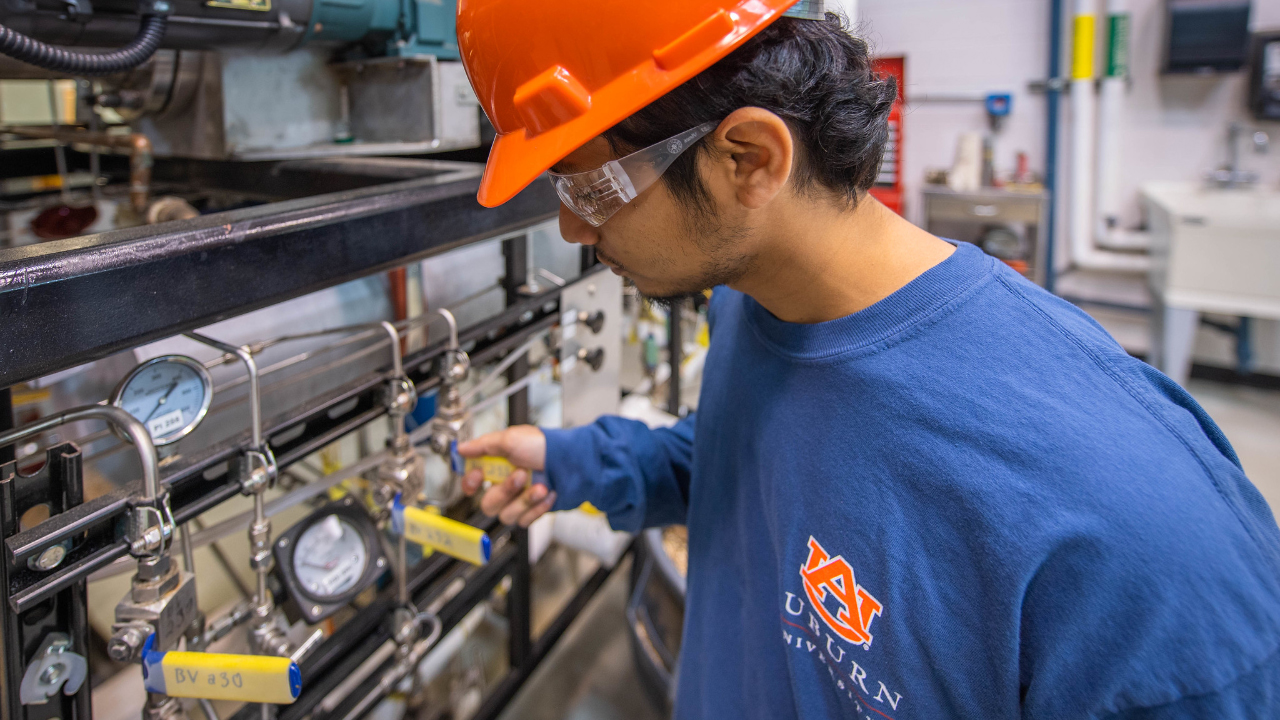
Facilities include a pilot-scale gasification and gas conditioning laboratory; a catalytic liquid fuel laboratory with fixed-bed reactors and continuously stirred tank reactors; a biomass characterization laboratory with walk-in refrigerated rooms and enclosed laminar hoods; and a liquid fuel characterization laboratory equipped with a pH meter, Karl Fischer titrator, thermogravimetric analyzer, and additional instrumentation.