New building to expand Auburn's stormwater research, training capabilities
Published: Nov 18, 2026 10:00 AM
By Dustin Duncan
 An AI-generated architectural rendering of the new $1.5 million building at Auburn University's Stormwater Research Facility, created using the project's actual construction plans.
The Auburn University Stormwater Research Facility is finally getting shelter.
The facility broke ground on a $1.5 million, 4,000-square-foot building in November that will expand its research capabilities, provide dedicated laboratory space and create new opportunities for hands-on professional training.
Michael Perez, director of the Stormwater Research Facility and the Brasfield & Gorrie Associate Professor in the Department of Civil and Environmental Engineering, said the building will address a longstanding need for permanent infrastructure as the facility's research and educational programs continue to expand.
Established in 2008 on two acres, the facility has grown to 12 acres in Opelika, and its faculty have conducted more than 40 research projects representing more than $12 million in research funding.

Since initial inception in 2008, the facility has become one of the nation's few dedicated outdoor stormwater research and training centers, supporting applied research, technology evaluation and workforce development.
Perez said the facility has operated primarily out of a small metal storage shed that for years has served as a makeshift office, workshop, and storage for researchers.
"We need dedicated space to allow us to properly do the work that we need to do,” Perez said. “It will allow us to have a permanent footprint in what is otherwise can very much feel like a remote field site.”
The new building will include a 1,000-square-foot laboratory, offices, meeting areas and a training room, bringing several functions currently spread between the research site and Auburn's main campus into one location.
The lab will also allow researchers to conduct indoor testing and process water quality samples on-site. Currently, students collect samples at the facility and return them to campus, where undergraduate researchers often assist with analysis.
Perez said processing those samples on-site will improve efficiency.
"Everything can be done in one spot, and we can then do tests right away and get results faster," Perez said.
The new building will also improve training for the hundreds of industry professionals who participate in the facility's annual Stormwater Week program.
The event brings together contractors, engineers, designers, installers and other professionals for classroom instruction and field demonstrations focused on stormwater management and erosion and sediment control.
"Right now, we rely on using classrooms on campus, do a half day of training, and then go out the next day and do a full day of training at the facility," Perez said. "With the new building, we'll be able to teach in the classroom and then take participants directly into the field to apply what they've learned."
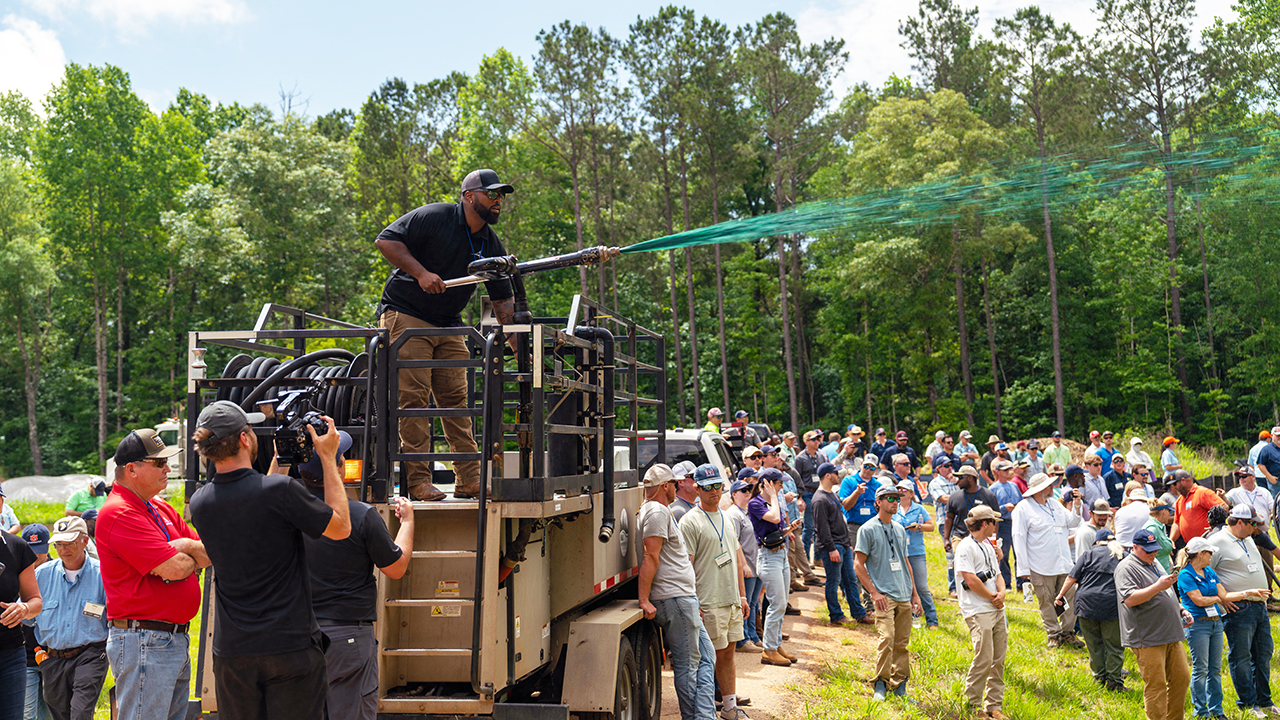
Perez said the new building could allow the facility to offer additional workshops throughout the year, including specialized sessions that explore individual stormwater management practices in greater depth.
Additionally, a project funded through the Alabama Department of Environmental Management will incorporate functioning stormwater management technologies around the building, including bioretention cells, underground detention systems, permeable pavers, cisterns and irrigation systems using reclaimed water.
These interconnected systems will demonstrate how different stormwater management practices work together.
"All those different urban stormwater management features are going to serve as educational components," Perez said. "We can bring groups from our classroom and say, 'OK, here's how you install an underground detention system. Let's go look at one right outside and understand how it works by running water through the practice.'"
The property will include four different types of underground detention systems, giving participants an opportunity to examine different approaches to stormwater management.
Perez said the investment will help position the facility as a leader in stormwater management.
"It's a strategic investment," Perez said. "It's positioning us to be even that much further as leaders in the country in stormwater management."
Media Contact: , dzd0065@auburn.edu, 334-844-2326