

Auburn Engineering tests smart crosswalk technology to improve pedestrian safety
Published: Nov 10, 2026 1:30 PM
By Dustin Duncan
 Auburn Engineering researchers are testing smart crosswalk technology on South College Street that automatically detects pedestrians and activates warning signals to improve safety.
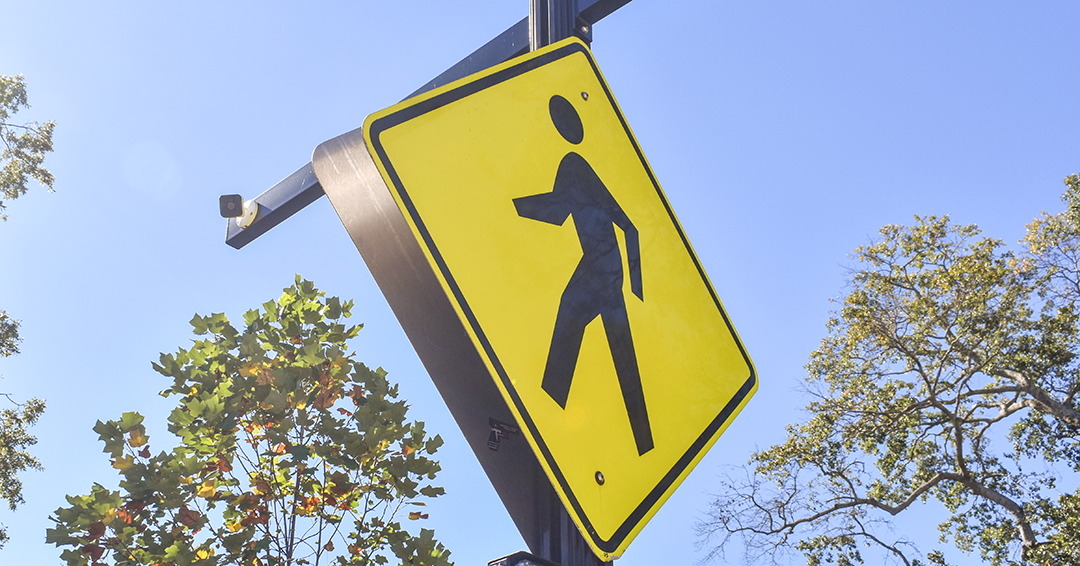
Smart crosswalk technology is being implemented in the city of Auburn.
Nsong Ernest Asiedu, graduate research assistant and Huaguo Zhou, the Elton Z. and Lois G. Huff Professor of Transportation, both in the Department of Civil and Environmental Engineering, are partnering with the city to improve pedestrian safety.
Their project focuses on Rectangular Rapid Flashing Beacon (RRFB) systems: crosswalk signs mounted with flashing lights — activated by the push of a button — which signal cars to stop and allow pedestrians to cross. These systems have been implemented in several places around Auburn University, including South College Street, where this new study will be taking place.

Asiedu and Zhou will be studying the implementation of intelligent RRFBs which automatically activate the warning system when a pedestrian is detected without pressing a button. These new systems will also include auditory warnings.
Previous research conducted under Zhou on current RRFBs in Auburn showed that about one in five pedestrians across 10 RRFB-equipped crosswalks did not press the button before crossing. At some crosswalks, this was as high as one in three.
Asiedu said the new system was mounted on South College Street in September, and research will be conducted over the course of a year using cameras mounted on the RRFB poles.
“The intelligent system uses its camera and edge-computing equipment to detect pedestrians and vehicles in real time and record operational information,” he said. “Recorded observations and system-generated data are subsequently reviewed to validate detection accuracy and evaluate pedestrian and driver behavior.”
Brandy Ezelle, the city’s former traffic engineering manager who has since retired, assisted with site coordination, installation approval and implementation for the project
“The city of Auburn has worked for years to improve safety and accessibility for people walking throughout our community,” she said. “This study will allow us to evaluate a promising technology at an existing crosswalk and determine how reliable data and real-time detection could support future safety decisions.”
Zhou said the smart RRFBs’ impact on the city, and potentially the campus, is specifically important due to the number of visitors and pedestrian traffic on certain Saturdays in the fall.
“This smart edge device will provide an enormous opportunity to improve pedestrian safety,” he said. “That responsibility is especially important in Auburn, where our streets serve residents, students and the many visitors we welcome during major events and football game days.”
Media Contact: , dzd0065@auburn.edu, 334-844-2326