

Auburn students tackle real-world challenges through international programs
Published: Nov 12, 2026 12:45 PM
By Carla Nelson
 Engineering students partnered with Spanish companies to address industry challenges using engineering problem-solving methods, while students enrolled in Auburn’s Business-Engineering-Technology (BET) minor worked in multidisciplinary teams to develop new products.
Auburn students tackle real-world challenges through international programs
Through a partnership between Auburn University’s Thomas Walter Center for Technology Management and CITI Navarra at the Public University of Navarra, Auburn engineering and business students traveled to Pamplona, Spain, for six weeks this summer to collaborate on real-world projects and gain international experience.
The program offered two distinct learning opportunities.
Engineering students partnered with Spanish companies to address industry challenges using engineering problem-solving methods, while students enrolled in Auburn’s Business-Engineering-Technology (BET) minor worked in multidisciplinary teams to develop new products.
International Engineering Projects
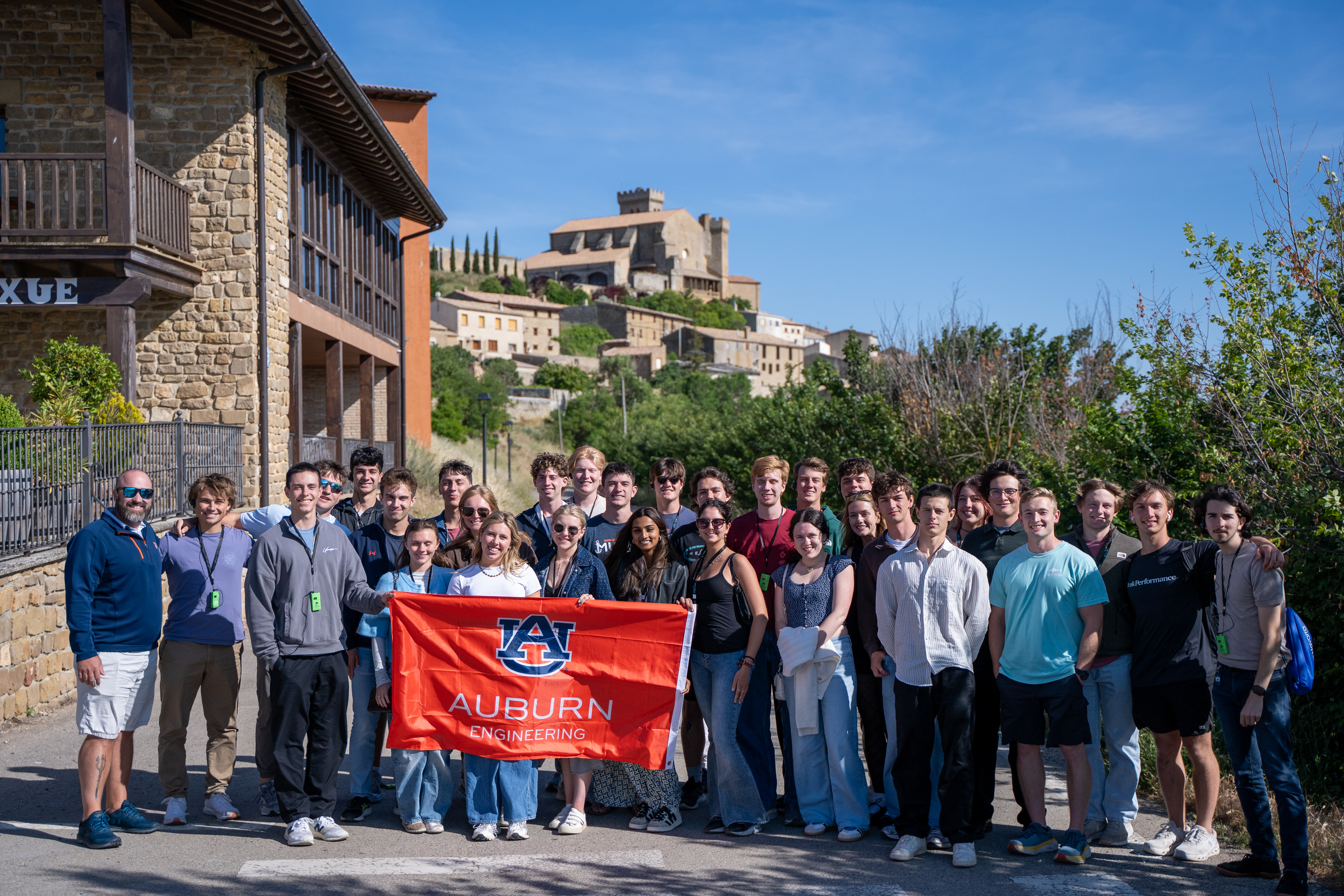 Engineering students worked with local companies, applying Six Sigma methodologies, to identify problems and develop solutions. Teams delivered weekly presentations to demonstrate their progress before presenting their final projects at the program’s conclusion.
Alex Kunneke, a senior studying software engineering, partnered with CIMA Nuevas Tecnologías Informáticas S.L., a company specializing in cybersecurity, software development and custom artificial intelligence (AI) solutions. The team developed Local Flow, a private, cost-effective AI pipeline designed to collect, analyze and extract relevant information from websites without sending sensitive data to external cloud providers.
The project addressed two challenges companies face when implementing artificial intelligence: the high cost of processing requests through external services and the potential privacy risks associated with sharing sensitive information.
Kunneke worked on a three-team project structure, with her team responsible for integration and backend architecture. Using FastAPI and Pydantic, the team developed a user-friendly application programming interface to connect the project's components.
“This experience pushed me completely out of my comfort zone, forcing me to quickly adapt and work with applications that I had never used before, work with team members of varying experience levels and solve real-time integration issues,” she said.
Kunneke added that the experience also provided an opportunity to develop skills in application programming interface development and local AI systems that she plans to carry into her engineering career.
International BET Program
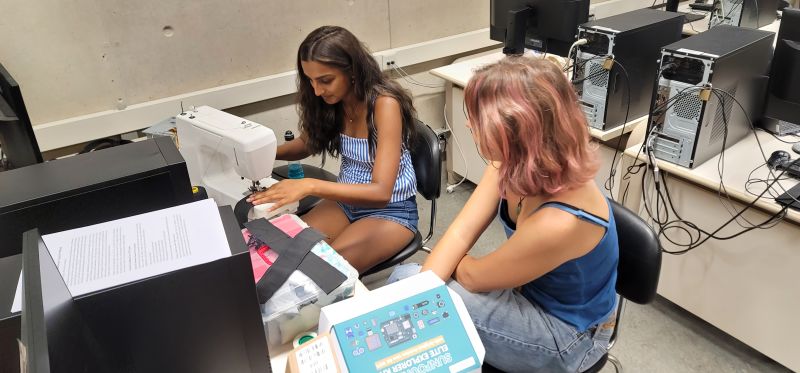 Students enrolled in Auburn’s Business-Engineering-Technology (BET) minor participated in the program’s second component, completing the second year of the minor through an international product development experience.
Working with Auburn and Public University of Navarra faculty members, students collaborated in teams to identify needs, develop product concepts and create solutions that combined engineering, business and technology.
Aliza Ziauddin, a sophomore studying civil engineering and pursuing the BET minor, described the experience as one of the most amazing opportunities she has had.
Her team designed an active posture-monitoring device to help people improve posture while sitting and working for extended periods. The device monitored users’ posture while helping them strengthen the muscles needed to maintain proper posture independently.
The team also developed a companion application that tracked users’ weekly performance, monitored sedentary time and provided reminders to stand after extended periods of sitting.
Through the project, Ziauddin gained hands-on experience with skills outside her primary area of study, including sewing, website development and product design.
“I was able to watch my teammates solder wires and work on coding the app, while I also learned how to sew as part of creating the product,” she said. “The coding seminars provided by our professors helped me learn the skills I needed to create a website for our project.”
The experience also exposed students to different perspectives through collaboration with international faculty members.
“We were able to work with a local industrial engineering professor, Dr. Sara, alongside our professors from Auburn,” Ziauddin said. “Because Dr. Sara grew up in Spain and had different experiences than our Auburn professors, she was able to give us different perspectives than what we were used to.”
Beyond the classroom and project work, the six-week program provided opportunities for students to explore Spain and other parts of Europe, experience new cultures and build connections outside the university.
“In my free time, I was able to travel to four different countries and 10 cities during the program,” Ziauddin said. “Being able to travel independently and connect with people in different countries is something I'd recommend to everyone. It's honestly one of the most life-changing experiences I've had.”
For more information about these programs, and to apply for summer 2027, click here.
Media Contact: , carla@auburn.edu, 3347400221