Aerospace Engineering professor receives grant to research how vortex rings interact with wavy surfaces
Published: Sep 1, 2026 10:30 AM
By Phillip Tutor
 Graduate student Will McAtee, left, and associate professor Vrishank Raghav work in an Auburn Engineering laboratory.
With support from the National Science Foundation (NSF) and a goal of turning surface geometry into a design tool for controlling fluid motion, an Auburn Engineering professor wants to answer a fundamental question: Can a surface’s shape control how vortex rings behave?
Vrishank Raghav, the Walt and Virginia Woltosz associate professor in Aerospace Engineering, has received a $350,000 NSF grant to investigate vortex-surface interactions and develop fundamental knowledge that could guide engineering surface design in manufacturing, energy and transport systems.
“By studying how vortex rings interact with carefully designed wavy surfaces, the project aims to uncover the physics that determine whether vortices rebound, stretch, mix or break down,” Raghav said.
“We are grateful for the support of the department and the Samuel Ginn College of Engineering at Auburn University, and especially for the students whose creativity, dedication and hard work make this research possible. We are also grateful to the National Science Foundation for supporting this work and providing the opportunity to pursue fundamental questions that can ultimately lead to advances in engineering and technology.”
Vortices are regions of rotating fluid that resemble motions seen in smoke rings or whirlpools, Raghav explained, and are common in flows ranging from aircraft aerodynamics to jets used for cooling and manufacturing.
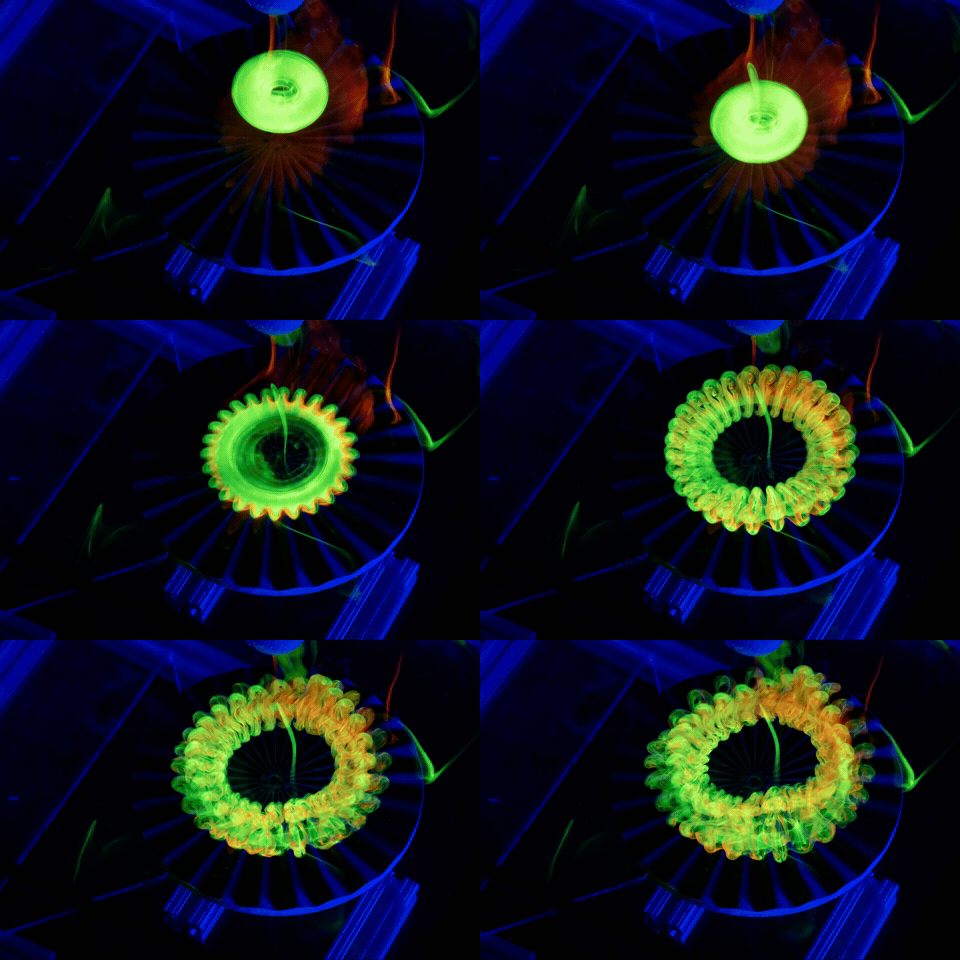
The research project, titled “Collaborative Research: Three-Dimensional Vorticity Dynamics in Vortex-ring Wavy-wall Interactions,” is a collaboration between Auburn and Oklahoma State University. Raghav will lead the experimental research and overall project, while Chitrath Prasad at Oklahoma State, the co-principal investigator, will lead the computational effort. The experiments and simulations will work together to reveal aspects of the flow that cannot be fully captured by either approach alone.
As the project’s principal investigator, Raghav envisions connecting discoveries in fluid mechanics with design principles for controlling flow, heat and material transport.
“The principles developed could inform surface designs that enhance heat transfer in microelectronics and turbines, improve mixing in advanced manufacturing and chemical processing, and control aerodynamic flows to reduce drag and noise,” he said.
Graduate student Will McAtee, who worked closely with Raghav on the proposal and conducted preliminary experiments that helped establish the project’s scientific foundation, said the research is “inspired by natural processes in which fluid structures interact with ‘imperfect’ surfaces.” He offers examples such as the human heart or the fins of whales, where surface features interact with swirling flows. “By recreating these flow interactions with wavy walls, we aim to understand how surface geometry influences vortex behavior,” said McAtee, who will continue working with Raghav on the newly funded research.
In announcing the grant, the NSF wrote that examining “how these vortices interact with a surface determines how heat is transferred, how fluids mix and how forces develop.” Underscoring the importance of Raghav’s research, it added: “The effects of these local surface features on vortex behavior remain largely unexplored.” Additionally, the project will include hands-on demonstrations of fluid motion with K–12 students.
“Nature often amazes us in design, and these complex surface features are no exception. Understanding how they interact with vortices may ultimately help us learn how to tailor surfaces to achieve desired flow behavior,” McAtee said.
Media Contact: , pot0004@auburn.edu, 334-844-3591