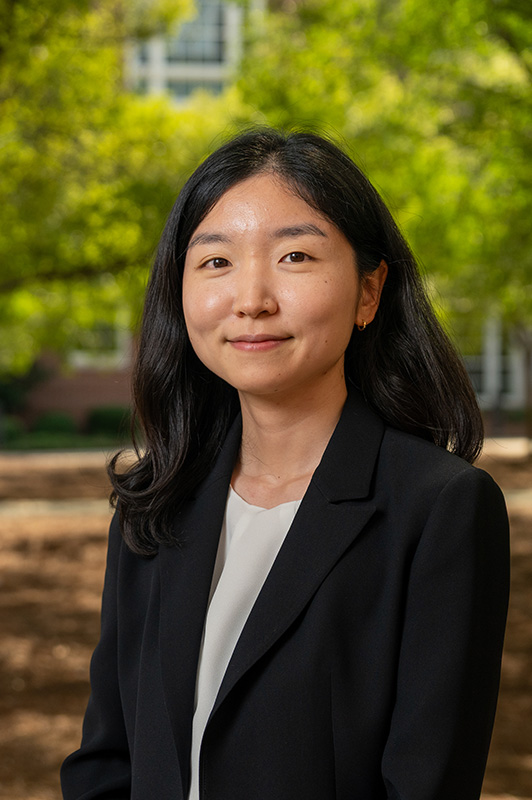
New Faculty: Assistant professor of industrial and systems engineering develops algorithms for complex logistics systems
Published: Sep 23, 2026 3:25 PM
By Staff Report
 Myungeun Eom, assistant professor of industrial and systems engineering, develops scalable algorithms for supply chain and logistics systems and studies decision-making under uncertainty.
Myungeun Eom is interested in finding better ways to make decisions in complex systems, from supply chains and transportation networks to online marketplaces where conditions can change from moment to moment.
Eom, a new assistant professor in the Department of Industrial and Systems Engineering, develops scalable algorithms for supply chain and logistics systems and studies decision-making under uncertainty. One of her current projects examines how online marketplaces, such as ride-sharing platforms, can efficiently match customers and service providers even when customers become impatient and leave the system.
Learn more about her research, her approach to teaching and what brought her to Auburn.
What are your research interests, and what drew you to this area of work?
My research focuses on developing scalable algorithms for modern supply chain and logistics systems. I am also broadly interested in decision-making under uncertainty. I was drawn to industrial engineering because I have always wanted to work on problems that combine mathematics with real-world human and operational systems. I became particularly interested in logistics optimization when I learned how complex real-world systems can be translated into mathematical models and solved systematically.
Tell us about a current research project you’re excited about. What are you hoping to accomplish, and what impact could the work have?
I am currently working on a dynamic matching problem motivated by online marketplaces, such as ride-sharing platforms. I am interested in designing algorithms that perform well in practice while also providing theoretical guarantees when customers are impatient and may leave the system. Ultimately, I hope this work can help us understand how matching platforms can make efficient decisions in dynamic and uncertain environments.
What attracted you to Auburn, and what makes it a good place for you to pursue your research and grow as a faculty member?
Auburn has a strong research community in manufacturing, which creates many opportunities for my work in supply chain and logistics. Since logistics systems are closely connected to manufacturing operations, I am excited about opportunities to collaborate with colleagues in manufacturing.
I also appreciate the supportive and welcoming environment in the department. As a junior faculty member, it is especially valuable to be in a place where I feel comfortable asking questions, exchanging ideas and learning from my colleagues.
How would you describe your approach to teaching and mentoring students? What can students expect from you in the classroom?
I believe it is important to help students understand the intuition and big picture behind what they are learning. In the classroom, I like to connect mathematical concepts to real-world examples so that students can understand not only how a method works, but also why it works and when it can be useful.
I take a similar approach to mentoring: I want to make sure that my students and I share a clear understanding of the big-picture research question before diving into technical details.
What do you enjoy doing outside of your work at Auburn?
I enjoy spending time outdoors and exploring nature. I am looking forward to discovering more of the beautiful trails and parks around Auburn and Alabama.
Media Contact: , dzd0065@auburn.edu, 334-844-2336