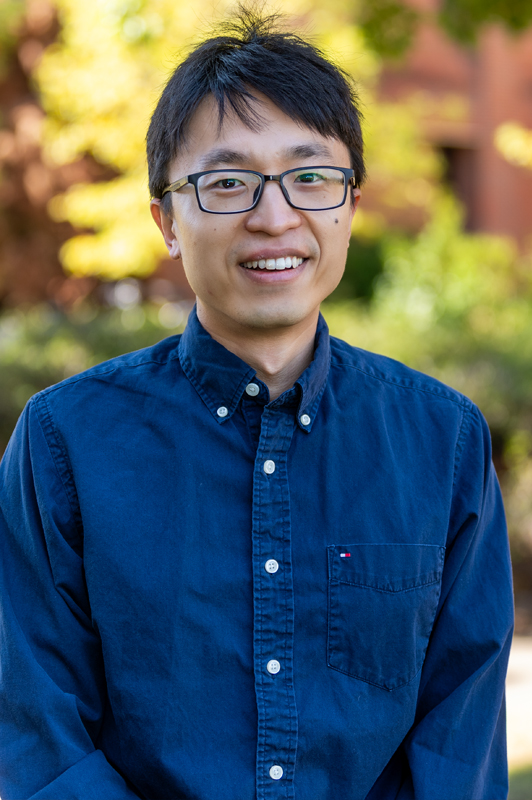
The speed of light: Assistant professor of electrical and computer engineering using photonics to accelerate data transmission
Published: Sep 24, 2026 7:30 AM
By Joe McAdory
 Zihe Gao was awarded $306,524 by the National Science Foundation to increase laser communication speeds by generating quantum states of light.
Rapid growth in artificial intelligence (AI) and cloud computing is driving unprecedented data traffic, pushing communications technologies to their limits. Zihe Gao, an assistant professor in the Department of Electrical and Computer Engineering, is exploring a bypass around the bottleneck.
His project, “Collaborative Research: Harnessing Non-Hermitian Topology for Ultrafast Laser Modulation and Quantum Entanglement Generation,” was awarded $306,524 by the National Science Foundation (NSF) to increase laser communication speeds by and to generate quantum states of light.
Modern communications networks rely on optical fiber to move information quickly and efficiently. Those systems transmit data by modulating lasers to encode information, but the speed of that process is limited by the physical response of the devices themselves.
“There is an intrinsic turn-on and turn-off time. That’s the finite response of a laser,” said Gao, who specializes in photonics. “People have been working on making a laser turn on in picoseconds rather than nanoseconds, and that’s our goal.”
Gao said that, if the idea proves successful, the work could have broader relevance to companies developing high-speed optical interconnect technologies, such as Cisco, Intel, Marvell, and NVIDIA, as well as hyperscale AI infrastructure operators such as Google.
“Another goal is to make token generation for large language models cheaper and more energy efficient,” he said. “Tokens are the basic units of text processed by chatbots like ChatGPT. There is an industry-wide push to reduce the energy and cost required to generate each token. Part of that cost comes from the energy required to move enormous amounts of data through optical links, which ultimately relies on lasers rapidly turning on and off to encode and transmit information.”
Applied to linked optical parametric oscillators, the same physics could also generate customized “squeezed” and “entangled” quantum light, Gao said. Those quantum states could support advances in quantum sensing, secure communications, quantum information processing and future computing technologies.
Much of the work, including fabrication and testing, will be completed at the Alabama Micro/Nano Science and Technology Center inside the Woltosz Engineering Research Laboratory, directed by Mark Adams, the Godbold Professor in the Department of Electrical and Computer Engineering.
Collaborators on the project will also include researchers from the City University of New York.
Gao said success will be measured in two ways. The team hopes to demonstrate that its approach can significantly increase laser modulation speeds while also expanding scientific understanding of the underlying physics.
But the project is not focused solely on building a faster device.
“This is fundamental research, meaning we want to understand how this kind of system works,” Gao said. “We’ll be asking, ‘what is the physical law?’ and ‘what is the collective behavior in this system?’ Hopefully, this research will generate knowledge that can help other aspects in photonic device research.”
Media Contact: , jem0040@auburn.edu, 334.844.3447