New Faculty: Industrial and Systems Engineering associate professor brings AI to advanced manufacturing
Published: Sep 1, 2026 9:00 AM
By Staff Report
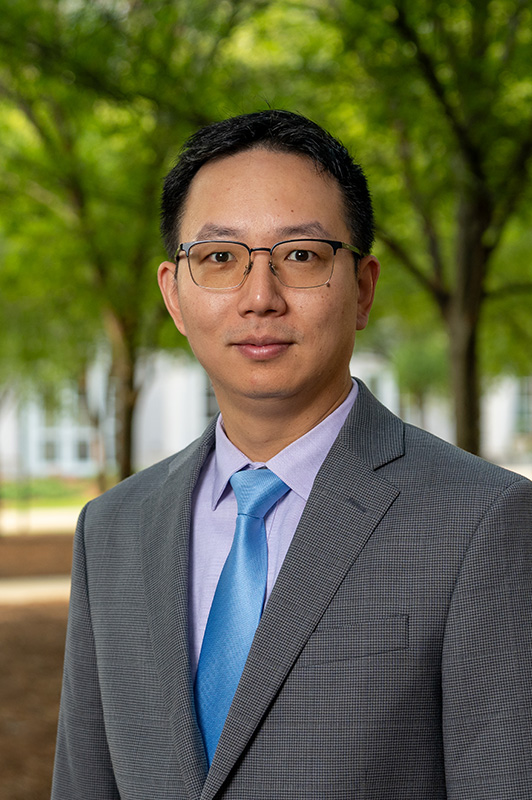
 Haifeng Wang
Advanced manufacturing systems generate enormous amounts of data, but converting that information into better decisions — and more consistent products — remains a challenge.
Haifeng Wang, a new associate professor in the Department of Industrial and Systems Engineering, develops machine learning and optimization methods that can interpret complex engineering data and improve how real-world systems operate.
One of his current projects applies sensing and machine learning to continuous fiber deposition for multi-material additive manufacturing. The goal is to help manufacturers better understand and monitor the process while improving product quality and consistency.
Learn more about his research, his approach to teaching and mentoring, and what brought him to Auburn.
What are your research interests, and what drew you to this area of work?
My research focuses on machine learning modeling and optimization, particularly for complex engineering systems involving heterogeneous data. I am interested in developing artificial intelligence methods that are not only accurate but also robust, interpretable and capable of learning from different types and sources of data. My work has applications in advanced manufacturing, health care and agriculture.
What originally drew me to this area was seeing how much valuable data real-world systems generate and how difficult it can be to turn those data into useful decisions. I enjoy working at the intersection of AI, data analytics and optimization, where we can develop new methodologies while also addressing practical problems. What continues to excite me is the opportunity to take advances in AI beyond the computer and translate them into tools that can improve how real systems operate.
Tell us about a current research project you’re excited about. What are you hoping to accomplish, and what impact could the work have?
One project I am particularly excited about focuses on developing machine-learning-assisted continuous fiber deposition for multi-material additive manufacturing. The project brings together advanced manufacturing and machine learning to better understand and ultimately improve a complex manufacturing process.
My role focuses on using sensing and machine learning to extract useful information from the manufacturing process and support better understanding and decision-making. Ultimately, we hope this work will contribute to more intelligent manufacturing systems that can better monitor processes and improve product quality and consistency.
I am excited about this project because it represents the kind of interdisciplinary work I enjoy most: combining expertise in AI, manufacturing and materials science to address problems that would be difficult for any one field to solve independently.
What attracted you to Auburn, and what makes it a good place for you to pursue your research and grow as a faculty member?
Auburn’s strong engineering environment, the Department of Industrial and Systems Engineering and diverse research resources were major attractions for me. My research has always been interdisciplinary, and Auburn offers many opportunities to work with colleagues across industrial and systems engineering, manufacturing, agriculture, health and other areas.
I also value Auburn’s strong connections with industry because I want my research to address meaningful problems and ultimately have an impact beyond academic publications. Auburn provides an excellent environment to build new collaborations, explore new research directions and continue growing as both a researcher and educator.
How would you describe your approach to teaching and mentoring students? What can students expect from you in the classroom?
I want students to learn how to learn. As an engineer, I believe one of the most important skills is being able to explore possibilities and find a path forward, especially when a problem does not have an obvious solution. I encourage students to explore on their own, ask questions and think creatively.
I want students to understand fundamental concepts but, more importantly, know how to apply those concepts and develop their own approaches when they encounter real engineering problems. I especially enjoy bringing examples from research and industry into the classroom so students can see why the methods they are learning matter and how they can apply them in their future careers.
I take a similar approach to mentoring. I provide students with guidance and support, particularly when they are learning something new, while encouraging them to gradually take ownership of their research. One of the most rewarding parts of being a faculty member is watching students grow from needing detailed guidance to becoming independent researchers who can define problems, explore possible solutions, develop their own ideas and confidently communicate their work.
What do you enjoy doing outside of your work at Auburn?
Outside of work, I enjoy spending time with my family and traveling. We love exploring new places together, especially through hiking, camping and boating. With two young children, these outdoor adventures are a great way for us to spend time together and discover something new. Since moving to Auburn, we have also enjoyed exploring the area and making Auburn our home.
Media Contact: , dzd0065@auburn.edu, 3092316887