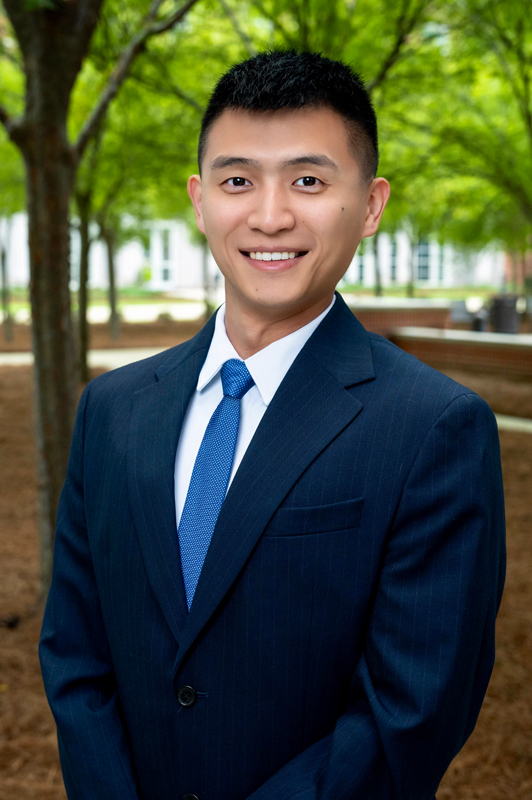
Assistant professor in CSSE wins Sony Faculty Innovation Award
Published: Jun 30, 2026 7:30 AM
By Joe McAdory
 Jiaqi Wang, assistant professor in the Department of Computer Science and Software Engineering, won the Sony Faculty Innovation Award, a program that supports pioneering academic research and provides $100,000 in funding.
Jiaqi Wang is researching a future where artificial intelligence (AI) models don’t require training. Instead, they can be generated.
His research, “The Next Era of Parameter Acquisition: Neural Network Model Generation via Large Language Models,” earned the assistant professor of computer science and software engineering the Sony Faculty Innovation Award, a program that supports pioneering academic research and provides $100,000 in funding.
“Imagine a robot deployed in a new warehouse, factory or disaster response environment,” he said. “Today, adapting the robot to new tasks often requires collecting data and retraining AI models, which can be costly and time-consuming. With our vision, the robot could automatically generate and adapt its own AI models for navigation, object recognition or task planning based on the environment and user instructions, allowing it to become useful much more quickly.”
The same idea could support agriculture, forestry, manufacturing, railway operations and civil engineering, Wang said.
“Many of these users have deep domain knowledge but limited AI expertise or access to large datasets,” he said. “Instead of hiring specialists to build models from scratch, they could describe what they need — identifying crop diseases from drone images, detecting defects in railway components, monitoring construction progress or spotting manufacturing anomalies.
“The system could then generate a task-specific model from the available data, making advanced AI tools accessible to a much broader range of industries.”
Wang said the implications for electronics industry giants like Sony are huge, as the project could speed the creation of AI models that support imaging, entertainment, audio, gaming, robotics and Internet of Things products. The work also has long-term potential to support a collaborative AI ecosystem in which specialized agents serve different Sony business units while sharing knowledge through a common foundation model.
“As a researcher, many of the ideas we pursue are highly exploratory, and it can take years for their impact to become clear,” Wang said. “Support from a world leading technology company like Sony is a strong affirmation that this research direction is both scientifically meaningful and practically relevant. As a junior faculty member, I view this award less as recognition of a single achievement and more as encouragement to pursue bold new directions in AI.
“This award motivates me to continue developing ambitious ideas with real-world impact and creates valuable opportunities to build long-term collaborations with industry partners and provide students with meaningful research and internship experiences.”
Media Contact: , jem0040@auburn.edu, 334.844.3447