Stormwater Week showcases Auburn Engineering’s expanding stormwater expertise
Published: May 19, 2026 1:15 PM
By Dustin Duncan
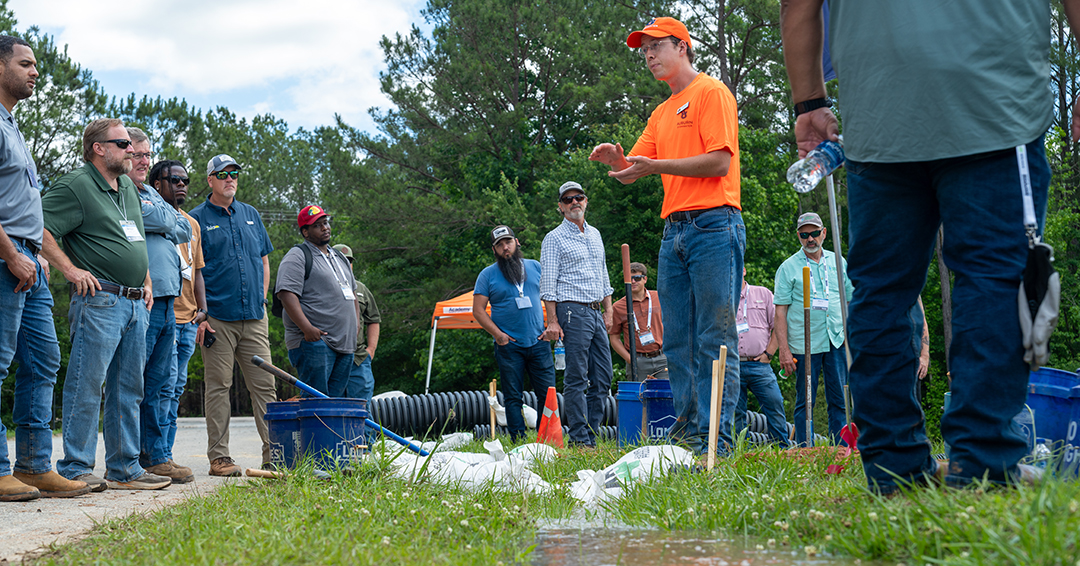 Participants gather for a hands-on erosion and sediment control demonstration during Auburn Engineering’s annual Stormwater Week at the Auburn University Stormwater Research Facility. The event brings together contractors, engineers, regulators and industry professionals for field-based stormwater training and education.
What began more than a decade ago as a small training event on a two-acre site has grown into one of the Samuel Ginn College of Engineering’s largest stormwater education efforts. The event now draws hundreds of industry professionals to the Auburn University Stormwater Research Facility and reinforces its reputation as a hub for stormwater training and applied research.
The college’s annual “Stormwater Week” returned this May at the Stormwater Research Facility, bringing together contractors, engineers, regulators and other professionals for hands-on training and field demonstrations focused on erosion and sediment control practices.
The week included the facility’s installer training program — a day-and-a-half event designed for contractors and field crews — along with a separate field day showcasing emerging technologies, products and best practices in stormwater management.
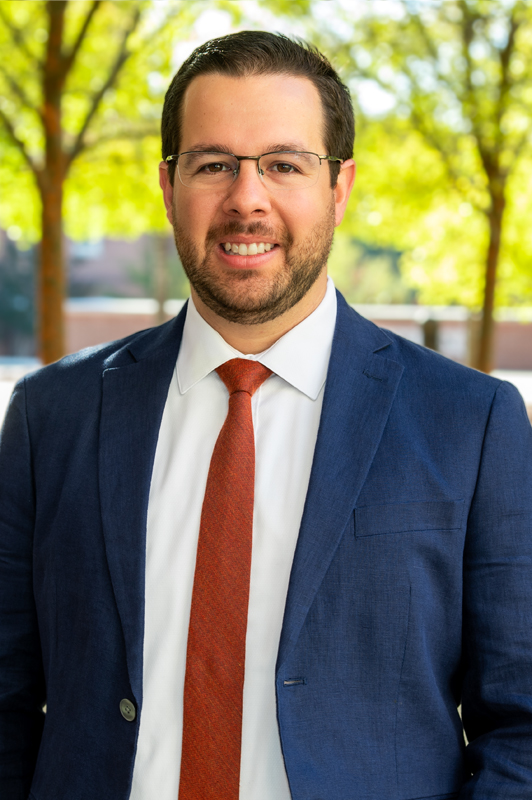
“We’re getting recognized as the place to be, the place to come do stormwater work,” said Michael Perez, director of the Stormwater Research Facility and Brasfield & Gorrie associate professor of civil and environmental engineering. “It’s a place to get stormwater education, and people want to be connected to that.”
The installer training combines classroom instruction with field application, allowing participants to learn concepts before putting them into practice outdoors. Participants spend the first portion of the program reviewing installation techniques and examples of successful and unsuccessful methods before moving into the field to complete installations themselves.
“Our contractors don’t want to just sit in a classroom and watch PowerPoints,” Perez said. “They’re going to learn by doing.”
The field day, meanwhile, attracts a broader audience of designers, engineers and regulators while giving vendors an opportunity to demonstrate new products and technologies under real-world conditions. Organizers run water through the demonstrations so attendees can observe how practices and materials behave in the field.
The event has expanded significantly since it began in 2014. Organizers estimate the original event attracted roughly 80 to 90 attendees and used about two acres for demonstrations and training. In 2026, the Stormwater Research Facility spans approximately 12 acres and is expected to host more than 285 attendees during field day activities alone.
Next year, the Stormwater Research Facility is scheduled to host the International Erosion Control Association’s Municipal Wet Weather Conference after serving as the conference site in 2023. Organizers said the association now hopes to return to Auburn every other year.
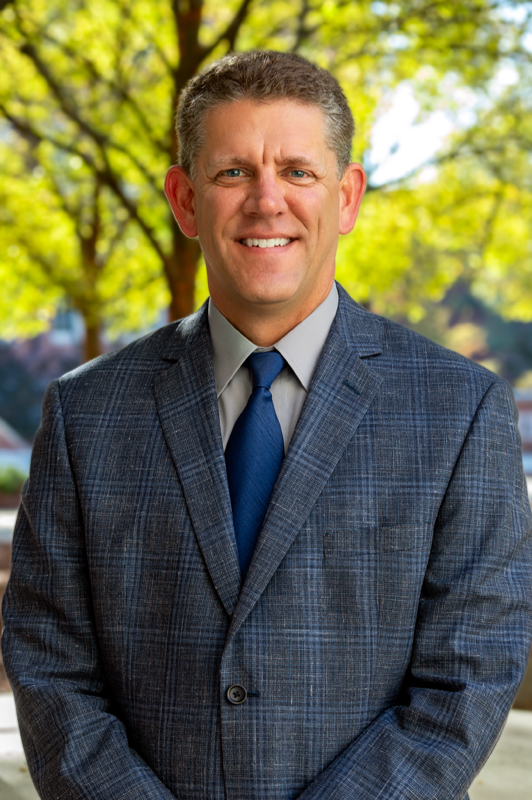
David Timm, chair of the Department of Civil and Environmental Engineering, said the Stormwater Research Facility has become known nationally for applied research, professional development and field-based instruction.
“The Stormwater Research Facility continues to grow its reputation in stormwater education and applied research,” Timm said. “The combination of faculty expertise, innovative research and hands-on field training creates an environment that attracts professionals from across the industry to Auburn.”
A planned building at the research facility is also expected to further expand its training and research capabilities. The building will include classroom, laboratory and office space directly adjacent to the field site, allowing instructors to move directly between classroom instruction and field demonstrations.
“My vision is a class where we spend some time inside the classroom learning the basics, then come out to the field and install that very practice we just talked about,” Perez said. “Then we go back into the classroom, learn the next topic and come back out to the field.” Media Contact: , dzd0065@auburn.edu, 334-844-2326