Large-scale advanced systems supporting NCAME qualification efforts toward Army AM adoption
Published: Apr 1, 2026 11:00 AM
By Jeremy Henderson
![A rendering of a 3D-printed aerospike rocket engine, a prime example of the complex designs and large-scale components NCAME can qualify with its new AMCM M-4K system. [Image courtesy of AMCM/EOS]](http://eng.auburn.edu/images/_wide/e72a3a72-5326-48e2-9431-18367cb01736-Recovered.png) A rendering of a 3D-printed aerospike rocket engine, a prime example of the complex designs and large-scale components NCAME can qualify with its new AMCM M-4K system. [Image courtesy of AMCM/EOS]
A rendering of a 3D-printed aerospike rocket engine, a prime example of the complex designs and large-scale components NCAME can qualify with its new AMCM M-4K system. [Image courtesy of AMCM/EOS]
The U.S. government is expecting big things out of Auburn's National Center for Additive Manufacturing Excellence (NCAME) — literally.
Supported by more than $13 million in Army funding, the center recently acquired two advanced metal additive manufacturing (AM) systems geared for the much more complex — and much larger — metal components necessary for evolving AM's role into the Army’s modernization efforts.
The FormAlloy L5, a five-axis direct energy deposition (DED) printer, is uniquely capable of fabricating parts with higher reliability due to features incorporated for closed-loop feedback controls, a feature set to significantly enhance NCAME’s development of parts manufacturing.
“Ensuring consistency in process output is especially crucial in the large format fabrications the Army will integrate into its systems,” said NCAME Director Nima Shamsaei. “The FormAlloy L5 will help us do that.”

How? By allowing NCAME researchers to explore material models predicting mechanical performance, including fatigue strength, a key property needed in qualifying parts for deployment readiness.
Analyzing and applying the results of those models into new large-format AM printers supporting machine transferability and equivalency is something few research centers can achieve.
"NCAME’s deep expertise and world-class capabilities make them an ideal collaborator for advancing additive manufacturing research and accelerating the path to production-relevant solutions for aerospace, defense and industry," said FormAlloy CEO Melanie Lang. "We're proud to partner with them."
NCAME also recently acquired the AMCM M-4K, a heavy-duty printer featuring four lasers capable of producing builds up to 1 meter tall. That capacity is essential as the Army becomes more interested in large-scale AM, which requires structural parts previously limited by smaller build volumes.
"Equipping NCAME with the AMCM M-4K will accelerate the transition from full-scale prototypes to flight-critical and other high-value industrial applications," said Glynn Fletcher, president of EOS North America, whose subsidiary, Additive Manufacturing Custom Machines, produces the printer. "We’re putting production-scale, large-format metal AM capabilities in the hands of a very talented team with unique strengths in modeling, characterization and rigorous qualification."
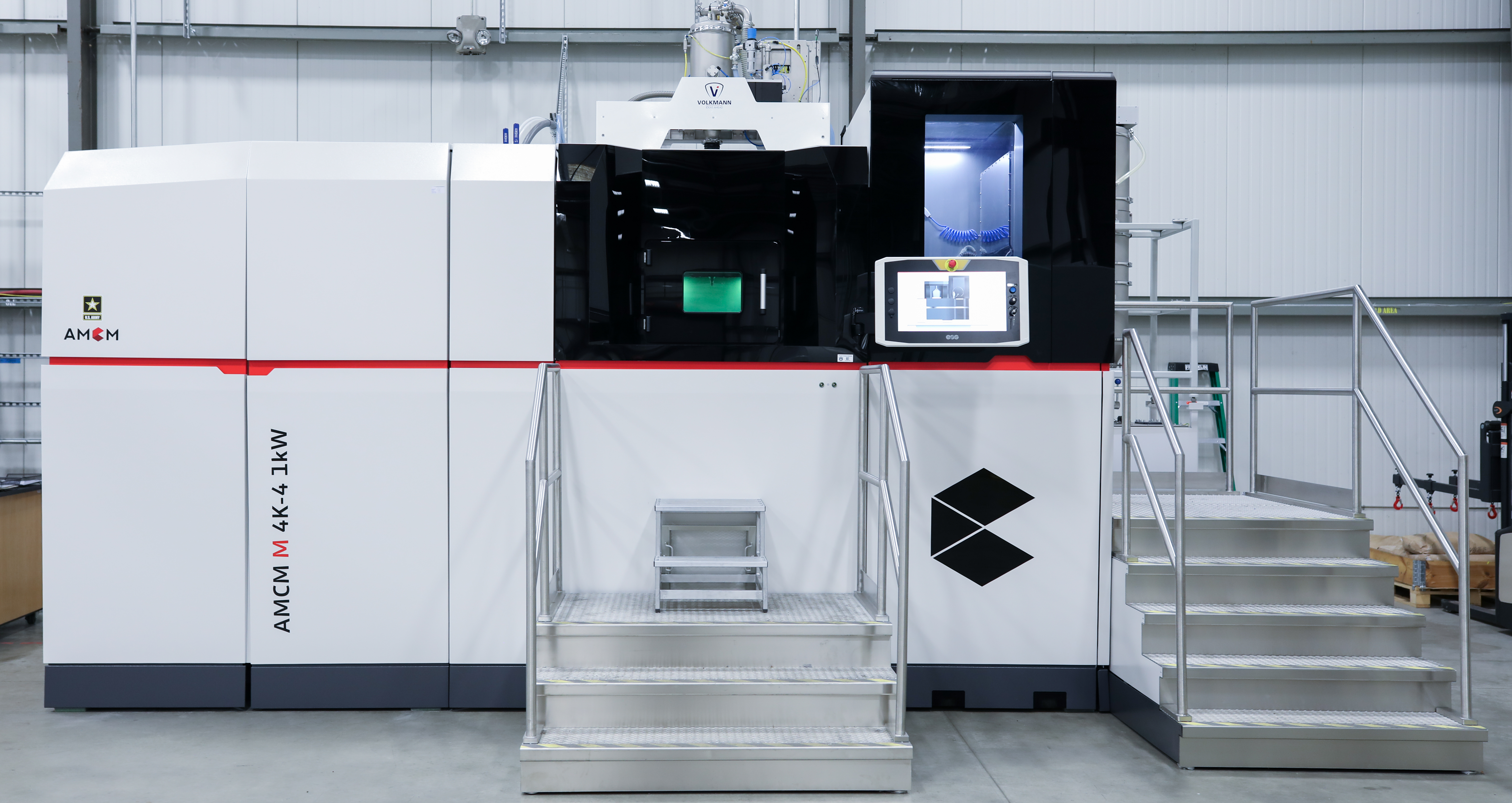
The two machines complement what is already one of the most comprehensive collections of metallic AM hardware in the country.
“The combination of research scientists and novel additive manufacturing equipment at Auburn enables the rapid qualification of creative designs,” said Jeffrey Gaddes, an advanced manufacturing subject matter expert at the U.S. Army Combat Capabilities Development Command Aviation & Missile Center (DEVCOM AvMC), “in order to quickly solve readiness issues impacting the battlefield.”
And sustain that readiness.
"Integrating large-format systems is absolutely necessary for our sustainment strategy, which is why NCAME is such an important partner,” said David Gorsich, chief scientist at DEVCOM Ground Vehicle Systems Center. “They're basically laying the technical foundation for manufacturing and repairing critical components to sustain the fleet."
NCAME is also already employing its new acquisitions toward AM part production for aerospace manufacturer Bell Textron, a contractor on the largest aviation project in Army history.
"Both of these printers significantly enhance the scope of our capabilities,” said Scot Carpenter, NCAME lab research manager. “As we begin to print real parts for the Army, they are interested in larger and larger components — that’s why we need printers like these."
Media Contact: , jdh0123@auburn.edu, 334-844-3591