Doctoral student in chemical engineering develops self-powered hydrogel for nerve stimulation, wins Graduate Engineering Research Showcase
Published: Apr 8, 2026 9:20 AM
By Joe McAdory
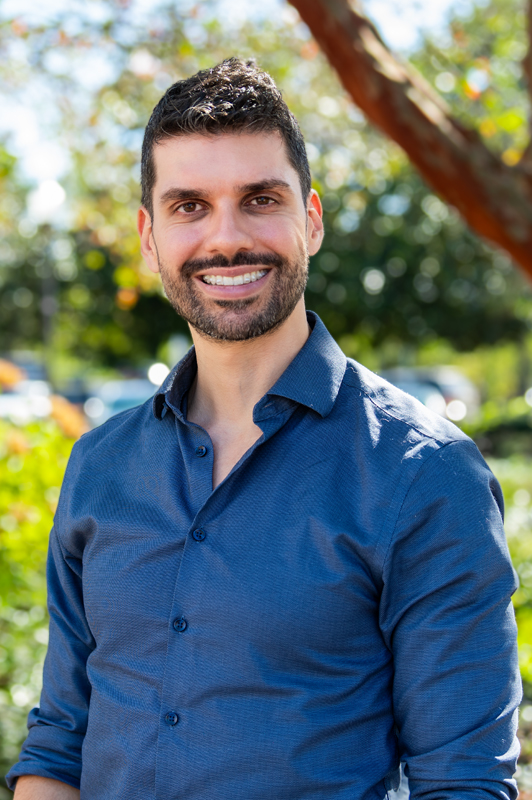
 Tofayel Ahammad Ovee
Imagine a prosthetic hand that doesn’t just grasp an apple, a fork or a glass of tea, but allows its user to feel texture. Tofayel Ahammad Ovee hopes to make that a reality.
A doctoral student in the Department of Chemical Engineering, Ovee developed a self-powered piezoionic hydrogel that converts touch into nerve-stimulating electrical signals. Faculty judges awarded his research, “Mesostructure and encoded transduction for amplifier-free bioelectric stimulation,” first place and $850 at the 2026 Graduate Engineering Research Showcase (GERS) on April 2.
Presented by the College’s Council of Engineering Graduate Students and now in its 13th year, GERS allows students to share their work with faculty and peers across disciplines. This year, 180 students presented posters in the Brown-Kopel Center’s Grand Ballroom, where they were evaluated by faculty and industry judges.
“This year’s Graduate Engineering Research Showcase was remarkable not just for its size, but for the sophistication of the work our students brought forward,” said Maria Auad, associate dean for graduate studies and faculty assessment. “The level of preparation, creativity and technical depth on display was the strongest we’ve seen, and it reflects the momentum our graduate students are building across the college.”
Ovee, who will earn his doctorate this year, set out to answer a fundamental question: could a soft material generate the kind of electrical signal a nerve would recognize?
Working with Jean-François Louf, assistant professor of chemical engineering, he engineered a mesoporous, eel-inspired hydrogel designed to produce its own ionic voltage when compressed. Unlike traditional systems that rely on external power sources, the material generates a signal on its own when touched.
“The idea is that when you squeeze the material, it creates an ionic voltage and current,” Ovee said. “The material itself is self-sufficient to trigger neuron activation.”
To test whether that signal could activate living tissue, Ovee partnered with researchers in the College of Veterinary Medicine to conduct experiments on the sciatic nerve of a mouse.
“We connected the hydrogel directly to the nerve and applied pressure,” he said. “The muscle twitched, and the EMG showed a clear response. That’s when we knew the material could stimulate neurons without any external power. We have very good data showing that we can trigger neuron activity in a mouse leg and produce muscle activation.”
This is the second consecutive year that a student in Louf’s Nature-Inspired Fluids & Elasticity Lab won the Showcase. Tori Phillips took first place last spring with her research, “Modeling Hydraulic Redistribution Using Transparent Soil.”
Rounding out this year’s Showcase winners were:
- Matthew Kmetz, civil and environmental engineering, second place overall ($750)
• Thiraj Santhush Wegala, industrial and systems engineering, third place overall ($650)
• Abigail Lacy, civil and environmental engineering, best first-year graduate student presentation ($500)
• Grace Houde, civil and environmental engineering, honorable mention ($350)
• Benjamin Forson, civil and environmental engineering, honorable mention ($350)
• Tyler Flegal, mechanical engineering, honorable mention ($350)
• Rukesh Gusain, mechanical engineering, honorable mention ($350)
• James Browning, computer science and software engineering ($350)
• Griffin DiMaggio, aerospace engineering department winner ($250)
• Hamid Syed, biosystems engineering department winner ($250)
• Gregory Emmanuel Idun, chemical engineering department winner ($250)
• Pascal Obeng, civil and environmental engineering department winner ($250)
• Zewei Zhang, computer science and software engineering department winner ($250)
• Jacob Marchio, electrical and computer engineering department winner ($250)
• Bilal Melhim, industrial and systems engineering department winner ($250)
• Valentina Nesterova, materials engineering department winner ($250)
• Kislaya Mishra, mechanical engineering department winner ($250)
• Taegyu Yang, polymer and fiber engineering department winner ($250)