NSF backs Auburn-led research into rewriting rules of metallic materials
Published: Mar 30, 2026 2:00 PM
By Jeremy Henderson
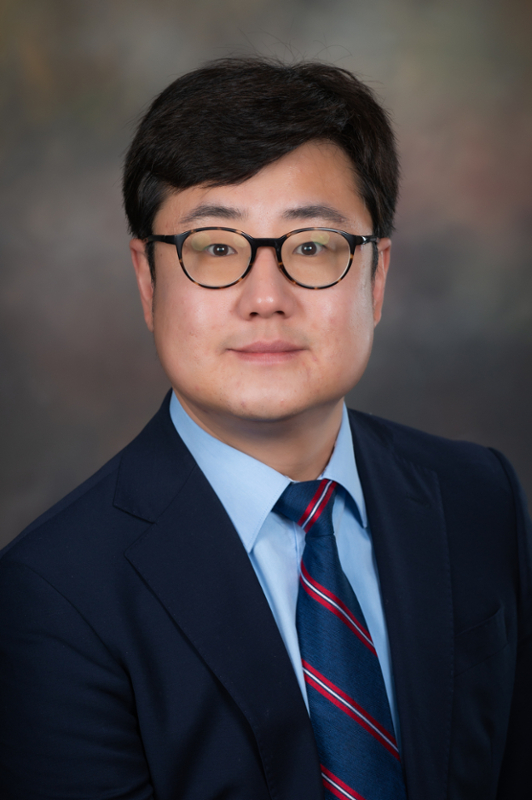
 Chanho Lee, assistant professor in mechanical engineering, holds a newly designed and fabricated refractory multi-principal element alloy sample prepared for a mechanical property test.
The structured metals crucial to extreme environment systems such as aerospace propulsion and nuclear energy systems can be really strong at high temperatures — a good thing. Or they can be somewhat pliable at room temperature — also a good thing. But they can't be both. That's just how the game is played... for now.
Backed by $2 million through the National Science Foundation's Designing Materials to Revolutionize and Engineer our Future program, a research team led by assistant mechanical engineering professor Chanho Lee is looking to rewrite the rules of metallic materials thoroughly enough to overcome that age-old trade-off between durability and ductility.
"Our work aims to move beyond conventional deformation theories by introducing a new framework," said Lee, the project's principal investigator (PI) and director of the Advanced Materials Laboratory.
That new paradigm is powered by multi-principal element alloys — essentially cocktails of five or more elements — and metastability engineering, a relatively novel concept that turns internal instability into a sort of structural superpower by forcing atoms to rearrange under stress.
Translation? Metals that perform better under pressure — literally.
"Rethinking how metals accommodate deformation opens a pathway toward a new generation of structural materials that are both exceptionally strong and mechanically reliable across a wide range of operating conditions," Lee said.
The real-world implications for bridging that atomic gap are legion. In jet engines and rocket thrusters, for instance, efficiency is limited by how hot an engine can run. Nickel-based superalloys reach their limit around 1100°C. Lee's research could push those temperatures to 1500°C and even beyond, allowing significantly more thrust with far less fuel. It's an ambitious project. But it's not Lee's first research rodeo.
Since arriving at Auburn in early 2023, he's served as PI on multiple projects pertaining to advanced manufacturing, materials characterization and process optimization funded through the Korea Institute of Industrial Technology.
His collaborators this go-round include co-principal investigators Shuozhi Xu (University of Oklahoma), Xin Wang (University of Alabama), Yifan Zhang (Clemson University), Hyunseok Oh (University of Wisconsin–Madison) and Anirban Patra (the Indian Institute of Technology Bombay).
"Leading a project of this scale carries tremendous meaning for me," Lee said. "Securing this award with five professors from different institutions represents a strong vote of confidence in the ability of early-stage researchers to lead ambitious scientific efforts. It validates not only the scientific vision, but the ability to build a team united around a shared mission."
Media Contact: , jdh0123@auburn.edu, 334-844-3591