Professor in electrical and computer engineering part of $1.5M collaborative effort to strengthen mathematical foundations of AI
Published: Oct 28, 2025 9:30 AM
By Joe McAdory
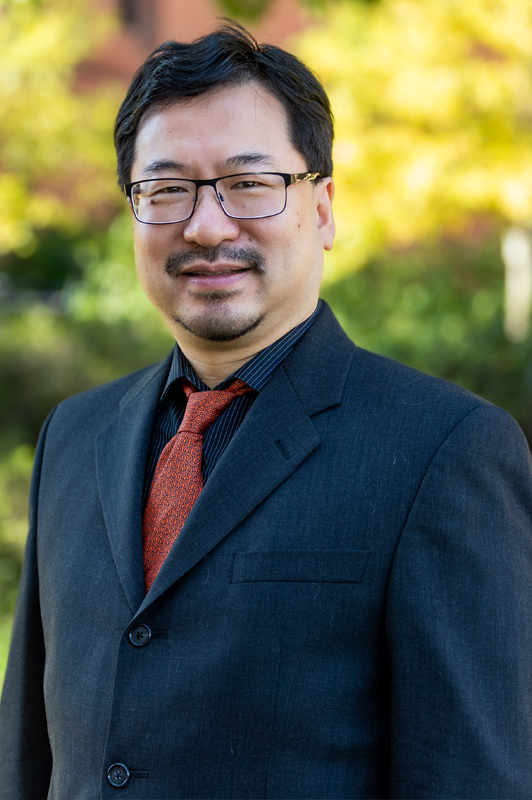
 Shiwen Mao's role in the project is to apply theoretical advances developed in diffusion modeling and topological data analysis modules to wireless engineering problems.
Shiwen Mao, Professor and Earle C. Williams Eminent Scholar Chair in the Department of Electrical and Computer Engineering, is part of a $1.5 million collaborative research effort to establish a new theoretical framework for artificial intelligence (AI) and data science (DS) and apply it to solve practical engineering problems.
“This is a time of rapid technological advancement, particularly with the rise of artificial intelligence and data science,” said Mao, who also directs the college's Wireless Engineering and Research Education Center. “A deep mathematical foundation has become more essential than ever because mathematics provides the language and structure that underlie nearly all modern technologies, from machine learning algorithms and communication networks to cybersecurity and data analytics.”
The National Science Foundation (NSF)-funded project, “Building a Robust Mathematical Foundation for AI and Integrated Data Science at Auburn and Tuskegee University,” brings together 13 faculty members to develop new mathematical foundations for AI and DS.
Through a series of research modules and training activities, the initiative aims to prepare future researchers to lead in the design and application of mathematically grounded AI and data-driven systems.
Mao serves as a co-principal investigator for the Auburn portion of the project, led by principal investigator Yanzhao Chao, professor in the College of Sciences and Mathematics.
The project comprises three core training modules: diffusion modeling for generative AI, topological data analysis and differential equation–based machine learning for anomaly detection. Each module connects research and instruction through two thematic clusters — one centered on the mathematical foundations of AI/DS and another emphasizing applied research.
“My specific role is to apply the theoretical advances developed in the diffusion modeling and topological data analysis modules to wireless engineering problems,” Mao said. “I will collaborate closely with mathematicians and statisticians on the team to address real-world engineering challenges using diffusion models and generative AI, and to help define research projects that support course development and training activities.”
Mao said an essential component of the effort is an AI/DS summer school at Tuskegee University, where he will deliver lectures and research talks.
“Many existing works apply diffusion models in a straightforward manner without theoretical underpinnings,” he said. “In this project, our mathematics collaborators have proposed a novel supervised learning framework that leverages forward stochastic differential equations and the corresponding backward ordinary differential equations for density estimation and synthetic data generation. This mathematical formulation greatly simplifies the training process for diffusion models, which was very time consuming previously, and enables new applications in dynamic environments.”
For Mao, the project builds on nearly two decades of interdisciplinary teamwork.
“I have been collaborating with several colleagues in the Department of Mathematics and Statistics since I joined Auburn University in 2006,” he said. “Over the years, we have developed several collaborative research proposals, three of which have been funded by the NSF, including this one,” Mao said. “This project presents an excellent opportunity to further strengthen and expand these collaborations, supported by substantial resources and shared expertise in AI and data science. I am confident that it will lead to significant research and educational outcomes.”
Media Contact: , jem0040@auburn.edu, 334.844.3447