Assistant professor in CSSE exposes vulnerability in AI-powered security cameras, offers new defenses in development
Published: Oct 10, 2025 8:00 AM
By Joe McAdory
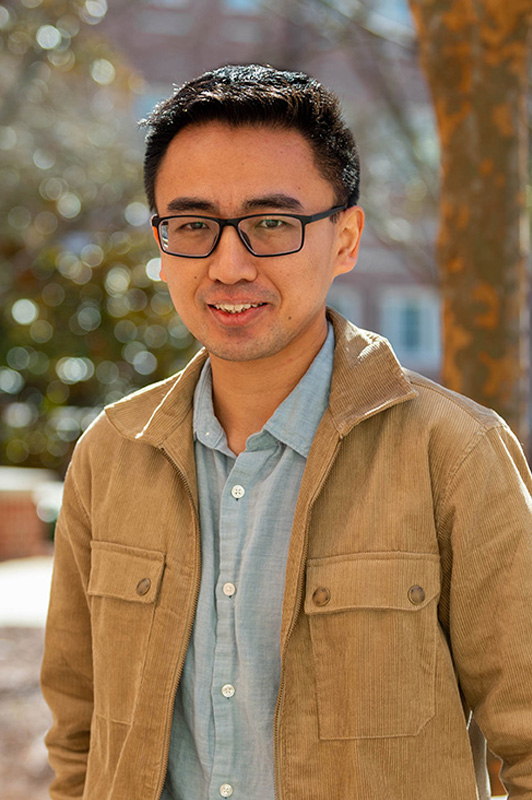
 Yazhou Tu, assistant professor in computer science, and software engineering and graduate student Eftakhar Ahmed Arnob show that lasers can distort the view provided by security cameras.
October marks Cybersecurity Awareness Month and Yazhou Tu’s research team is working to fix critical vulnerabilities in artificial intelligence (AI)-powered security cameras that millions of Americans rely on to protect their homes — flaws that allow inexpensive laser pointers to blind the devices and bypass their security features.
As an assistant professor in the Department of Computer Science and Software Engineering (CSSE), Tu’s research discovered that smart doorbells from major manufacturers can be defeated by low-cost laser attacks, allowing thieves to steal packages or break into homes without triggering alarms or recordings.

“Cybersecurity nowadays extends farther than computers, websites or servers,” said CSSE graduate student Eftakhar Ahmed Arnob, a researcher in Tu’s laboratory. “We must also consider cyber-physical systems. If you look at drones, robotic dogs, smart homes, and autonomous vehicles, these systems are getting more intelligent to perceive the environment and handle things automatically.”
Tu’s work emphasized that AI systems such as smart doorbells with security cameras, while marketed as enhancements, don't automatically address all vulnerabilities and might even create new risks.
“We don't have a silver bullet to make real-world systems absolutely secure,” Tu said. “That's why we need different methods and improvement of the fundamental designs to address emerging attack vectors.”
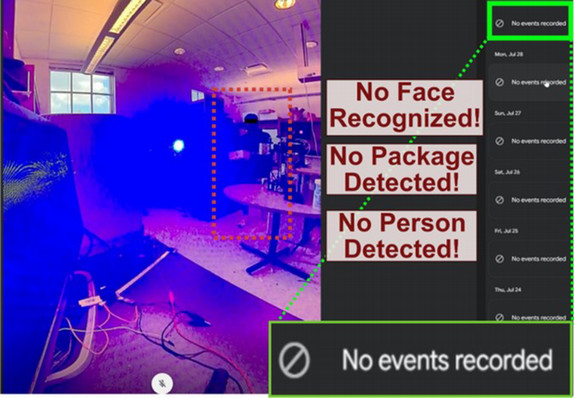
The doorbell vulnerability stems from a fundamental design flaw. When a laser is pointed at these cameras, the light bounces repeatedly inside the lens system, creating optical distortions that confuse the AI detection systems.
Rather than recording suspicious activities, the cameras simply fail to detect anything. No motion. No person. No package. Just like that, those long-awaited Christmas presents are gone.
“The cameras also don't notify homeowners that their view is being blocked by the laser,” Arnob said.
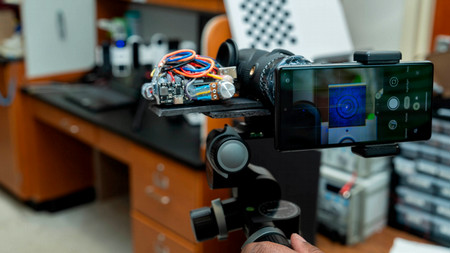
Unlike conventional defenses that rely on deep learning models requiring extensive data collection across countless attack scenarios, Tu’s research focuses on developing a solution based on adversarial optical physics.
The defense works by detecting the injected stray lights and patterns created by laser reflections and refractions inside the lens, artifacts that wouldn't appear with normal lighting or objects. Tu said the advantage of this physics-based approach is that it doesn't require extensive training to map every possible attack scenario or environmental condition, making it more practical for real-world deployment across diverse settings.
“We are working on short-term and long-term solutions,” Tu said. “It usually takes more than a simple patch of the software. The algorithms may need to be analyzed and adjusted because there are some fundamentals they previously have not considered at all. Researchers in this area are working on identifying the threats, and to provide more defenses to it before they become reality.”
Tu and his research team are collecting additional data and reaching out to manufacturers with their findings and proposed solutions. The long-term fixes will require software patches, changes to algorithms and workflows to act securely in the presence of attacks and potentially hardware design improvements.
Media Contact: , jem0040@auburn.edu, 334.844.3447