Aerospace engineers developing hybrid-electric autonomous aircraft to cut aviation emissions
Published: Sep 4, 2025 8:00 AM
By Dustin Duncan
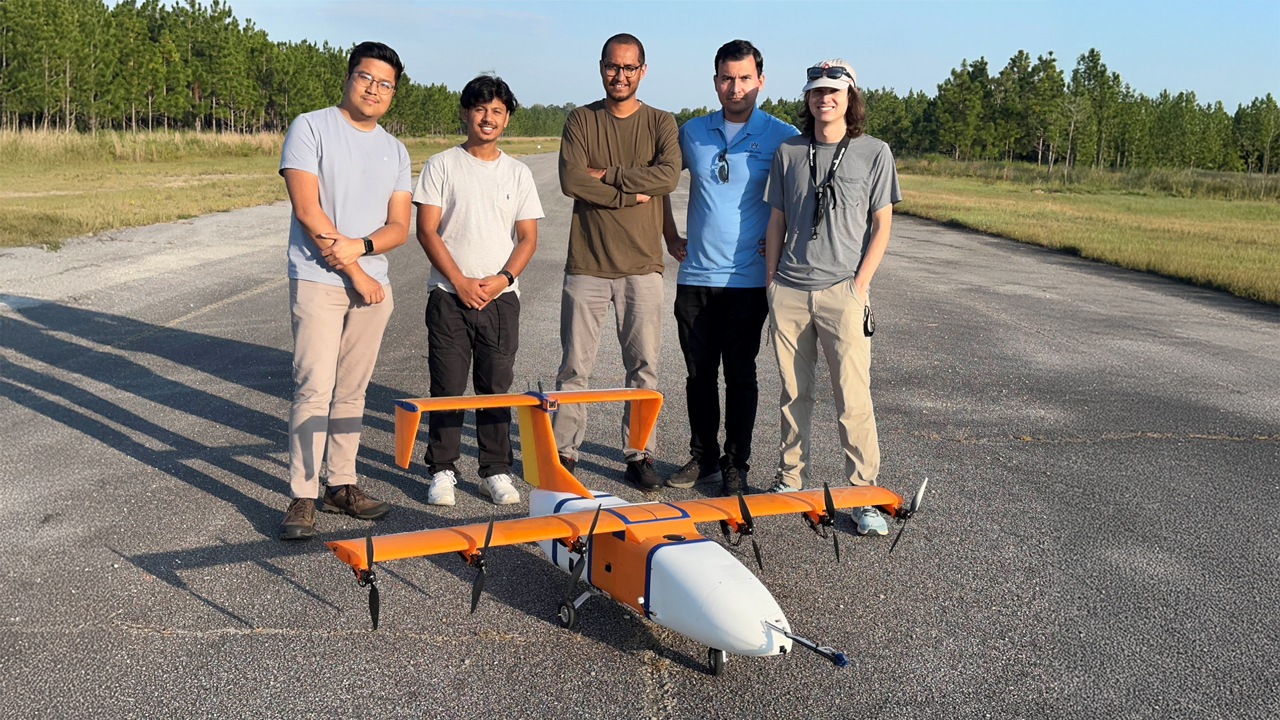 Members of aerospace engineering’s Vehicle Systems, Dynamics, and Design Laboratory — from left, doctoral students Stefanus Harris Putra, Bikash Kunwar, Rajan Bhandari, associate professor Imon Chakraborty and doctoral student Cole McCormick — stand with a prototype hybrid-electric unmanned aircraft designed to cut fuel use and emissions in the growing air cargo market.
The Vehicle Systems, Dynamics, and Design Laboratory (VSDDL) is working with Rune Aero Inc., an aerospace startup, to develop and test a hybrid-electric unmanned aircraft that could dramatically cut fuel use and emissions for the growing air cargo market. The project, supported by NASA, is part of a larger national effort to make aviation more sustainable and efficient.
In the first phase of the project, Imon Chakraborty, associate professor of aerospace engineering, and his graduate students at the VSDDL designed and built a subscale prototype of Rune’s autonomous cargo delivery aircraft. That work laid the foundation for the project’s second phase, for which NASA approved funding, and which has now begun.
“Our team at Auburn has been involved since the beginning,” Chakraborty said. “Now in Phase II, we’re pushing further — optimizing the hybrid-electric propulsion system, building a new test bench in the lab and running extensive simulations and control system testing to prepare for hybrid-electric flight tests.”
Auburn’s role goes beyond simulations. Researchers also collaborate with Rune engineers on the design and are responsible for constructing and testing the subscale aircraft itself.
“This is a true partnership,” Chakraborty said. “Rune Aero and Auburn share responsibility for planning, design and testing. At Auburn, we’re not only running the simulations but also building the subscale prototype ourselves. In year one, we’re focused on design, development and all-electric testing. In year two, we’ll move into hybrid-electric flight demonstrations.”
Nadine Auda, co-founder of Rune Aero Inc., said working with Auburn and the VSDDL has been invaluable.
“Their research strengths complement our commercialization path,” Auda said. “Together, we’re proving that hybrid-electric propulsion can scale to meet the needs of the next generation of cargo aircraft."
According to Chakraborty, the personnel in VSDDL have a unique set of tools, skills, capabilities and prior experiences that allow them to undertake and complete this work.
“Our lab’s research pipeline covers every step — from design and control development to simulation and subscale flight testing – complementing Rune’s overall development efforts,” Chakraborty said. “That systems-level approach is what allows us to take on a project as complex as hybrid-electric aviation.”
Graduate students are playing a vital role in the work, taking on responsibilities that range from designing power systems and propulsion tests to integrating software into flight. Four doctoral students — Rajan Bhandari, Stefanus Harris Putra, Bikash Kunwar and Cole McCormick — are contributing directly to the project, with their individual roles tied to their dissertation research.
“Graduate students are absolutely central to Auburn’s contributions on this project,” Chakraborty said. “Their work feeds directly into their dissertations and gives them the experience of working on a federally funded, industry-relevant project.”
Bhandari works on both ends of the project — optimizing the full-scale hybrid-electric cargo aircraft and developing subscale prototypes to validate designs.
“My role spans from running multidisciplinary design and optimization studies to bench testing hybrid-electric propulsion systems,” Bhandari said. “I also assist with manufacturing and flight testing, which means I get to see our conceptual design evolve from computer simulation to real-world flight.”
Putra works on detailed design and manufacturing.
“The Rune project allows me to work on a design with very unique challenges,” Putra said. We have never had an internal combustion engine in any of our vehicles before, so the challenge of integrating an engine into our mostly 3D-printed designs to create a hybrid-electric architecture is very interesting to me.”
Kunwar said his work spans simulation, flight testing and hardware evaluation.
“I work on a closed-loop simulation and flight testing, modeling aerodynamics, integrating control laws and missions onto flight test hardware, collecting flight data and using that data to improve the simulation,” Kunwar said. “I am also testing hardware components intended for the hybrid-electric propulsion architecture that we will flight-test.”
McCormick said he focuses on manufacturing and testing for the Rune project.
“I work on manufacturing for the subscale vehicles and testing the hybrid-electric propulsion system,” he said. “Creating a hybrid system at this scale is quite challenging, so I am looking forward to getting to see this system operating as the Rune vehicle matures.”
The Auburn team is also responsible for testing stability and control, using simulation tools developed at the university with NASA support. These simulations predict how the aircraft will respond under various conditions, and flight tests are used to verify the results.
Ultimately, the project seeks to demonstrate that hybrid-electric propulsion is a scalable solution for autonomous cargo aircraft.
“The goal is to validate the technology and show it’s ready for broader application,” Chakraborty said. “Over the next two years, we’ll design, build and flight-test a subscale hybrid-electric demonstrator as a proof-of-concept to show its potential for cargo transport.”
If successful, the research could lay the groundwork for broader applications of hybrid-electric technology in passenger aircraft, air taxis and beyond.
Media Contact: , dzd0065@auburn.edu, 334-844-2326