Associate professor in electrical and computer engineering earns co-authored IEEE Best Paper Award
Published: Aug 27, 2025 7:30 AM
By Joe McAdory
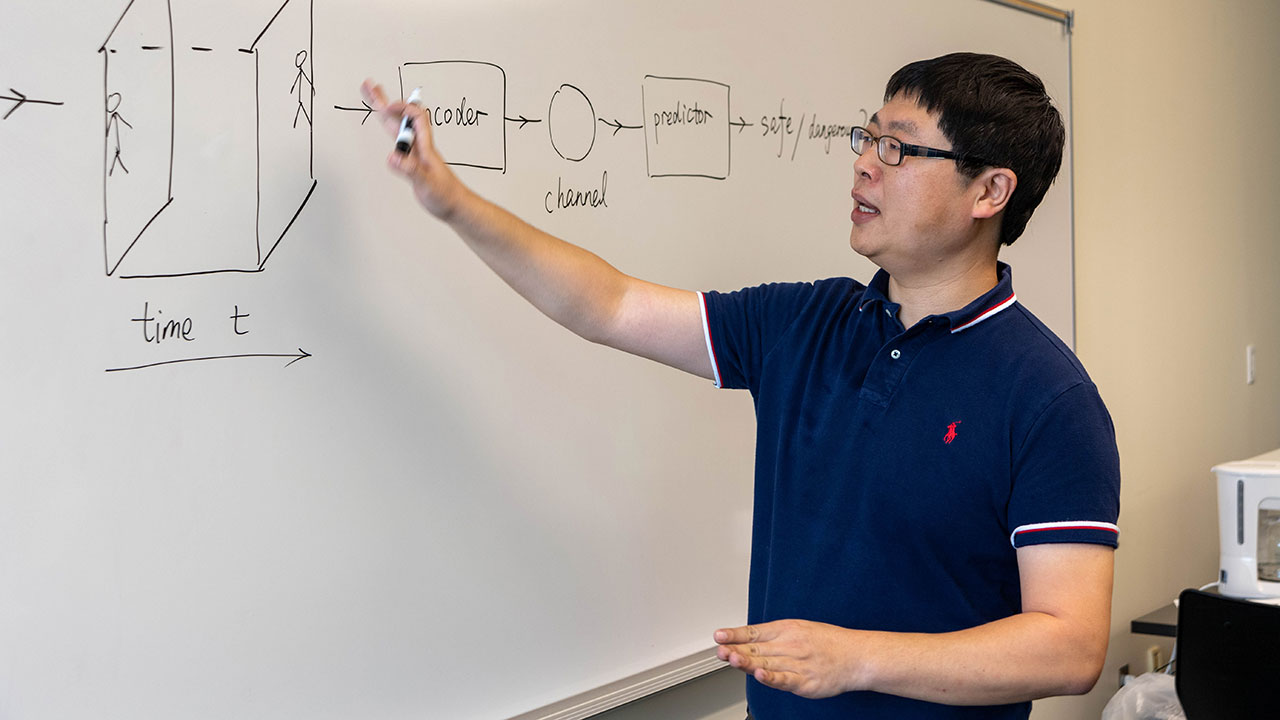 Originally published by the journal IEEE/ACM Transactions on Networking in 2024, Sun's paper introduced a new framework for remote inference, where artificial intelligence systems make decisions based on data collected by sensors, such as video frames from cameras or signals from autonomous vehicles.
Is newer always smarter? Not when it comes to data. Auburn Engineering-led research shows that, in artificial intelligence (AI) and next-generation systems, older data can often yield better, more informed decisions.
Yin Sun, the Godbold Associate Professor in the Department of Electrical and Computer Engineering (ECE), won the Institute of Electrical and Electronics Engineers (IEEE) Communications Society William R. Bennett Prize, awarded annually to the best original paper in networking for his co-authored paper, “Timely Communications for Remote Inference.”
Sun co-authored the paper with former Auburn University ECE doctoral student Md Kamran Chowdhury Shisher, a postdoctoral researcher at Purdue University who earned a PhD in electrical engineering at Auburn in 2024 and was a research assistant in Sun’s Real-Time Network Lab. Other co-authors included I-Hong Hou, a professor in electrical engineering at Texas A&M University.
“We found that fresh data isn’t always better — and that insight changes how we design communication systems, allocate resources and respond to real-world challenges like wildfires, infrastructure safety and emergency response,” Sun said.
Originally published by the journal IEEE/ACM Transactions on Networking in 2024, the paper introduced a new framework for remote inference, where AI systems make decisions based on data collected by sensors, such as video frames from cameras or signals from autonomous vehicles.
Sun said engineers have long assumed that newer data was better data and discovered that this assumption doesn’t always hold, especially when the data doesn’t follow predictable Markovian patterns.
To address this, the researchers developed what they consider a “selection-from-buffer” model, which allows systems to choose whether to send fresh or stale data based on its usefulness. This approach introduced new scheduling algorithms that optimize both data transmission and inference accuracy.
“This is fundamental technology for 6G,” Sun said. “Instead of sending entire files, we can transmit just the 2 percent that matters. That means you can monitor dozens of sensors in real time without overwhelming the system.
“We began this project five years ago from ground zero. It was exciting to start from scratch and see him run experiments that challenged the old assumption that fresh data is always better than old data.”
Sun said the next step is taking this research from theory to application.
“We’re engineers. We build things to solve real-world problems,” he said. “This honor validates the fundamental work we’ve been doing for years, and it means a lot to our college and inspires our students who will continue to build upon this research. They’re seeing how their skills can develop systems that benefit society.”
The award will be presented on Dec. 9 at IEEE GLOBECOM in Taipei, Taiwan.
Media Contact: , jem0040@auburn.edu, 334.844.3447