

AU professor touts his bullet-resistant vest
 In a school full of high-tech gadgetry, Auburn University's most important contribution
to the war on terrorism might be something as low-tech as a few pieces of fabric.
In a school full of high-tech gadgetry, Auburn University's most important contribution
to the war on terrorism might be something as low-tech as a few pieces of fabric.
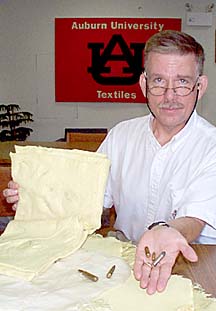
Howard Thomas, a professor in the Department of Textile Engineering, has invented a bullet-resistant vest that he contends is lighter, more comfortable and more effective than the flak jackets that the U.S. military is using.
So why, after more than a decade, has he not been able to sell it?
"There are a lot of people who are happy with the status quo," he said. "This is a very, very conservative and recalcitrant kind of industry that's not open to new ways of doing things."
The Army's Air Warrior unit, consisting mainly of helicopter pilots, has been conducting field tests on Thomas' patented technology for the past several months and has new funds to continue research. Thomas said it gives him hope that his long-awaited breakthrough is near.
Thomas said preliminary tests confirm that ArmorFelt, as his invention is called, can stop blasts as close as 3 feet from a wide range of weapons, including a 9 mm rifle, a 9 mm pistol and a .357-caliber Magnum revolver.
"It passed with flying colors. As a matter of fact, we're above their standard," he said. "The ballistics performance on the vest is far above what they have in the field right now."
Some experts remain skeptical, however. Loren Thompson, a defense analyst at the Lexington Institute in Arlington, Va., said a lighter bullet-resistant vest would have obvious advantages for soldiers in places such as Iraq. But, he said, the Pentagon generally has moved toward vests that contain rigid ceramic plates.
For example, current outfits worn by the Air Warrior unit include body armor with a ballistic upgrade plate that will protect the aviator from multiple-hit .30-caliber armor-piercing rounds.
"Soft body armor clearly has many uses in law enforcement and peace-keeping operations around the world," said Thompson, who teaches military technology at Georgetown University in Washington. "But for the level of protection that's required in Iraq, it's not enough.
"The problem we face in Iraq is the enemy is so unpredictable," he said. "What the professor has developed may be effective 90 percent of the time. What the military is worried about is the other 10 percent of the time."
Beth Cook, a spokeswoman for the office responsible for outfitting military personnel -- the Program Executive Office Soldier -- said that Air Warrior officials were not available to comment last week about their ArmorFelt testing.
For Thomas, who has been working on the ArmorFelt idea since the early 1990s, skepticism has become frustratingly familiar. He said that his vest would not negate the need for hard body armor inserts in military situations.
He said ArmorFelt is designed to be worn underneath hard body armor. He said it offers more protection than what Air Warrior aviators wear now and is better than any bullet-resistant vest on the market.
No protective gear, Thomas said, is 100 percent effective against bullets. Taking a bullet, even while wearing a top-of-the-line vest, is something that no soldier would volunteer to do.
The force of the bullet makes a tremendous impact, sometimes fracturing ribs. At best, Thomas said, the recipient can expect severe bruising and a trip to the hospital. He compared the experience to taking a whack from a Barry Bonds home-run swing.
But when Thomas fires a submachine gun against a clay backdrop covered by ArmorFelt, the material's effectiveness becomes evident. After one such demonstration earlier this year, the clay showed depressions caused by the gunfire, but none of the bullets had penetrated the cloth.
ArmorFelt looks nothing like normal body armor. The flimsy cloth more resembles a handkerchief than a bullet-stopper. And that, Thomas said, may be part of his problem in promoting it.
Most bullet-resistant vests are constructed with multiple layers of fabric woven together. Designers boost protection by increasing the number of layers, which makes many such vests thick and heavy.
ArmorFelt, meanwhile, is a nonwoven blend of Spectra and Kevlar -- the two best-known bullet-resistant products in the United States. They form the front and back layers of Thomas' vest, sandwiching traditional woven bullet-resistant materials.
The Kevlar and Spectra blend is fed into a machine that smoothes the surface and moves the blend over a conveyor belt into a machine that punches in many thousands of fibers measuring 1½ to 3 inches long. Near-microscopic barbs on the end of the those fibers are able to absorb and redistribute the energy created by a gunshot.
In Thomas' tests, bullets striking the clay draped in ArmorFelt caused depressions that were up to half as deep as clay covered with a traditional vest, depending on the weapon.
The secret to ArmorFelt, Thomas said, is that it does not rely on intricate stitching, so it's not as vulnerable to tearing and ripping. He said that makes ArmorFelt useful even against shrapnel from heavy arms.
Thomas said the Marine Corps in December 2003 used C-4 explosives to detonate 105 mm howitzer shells set next to vehicles. He said ArmorFelt, weighing 2.5 pounds per square foot, was as effective at preventing damage to the vehicles as ceramic armor weighing 7.5 pounds per square foot.
Thomas said he came up with the idea of ArmorFelt after watching a news report during the first Gulf War. At the time, he was teaching at the now-defunct Institute of Textile Technology, an industry-funded school in Charlottesville, Va.
The soldiers were taking off their bulky flak jackets -- tossing aside their potentially life-saving protection -- because of the desert heat.
"If it's stiff and heavy, the soldier's going to take it off," he said.
So Thomas and his graduate assistant at the Institute of Textile Technology, Greg Thompson, began working with various fabrics and came up with an initial design.
When a bullet strikes, it generates a shockwave that travels through the vest. But the fibers act as a spring and repulse the shockwave back toward the bullet, which slows and eventually stops it.
"It's much more like a pool of liquid," Thomas said. "It's a completely radical new way of looking at it."
Thompson, who now works for Milliken & Co., a chemical and textile company in Spartanburg, S.C., said he wrote his graduate thesis on the topic. Although he originally planned to conduct experiments on Kevlar and Spectra separately, he said that he and his professor encountered difficulties working with the Spectra.
So they decided to try putting the two together.
"It was almost by accident that we blended these materials," Thompson said.
Thomas said his son wore one of the early prototypes when he was in a youth group that exposes teenagers to law enforcement. He said his son wore better protection than the officers he rode along with.
That son is now studying criminal justice at Southern Union Community College in Opelika and hopes to be a police officer, giving his father extra motivation to bring ArmorFelt into wide use.
Science & Engineering Services Inc. of Columbia, Md., has been working to market ArmorFelt for the past two years. "We're very excited about this technology," said Robert Serino, director of operations for the 200-employee company, which has a manufacturing facility in Huntsville, Ala. "The tangible benefits are very clear."
Serino said company officials see widespread potential for ArmorFelt in the military, police forces and homeland security. In addition to bullet-resistant vests, he said, it could be used to line tents, buildings and military vehicles to provide protection from small arms and shrapnel.
The first step, though, is winning the initial contract. Serino said Thomas is fine-tuning the design to make the vest even lighter and more flexible than it is now.
"In the military, there is what I would call, 'continual improvement,'" he said. "There'll be an evolution. There's always a desire for improvement."
Media Contact: , cobbche@auburn.edu, 334.844.2220