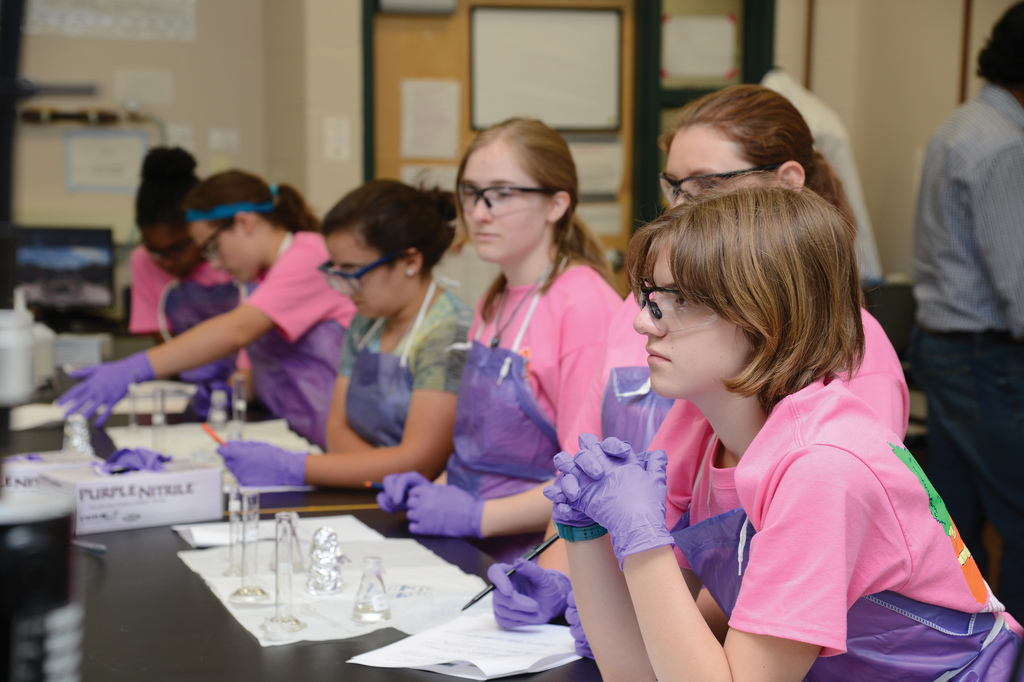
 The Auburn Creed states, "I believe in education, which gives me the knowledge to work wisely and trains my mind and my hands to work skillfully." Twenty rising 8th-, 9th- and 10th-grade girls from around the country embodied this part of the creed by spending a week at the College of Engineering's first Women in Engineering Camp. The camp, held in July on the Auburn campus, provided the opportunity for students to gain hands-on experience in engineering and with scientific design processes.
Virginia Davis, Mary and John H. Sanders associate professor in the Department of Chemical Engineering, is focused on promoting engineering careers for women and minorities. She saw a need to participate in the camp to provide educational opportunities to students, as well as increase female representation in science, technology, engineering and math (STEM) disciplines.
"We see significant issues with diversity," says Davis. "If current proportions hold true, we won't have the engineers, economists or mathematicians that we need. We must get women and minorities engaged."
Phylesia Hill, a senior in mechanical engineering and camp counselor, recognized the need to encourage women to choose engineering.
"Engineering is known to be a male-dominated field, and it is comforting, as a female, to see other females with the same interests," she says. "Having a women's only camp for engineering is important."
[miniflickr photoset_id=72157638326373624&sortby=date-posted-asc&per_page=10]
To kick off the week, Bonnie Wilson, Auburn's coordinator for the Women in Science and Engineering Institute, introduced participants to the engineering design process including how to identify a problem or opportunity for improvement, research, brainstorm solutions, select an approach, and finally, prototype, test and refine a design. The girls put this process to the test by creating ping pong ball launchers before moving on to a more serious matter on a global scale.
Wilson discussed a number of everyday challenges faced by women in Ukunda, Kenya, the birthplace of Auburn alumna Esther Ngumbi. Esther, a postdoctoral fellow in the Department of Entomology, and her parents opened a primary school – the Faulu Academy – in Ukunda after her parents retired from public service in 2011.
"The campers learned about life without running water and electricity, and were challenged to research and create solutions to these everyday obstacles to benefit the lives of students at the school," says Wilson. The girls brainstormed and researched a variety of issues and developed prototype solutions that they presented to Ngumbi. Among the items developed were a long handled spoon for cooking, a flexible gutter system for collecting rainwater, and reusable cooling packs for refrigeration, as well as underground water storage solutions and a rigid gutter system.
Hill noted that Ngumbi's reaction to the campers' finished projects was the highlight of the Women in Engineering Camp.
"When the girls saw how amazed she was, they realized that being an engineer is more than creating things – being an engineer is creating things that change lives," says Hill.
[miniflickr photoset_id=72157638326373624&sortby=date-posted-asc&per_page=10]
The campers were also shown how engineering impacts everyday challenges that most Americans and people from other first-world countries never face. Thomas Baginski, professor in the Department of Electrical and Computer Engineering, presented student-made, low-cost water purifiers that prevent water-borne diseases in impoverished locations. Today, more than five countries, most recently India, are reaping the benefits of these one-of-a-kind purifiers. Baginksi explained how a pinch of salt and specially coated electrodes work together to produce chlorine compounds that sanitize the water to make it potable.
Cheryl Seals, associate professor in the Department of Computer Science and Software Engineering, taught an introduction to computer programming class throughout the week. Campers were introduced to computing concepts, personal productivity tools, web page development and visual programming using the program Alice 3D. Lessons were put into action by having the students create a web page or interactive game about themselves, which they presented to the group.
Participants also received a tour of the automotive manufacturing systems laboratory, or the "Lego Lab," from LuAnn Sims, graduate program coordinator and instructor in the Department of Industrial and Systems Engineering. In this lab, students use Legos to design and build vehicles at a rate of 70 cars per hour. Students produce three types of Lego vehicles: a 278-piece speedster, 254-piece SUV and 231-piece Baja car. The process requires 18 students, 15 for assembly operations and three for material delivery.
Christine Schnittka, a joint assistant professor in the College of Engineering and College of Education, gave an introduction to electrical generation and energy transformations by appealing to the students' love of pets. In many regions, coal is the primary source of energy which ultimately harms the environment. By examining indicator species, such as amphibians and snails, scientists can see the effects of burning coal for energy. In her "Save the Snails" curriculum, Schnittka explained how to create electricity by capturing the energy from gravity, and in turn, limiting the use of coal.
Schnittka developed the snail teaching curriculum to portray engineering as a real-world situation to helping animals. "They have empathy for animals and want to develop ways to help them," she says.
[miniflickr photoset_id=72157638326373624&sortby=date-posted-asc&per_page=10]
In addition, campers worked with Davis and her research assistants to learn more about how chemical engineering can create a positive environmental impact. Tera Jo Stone, a senior in chemical engineering, created a "magic sand" demonstration using a hydrophobic coating that repels water. Stone's experiment served as an engaging example of how a small change in properties can affect an object's behavior, as well as the role chemical engineers play in environmental clean-up.
"I think it's really important for girls to know that there are other female engineers in the College of Engineering," says Stone. "I really like when all sorts of students, male and female, can come and have a good time and learn about our program in fun ways."
Throughout the week, campers had the opportunity to meet with women engineers, including members of Auburn's chapter of the Society of Women Engineers and the college's 100 Women Strong program.
Jessica Taylor, undergraduate student recruiter for the College of Engineering, served as a coordinator and camp counselor for the week. As a female Auburn Engineering graduate, she thought there was no better way "to expose women to the world of engineering than through a summer camp."
Taylor sees the potential for future women's camps after determining the first one a success. "I thoroughly enjoyed organizing the first Women in Engineering summer camp. With the help of many people, it was a successful week," she says. "It was such a fun and rewarding experience to see 20 girls get excited about engineering. I am truly looking forward to the next summer camp as we develop more ways to attract women into the field of engineering."
At the end of the jam-packed week, parents were invited to the graduation ceremony held in the Shelby Center. Watching each girl walk proudly across the stage was a momentous occasion – 20 potential engineers ready to take on the world.
[miniflickr photoset_id=72157638326373624&sortby=date-posted-asc&per_page=10]