

Aerospace students best in the U.S. in solar system trajectory competition
By Olivia Ballard
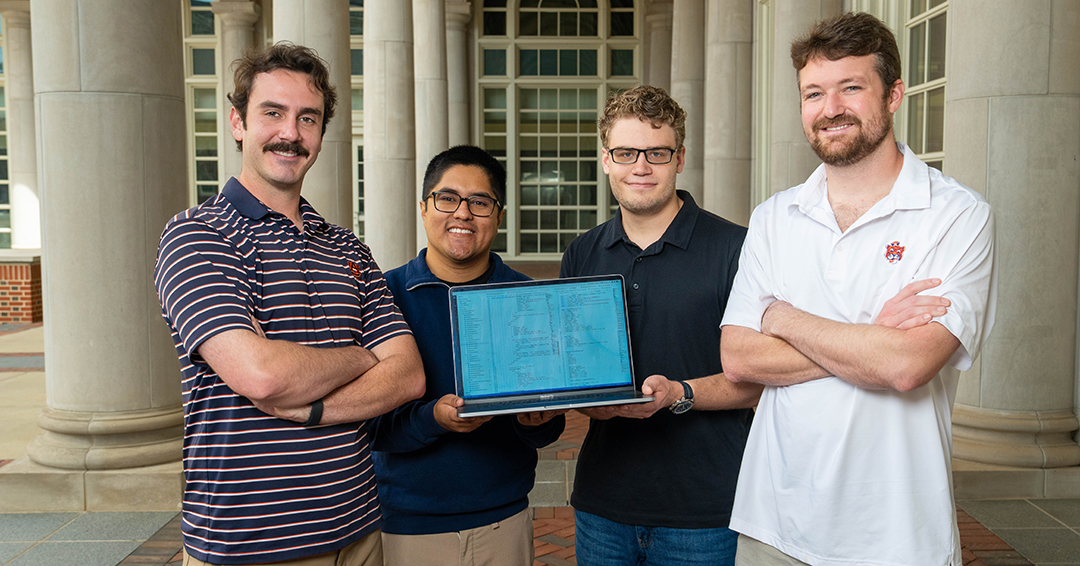
Auburn Engineering students led all U.S. teams at NASA’s Global Trajectory Optimization Competition, ranking No. 1 nationally and No. 10 overall among 101 teams from around the world.
Joe Ivarson, Eirik Mulder and Nick Nurre, all in aerospace engineering, and Luis Manuel Postigo, in computer science and software engineering and aerospace engineering, worked with other engineers to identify an optimal route through a solar system.
Computer Science and Software Engineering graduate students Jeremy Wang, Pedro Vasconcelos and Joe Lin also provided programming support and ideas in the early stages of the competition.
According to Mulder, the challenge was to create a long-term tour of the fictional celestial system Altaira, in which the spacecraft must collect as much science as possible by visiting planets and asteroids within a limited time frame.
He said one of the toughest parts was balancing each aspect of the challenge and getting a clear picture with so many moving pieces.
“A major part of the challenge was identifying and sorting through all the possible ways we could try to solve the problem,” Mulder said. “Dividing into teams to tackle separate challenges allowed us to identify our best approaches, and then we narrowed down our technique and iterated from there.”
The competition spanned four weeks with a live leaderboard. Competitors were given the problem statement, along with planet, asteroid and comet data and submission formats to guide them.
“We started with solving trajectories to the planets, collecting as much data as we could first, and then we moved on to asteroids and comets,” Nurre said. “Waiting for everyone to submit their final results was nerve-racking, but it was all worth it once it was over, and we were still 10th overall. It was even more exciting finding out we were first in the U.S.”
The problem was designed to mirror real-world systems and challenge teams to develop techniques applicable beyond the competition, Ivarson said.
“Having the resources and coursework from Auburn provided us with the preparation needed to effectively approach the problem,” he said. “The problems are modeled after real state-of-the-art mission challenges, and we were able to apply our lab experience and collaborate to develop solutions.”