

Aerospace engineers developing hybrid-electric autonomous aircraft to cut aviation emissions
By Dustin Duncan
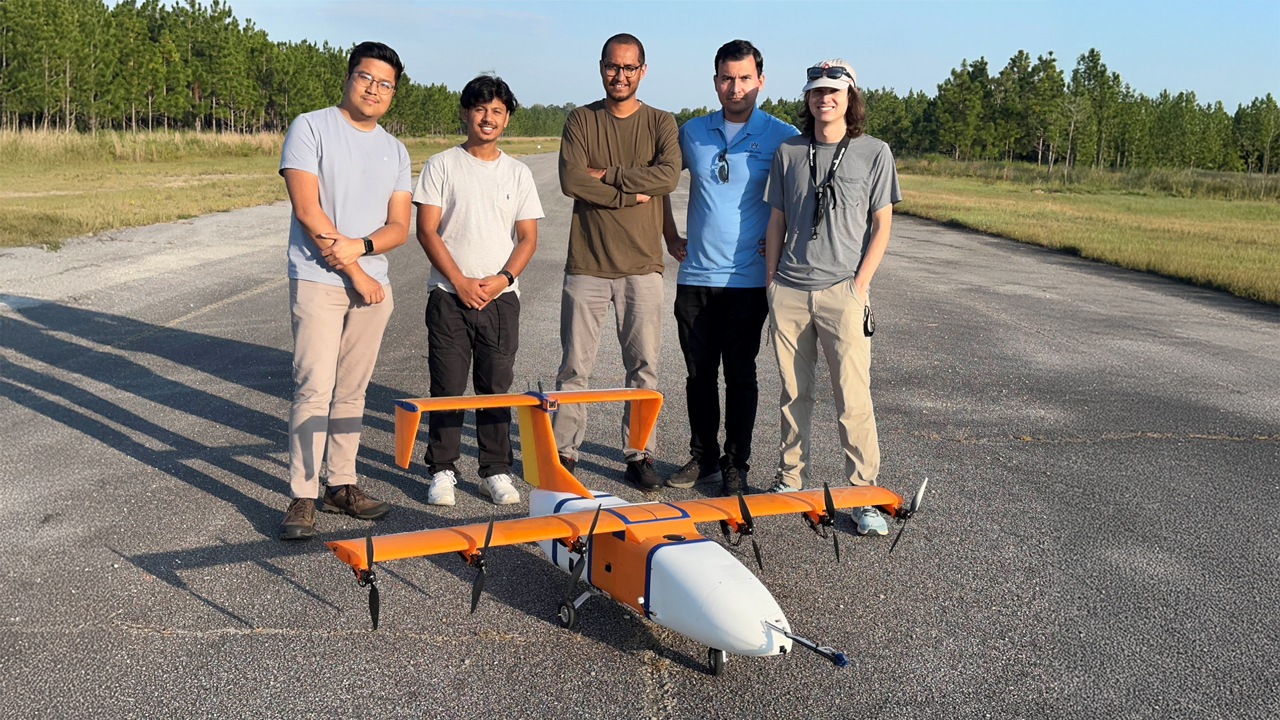
Aerospace engineering doctoral students Stefanus Harris Putra, Bikash Kunwar, Rajan Bhandari and Cole McCormick are helping develop a hybrid-electric cargo aircraft that could significantly reduce fuel use and emissions in regional air transport.
Working with Rune Aero and supported by NASA, a team in Auburn’s Vehicle Systems, Dynamics and Design Laboratory, or VSDDL, is designing, building and testing an autonomous aircraft for the growing air cargo market. The project is part of a broader push to make aviation more efficient and sustainable.
Led by aerospace engineering associate professor Imon Chakraborty, Auburn’s role spans the full development pipeline — from simulation and control system design to construction and flight testing of a subscale prototype.
In the project’s first phase, the team designed and built the prototype, laying the groundwork for continued development.
“Our team at Auburn has been involved since the beginning,” Chakraborty said. “Now in Phase II, we’re optimizing the hybrid-electric propulsion system, building new test capabilities and preparing for hybrid-electric flight demonstrations.”
Auburn researchers also collaborate closely with Rune Aero on aircraft design and validation, sharing responsibility for planning, development and testing.
“This is a true partnership,” Chakraborty said. “At Auburn, we’re not only running simulations — we’re also building and testing the aircraft.”
Graduate students play a central role in the work, contributing to propulsion design, simulation, manufacturing and flight testing.
Their efforts support dissertation research while providing experience on federally funded, industry-relevant projects.
Over the next two years, the team will refine the propulsion system and advance toward hybrid-electric flight demonstrations, with the goal of validating the technology as a scalable solution for future cargo aircraft.
“The goal is to validate the technology and show it’s ready for broader application,” Chakraborty said.
Researchers