

Associate professor successfully tests 3D printer in series of parabolic flights
Electrical and Computer Engineering
By Joe McAdory
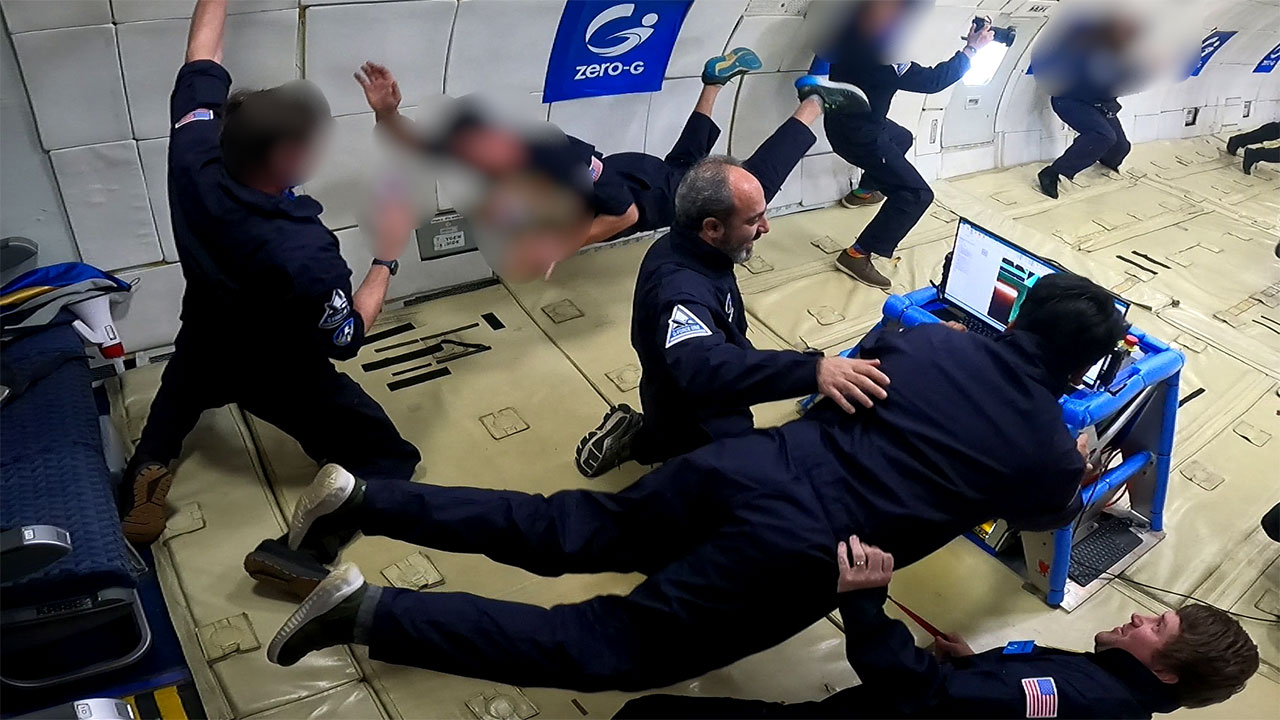
Masoud Mahjouri-Samani, the Godbold Associate Professor in the Department of Electrical and Computer Engineering, successfully tested a compact nanoparticle 3D printer during NASA-sponsored parabolic flights simulating microgravity.
Conducted near Salina, Kansas, the test marked the airborne debut of LASED, or Laser Ablation and Sintering Enabled Deposition, a low-power system designed to fabricate circuits, sensors and antennas in space. The project is supported by an $870,000 NASA grant.
“This was a one-shot win. From the very first parabola, the machine printed beautifully,” said Mahjouri-Samani, who conducted the flights with graduate student Aarsh Patel and research engineer Colton Bevel.
Aboard a modified Boeing 727, the team completed about 30 parabolic arcs, each providing roughly 20 seconds of microgravity.
The test points to a future where astronauts can manufacture electronics on demand, reducing reliance on Earth-based supply chains during long missions.
“In space, you want to print what you need, when you need it,” Mahjouri-Samani said. “We can design and build circuits on site.”
The printer measures about 24 inches per side and consumes less than 500 watts, integrating nanoparticle generation, material delivery and sintering into a fully automated system capable of producing complex structures in seconds.
Engineered to withstand significant G-forces, the device exceeded expectations in flight, producing prints equal to — and in some cases better than — those created on Earth.