

Embodying The Mission: Research
College launches novel internet tool designed to foster research collaboration across multiple disciplines
By Joe McAdory
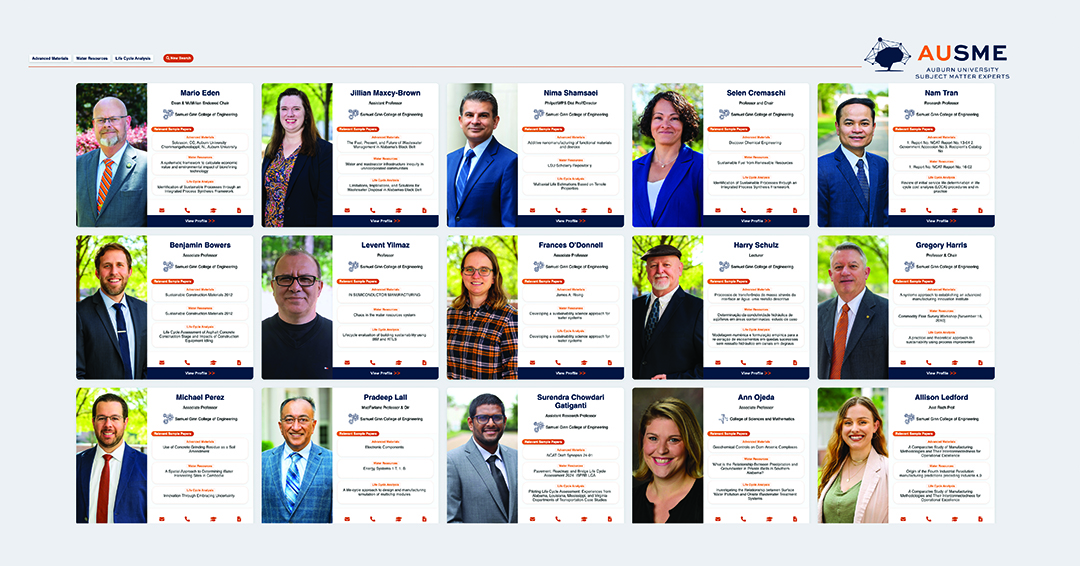
A dedicated team of faculty, staff and students within the Samuel Ginn College of Engineering has developed AUSME, a powerful online platform designed to accelerate interdisciplinary research by connecting experts across fields.
AUSME, or Auburn University Subject Matter Experts, is an artificial intelligence-powered, searchable tool that helps researchers discover collaborators, build partnerships and pursue complex, cross-disciplinary work.
The AUSME development team included Auburn Engineering Research Data & AI Development Coordinator Mostafa Rahgouy, who served as an AUSME AI developer, frontend and backend specialist; frontend specialist Soundarya Korlapati, a senior research engineer at the Auburn RFID Lab; Tyler Patterson, manager of digital strategy and operations; Emily Maddox, manager of Salesforce and data administration; Kelley Terry, director of research program development and grants; and Shannon Price, director of network services.
“This team didn’t just create a database — they built an engine for discovery,” said Gerry Dozier, director of the Auburn University Center for Artificial Intelligence and Cybersecurity Engineering and McCrary Eminent Chair Professor.
AUSME compiles publicly available research data, including publication records, citation metrics and collaboration networks, into interactive faculty profiles.
Users can search by keyword, filter by department or topic and identify potential collaborators based on shared research interests.
Designed for students, faculty and external partners, the platform expands access to Auburn’s research expertise and helps surface connections that might otherwise go unnoticed.
“The team who built AUSME understand research,” said Allan David, associate dean for research. “AUSME helps surface the kind of partnerships that drive innovation — when experts from different disciplines connect around shared challenges.”
Additional features in development include AI-generated research summaries, enhanced data visualizations and expanded search capabilities.
Researchers