

Auburn team claims autonomous racing victory at 163.6 mph
By Jeremy Henderson
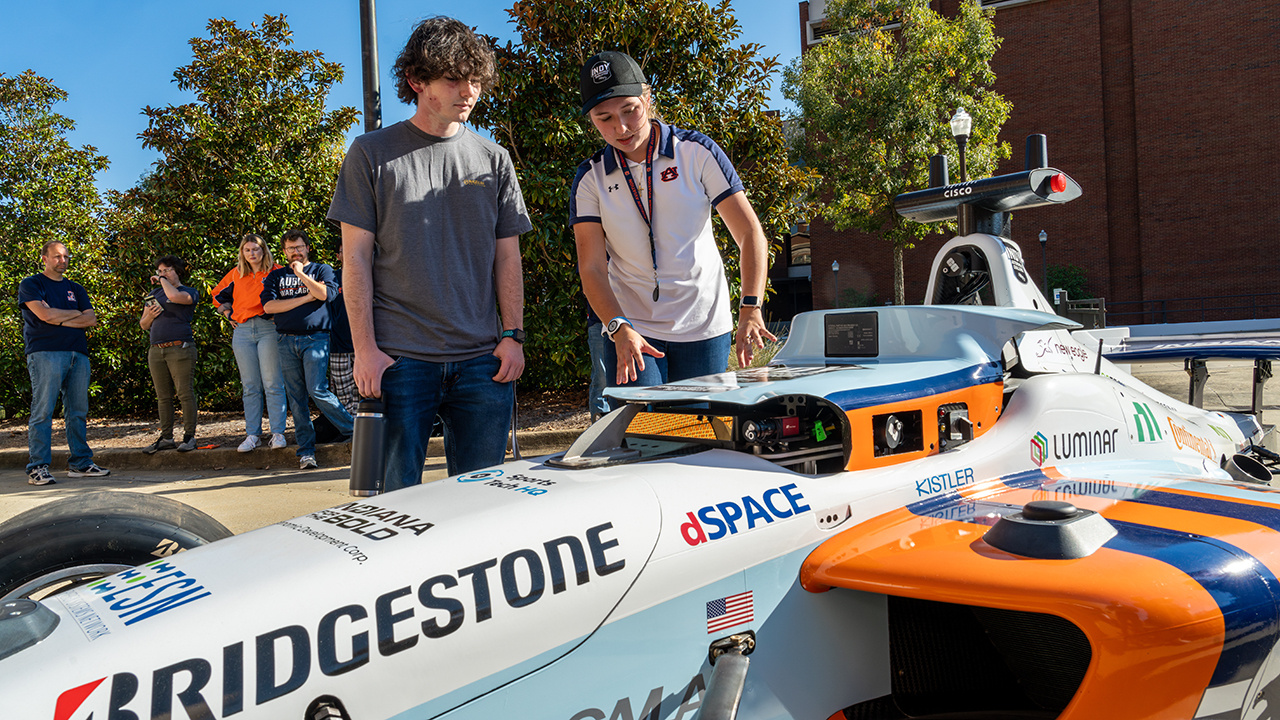
Auburn’s autonomous driving research shows no signs of slowing down. Quite the opposite.
Operating out of the GPS and Vehicle Dynamics Laboratory (GAVLAB), the university’s Autonomous Tiger Racing (ATR) recently topped the Tier 1 speed competition at the latest iteration of the Indy Autonomous Challenge (IAC) held in January at the Las Vegas Motor Speedway in conjunction with the annual Consumer Electronics Show.
Begun in 2021 to push the boundaries of autonomous technology and elevate consumer confidence in autonomous vehicles, the international autonomous vehicle competition requires teams to design a software stack integrating data from sensors like LiDAR, GPS-INS, computer vision cameras and radar well enough to maneuver driverless Dallara AV-24 Indy Lights cars at speeds in excess of 150 mph.
ATR was the first to run a Dallara AV-21 autonomous race car around the famed Indianapolis Motor Speedway leading up to the first IAC event, held at the famed 2.5-mile oval in October 2021.
This go-round, they nearly made history again. ATR claimed victory in the 10-minute time trials with a 163.6 mph lap, beating out teams from Indiana University and the California Institute of Technology; during earlier testing, in much better weather, they logged the second-fastest autonomous lap speed ever — 170 mph, only 2 mph behind the world record set by Italian race team PoliMove in 2022.
“We are a vehicle dynamics lab, so going fast should be our specialty,” said David Bevly, the Bill and Lana McNair Distinguished Professor and GAVLAB’s founder and co-director.
However, the work behind that specialization isn’t just about bragging rights for fastest laps; it’s about closing technological gaps.
The Department of Defense’s (DOD) Defense Advanced Research Projects Agency (DARPA) recently partnered with IAC to evaluate the deep reinforcement learning research necessary for consistently effective autonomous navigation in challenging environments. That’s a wheel Bevly, one of the foremost minds in autonomous research, has been behind for years.
In 2004, student researchers under Bevly placed 7th out of 45 competitors in the inaugural DARPA Grand Challenge, a now legendary DOD-funded driverless vehicle race in the Mojave Desert that kickstarted the modern era of autonomous vehicle development.