

National Institutes of Health awards $1.9M toward Auburn engineering’s transformative research into rapid immunodiagnostics
Materials Engineering
By Jeremy Henderson
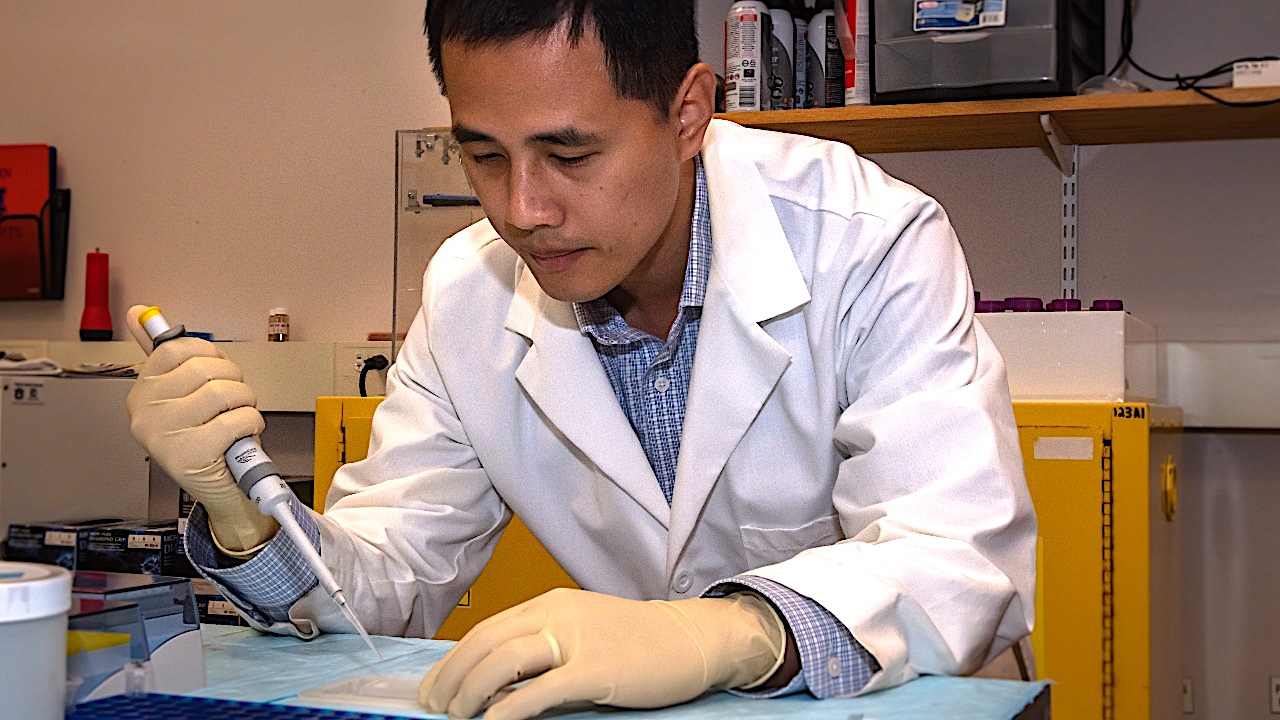
Pengyu Chen, the Francis Family Associate Professor and Ginn Faculty Achievement Fellow in the Department of Materials Engineering, believes he’ll soon be able to immediately unlock the secrets of your immune system with the prick of a finger. The National Institutes of Health (NIH) continues to believe it, too.
The NIH recently awarded Chen $1.9 million to continue his groundbreaking research on immune system analysis. The five-year grant is an extension of a 2019 NIH Maximizing Investigators’ Research Award (MIRA) for the same amount.
Chen’s research team will continue to develop cutting-edge technologies that combine nanomaterial-based sensors with advanced computer algorithms to measure, with just a single drop of blood, key immune proteins and track how immune cells behave and communicate. The innovative approach promises to provide critical insights that could transform the diagnosis and treatment of immune-related diseases like cancer, autoimmune disorders and infections.
“While this grant builds on the foundation of our 2019 MIRA, it is more than an extension,” Chen said. “We are broadening the scope of our work, incorporating AI-assisted technology and novel biosensing platforms to enhance immune profiling and monitoring.”
A key motivation for the project? Accessibility for all, Chen says, “regardless of their geographical or economic situation.”
“By leveraging AI with our nanoplasmonic biosensing platforms, we aim to provide rapid, real-time and highly personalized immune diagnostics at the point of care,” he explains. “This technology could have massive implications—enabling precise, accessible healthcare solutions for populations that are often underserved.”
Researchers