

Software developed by assistant professor in computer science and software engineering being used in breakthrough technique to identify leukemia cells
Computer Science and Software Engineering
By Joe McAdory
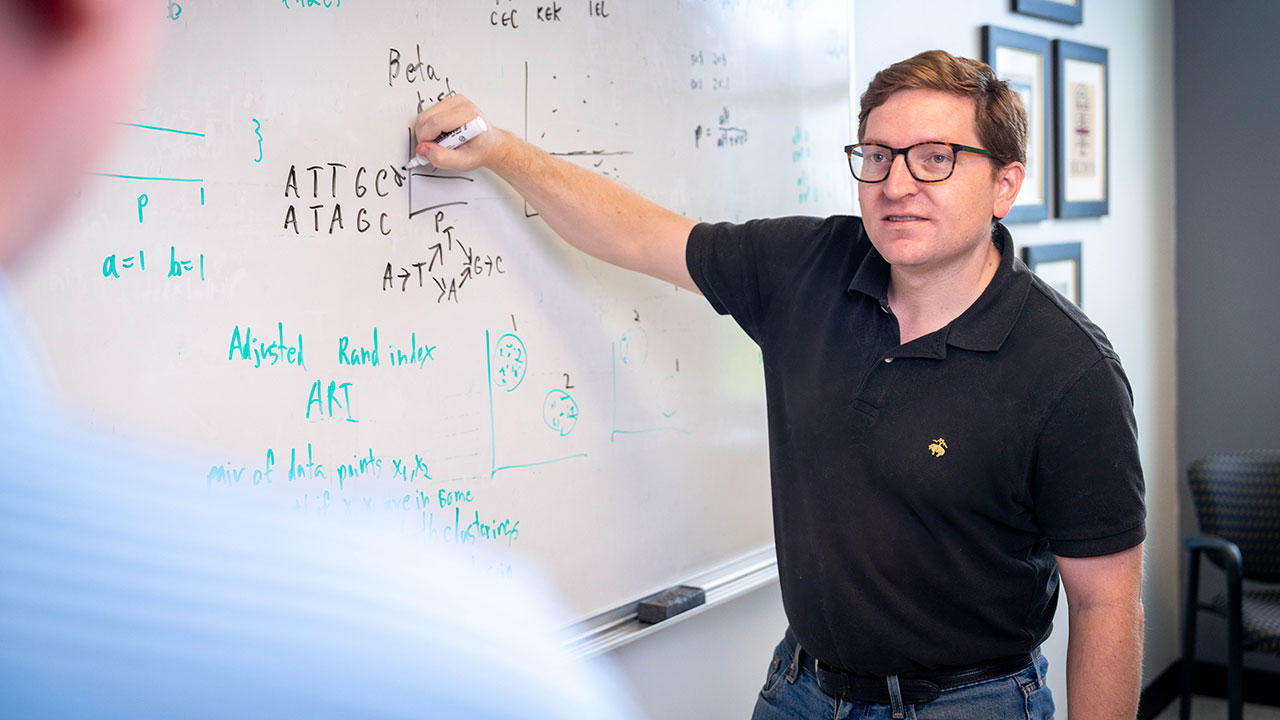
Haynes Heaton, an assistant professor in the Department of Computer Science and Software Engineering, has developed software likely to change the standard of care for leukemia patients undergoing bone marrow transplants.
By using his software, “cellector,” Dr. Heaton and fellow researchers hope to replace current diagnostics for post-bone marrow transplant relapse monitoring with single-cell RNA sequencing. Dr. Heaton and collaborators at the Fred Hutchinson Cancer Center at the University of Washington were awarded a $3.5 million grant from the National Institutes of Health for their project, “A Compass for Those With Relapsed Leukemia After Transplants.”
Single-cell RNA sequencing, created by biotechnology company 10x Genomics, is a technology revolutionizing biology. Genomics sequences RNA from each cell—attaching a DNA barcode to indicate its origin.
“It allows us to study what genes the cell is expressing, how they interact and the differentiation process,” Heaton said. “So far, single-cell RNA sequencing has been primarily used in research, but our study aims to bring this technology to the clinic as a diagnostic for leukemia cells after treatment.”
However, this data is sparse, requiring a new computational tool to accurately assign cells to individuals.
Enter cellector, which makes statistical distributions from thousands of data points. Using a beta-binomial iterative anomaly detection system, cellector accurately distinguishes donor bone marrow cells from user cells among transplant recipients to within 0.05%.
Previous methods, Dr. Heaton said, struggled to do so within 2%, making clinical decisions difficult.
“This is important because if a patient’s blood is being generated from his or her own bone marrow — their own genotype — then that person very well might be having a leukemia relapse, which is highly deadly,” Heaton said.