‘A space ecosystem on campus’: Interdisciplinary laboratory broadens Auburn's space research capabilities
Published: Aug 17, 2026 10:00 AM
By Joe McAdory
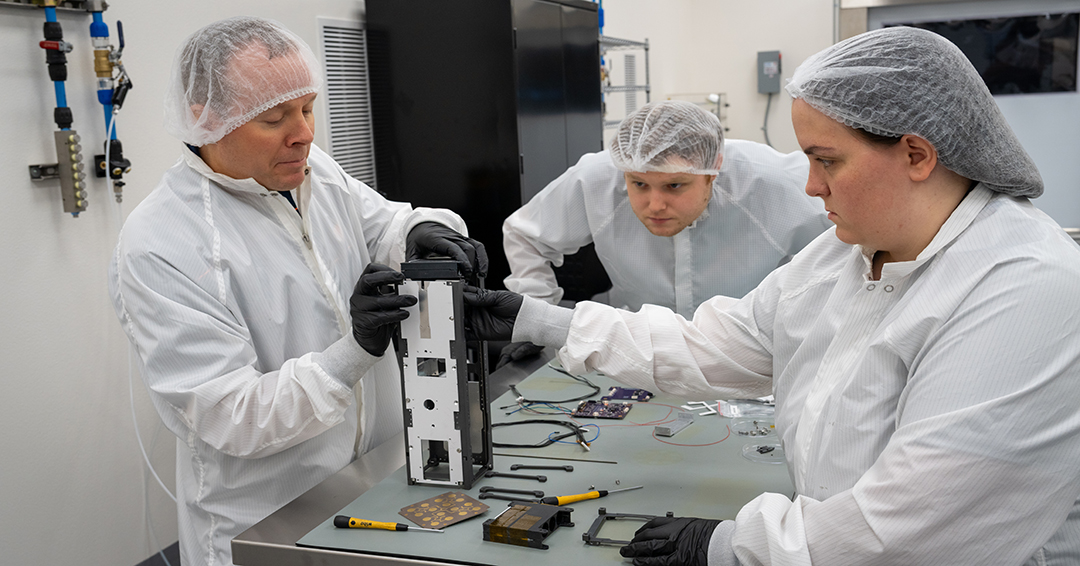 From left, Mark Adams, the Godbold Professor in electrical and computer engineering, TES research engineer Ben Colvett and research engineer Elizabeth McMeen build the framework for a satellite.
Auburn University researchers are expanding the university's presence in the space sector.
The Auburn Space Technology and Research Applications (ASTRA) program, an interdisciplinary hub for satellite development and space systems engineering, brings together satellite design, spacecraft testing, ground station operations and space technology.
“My goal is to establish a space ecosystem here on campus,” said Mark Adams, the Godbold Professor in the Department of Electrical and Computer Engineering and ASTRA principal investigator. “This is about much more than satellites. It's about creating the capability to communicate with spacecraft, conduct experiments and develop technologies that support future missions.”
Previously named the Auburn University Small Satellite Program, ASTRA will reflect its expanded scope beyond satellite building, though satellite development remains a cornerstone focus. The team has already launched four satellites and is preparing for future missions, including a planned partnership with the Department of War (DOW) expected to involve building multiple satellites over the next five years. The spacecraft will serve as testbeds for government-provided payloads and emerging technologies.
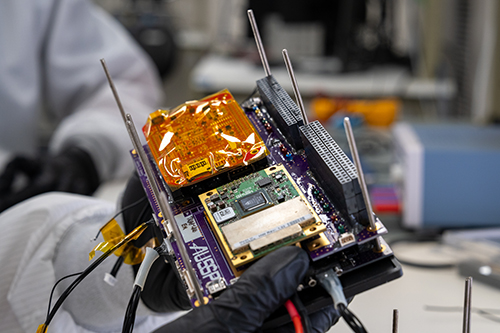
“Our partners will provide the payload they want to test, and we'll design and build a satellite around it,” said Adams, who also directs the Alabama Micro/Nano Science and Technology Center. “The satellite bus includes everything except the payload, including the power system, attitude determination and control system, onboard data handling, radios and the other subsystems that keep the satellite operating.”
Adams is joined at ASTRA by co-principal investigator Michael Fogle, the Hunt Endowed Professor in the College of Sciences and Mathematics’ Department of Physics, and research engineer Elizabeth McMeen.
“At no time have we, as a society, been more dependent on space,” said Fogle. “With that critical dependency, comes many opportunities, as well as threats. It’s our goal with programs like ASTRA to be at the forefront of innovation and research in the space domain and to help address the gaps that naturally form during rapid progress.”
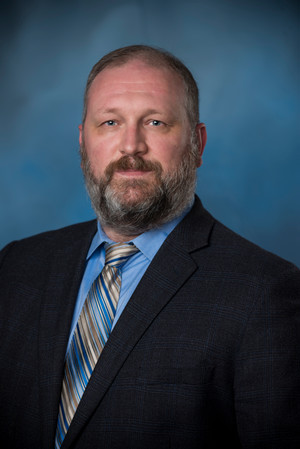
Fogle also serves as technical director of the Applied Research Institute’s new Radiation Effects Testing and Research Lab in Huntsville, where researchers will conduct radiation-effects testing on microelectronics, components, systems and payloads for space and defense applications.
“Testing is where we turn a spacecraft design into confidence that it can withstand the rigors of launch and operate as intended in space,” Fogle said. “By recreating those conditions here on the ground, we can identify problems early, reduce mission risk and give every system the best possible chance of success once it reaches orbit.”
Before a spacecraft can reach orbit, engineers must ensure it can survive the violent forces of launch and perform reliably in space. ASTRA's testing infrastructure helps researchers verify that readiness before a mission ever leaves the ground.
To recreate those conditions on the ground, the laboratory houses a vibration table capable of simulating launch conditions, a thermal-vacuum chamber that replicates the temperature extremes and vacuum of space and a three-axis Helmholtz cage that reproduces Earth's magnetic field to test spacecraft control systems.
Housed within the university’s Clean Manufacturing Laboratory in the Auburn Technology Park, ASTRA includes dedicated prototyping, assembly and testing areas connected through a clean-room environment. The arrangement allows researchers to move spacecraft through development and qualification testing without exposing them to contamination.
Adams said the lab now has a prototyping area, an assembly area and a test area.
“We can basically move from one to the other all within the clean room,” he said. “We can build two satellites simultaneously with no problem, and then we can just roll them across the hallway to do the testing."
This positions the program to support organizations beyond the university.
“There’s not many universities that have the capabilities we do,” Adams said. “We want to leverage the capabilities that we have developed over the years to provide our expertise and our services to help others.”
The laboratory plans to offer spacecraft qualification and related testing services to government agencies, universities and commercial organizations that need access to specialized facilities. Adams said Auburn's existing infrastructure creates an opportunity to support external partners while maximizing the use of equipment already required for university projects.
ASTRA is also moving into two of the most closely watched frontiers in the space industry: space-domain awareness and quantum communications. Adams said the effort to monitor and understand activity in Earth's increasingly crowded orbital environment, known as space-domain awareness, is a growing priority for the lab.
Adams said the lab is developing the tools to track that activity. “This is how we'll know what's going on up there,” he said. “We're building a mobile optical ground station, a telescope so we can go out and we can monitor the sky. That's also going to be a low-cost optical terminal for optical communications from space.”
Adams said the platform will also support future quantum communications research. ASTRA is already collaborating with Oak Ridge National Laboratory, which is developing a similar optical system for quantum applications.
“ASTRA is not just about satellites,” Adams said. “We're monitoring what’s happening in space, communicating with things in space, putting things into space and conducting experiments. We want to broaden our capabilities.
“That's how we build a space ecosystem.”
Media Contact: , jem0040@auburn.edu, 334.844.3447