Mechanical engineering professor earns award for translational research into 3D-printed orthopedic devices
Published: Aug 18, 2026 3:30 PM
By Phillip Tutor
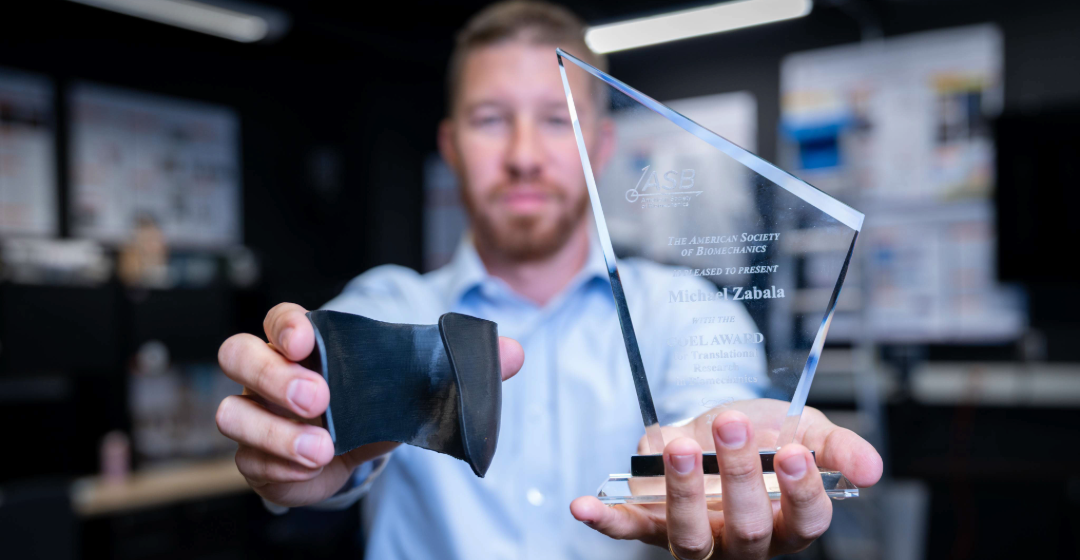 Michael Zabala displays an example of a 3D-printed orthopedic device and his Goel Award.
A novel concept developed in an Auburn Engineering lab with the aid of Auburn graduate assistants, debuted successfully with Auburn student-athletes and distributed by an Auburn-based company has earned an Auburn professor the top award in his field.
It’s the result of the emphatic connection between Auburn Engineering and Michael Zabala’s ground-breaking research into human biomechanics and custom-fit, 3D-printed orthopedic devices.
Zabala, the Auburn Alumni Engineering Council associate professor of mechanical engineering, received the Goel Award for Translational Research in Biomechanics in July from the American Society of Biomechanics (ASB). He accepted the award during the World Congress of Biomechanics in Vancouver, Canada.
An Auburn alum, Zabala embraces what he describes as the “Auburn pride” aspect of the award and the company he founded through his research, XO Armor Technologies. Roughly half of the company’s employees are Auburn graduates, he estimates.
“I am extremely honored,” Zabala said. “This award is given by the most prestigious society for the field of biomechanics. It is personally and professionally validating that they felt strongly enough about my research to provide me with this award.
“I think the company and the university are mutually benefitted — the university by having evidence of real-world impact from the research conducted on campus, and the company from having the credibility of its foundations being tied to Auburn University research.”
Given annually since 2016, the Goel Award requires winners to have demonstrated their research’s translational nature through the improvement of human health or well-being. That mandate is particularly compelling, Zabala said, because large-scale, positive impact from scientific research “is not always guaranteed.”
Since joining the Auburn Engineering faculty a decade ago, Zabala has become a national leader in combining modern technology such as 3D printing, artificial intelligence (AI), motion-capture and wearable electronic sensors with real-world biomechanical needs in medicine, athletic training and the military.
Inside the Auburn University Biomechanical Engineering Lab (AUBE Lab), which he directs, Zabala was developing a method of using materials such as polylactic acid, a biodegradable, plant-based plastic, for custom-made orthopedic devices when a moment of serendipity arrived.
It’s a well-told story in Auburn Engineering circles: In the fall of 2019, Auburn football’s head athletic trainer asked Zabala if his lab could make braces for injured players. Zabala, steeped in Auburn orange and blue, readily agreed. And that initial request for a hand brace for wide receiver Anthony Schwartz — which worked splendidly — became the fulcrum on which Zabala’s research pivoted from lab concept to industry game-changer.
The proof of feasibility was complete.
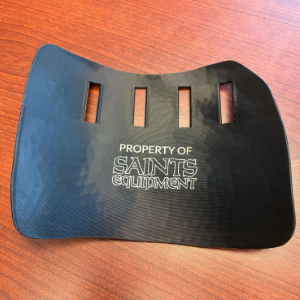
One request became two. Equipment managers and athletic trainers at other universities sought Zabala’s assistance. NFL teams called. The novel concept became an overnight success and quickly led to Zabala’s founding of XO Armor.
Instead of providing made-to-order orthopedic devices, the company now sells systems that allow teams to quickly make effective braces, pads, shoe insoles and other protective devices in house: a 3D printer, laptop, scanner, supplies and XO Armor’s proprietary software and manufacturing supplies.
The company’s list of clients includes a majority of NFL, NBA and MLB teams and an impressive array of NCAA athletic departments.
Included in Zabala’s application packet for the Goel Award were letters of recommendation from the equipment manager of the New Orleans Saints, an athletic trainer from the University of West Virginia and from Michael Goodlett, Auburn Athletics’ chief medical officer and team physician.
In essence, those recommendations placed the core of Zabala’s work in alignment with the Goel Award’s focus on improving human health through biomechanical research.
“I never would have imagined any of this,” he said. “I didn't even know I'd be back here at Auburn, much less get to contribute to Auburn football. And I never had any intention of starting a business. The need simply arose and we were able to respond.”
There is, though, so much more for XO Armor to do, Zabala believes.
Aiding injured athletes is a start. But what about creating custom-fit, 3D-printed orthotics for affected populations through partnerships with medical institutions, he wonders. Or assisting cerebral palsy patients who struggle with mobility issues? Those ideas are on his radar, too.
Both possibilities exemplify biomechanical research improving human health.
“The company is pursuing the medical application because from a business perspective, the total addressable market is much greater than sports,” Zabala said. “There are 32 NFL teams, and there are probably 32 clinics in Lee County alone that could use the technology.”
Media Contact: , pot0004@auburn.edu, 334-844-3591