

AU-led team joins AI and materials research in Genesis Mission
Published: Aug 6, 2026 10:30 AM
By Phillip Tutor
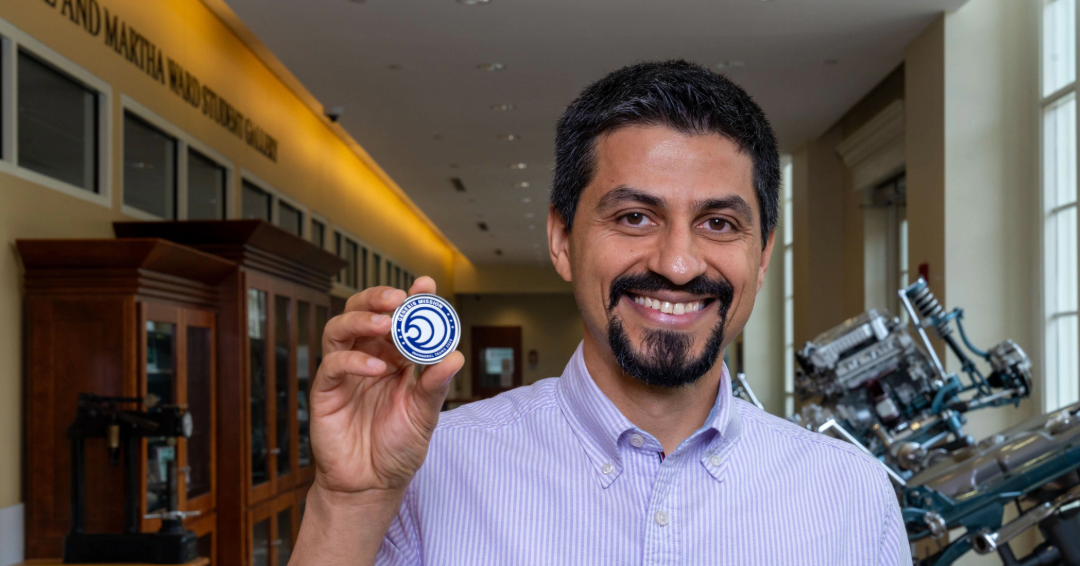 Reza Molaei holds a challenge coin given to Genesis Mission team members.
The federal government’s quest to revolutionize scientific discovery and boost innovation through artificial intelligence (AI) is giving Auburn’s Reza Molaei’s research a role in what may become a landmark endeavor.
Molaei, an assistant professor of mechanical engineering, has received funding from the Department of Energy (DOE) as part of the Genesis Mission, a White House-led effort to dramatically increase America’s scientific output and solve challenges in manufacturing, biotechnology, critical materials, nuclear energy and quantum information science.
Executive Order 14363, “Launching the Genesis Project,” which President Trump signed last November, aims to “create AI agents to test new hypotheses, automate research workflow and accelerate scientific breakthroughs.”
Molaei’s team, which includes Auburn’s Robert Jackson, a mechanical engineering professor, and colleagues from Kansas State University, Iowa State University and Oak Ridge National Laboratory, is researching three-dimensional structures made of repeating internal surfaces called triply periodic minimal surface (TPMS) structures. Engineers can create TPMS structures that offer low weight, increased strength and varying levels of energy absorption, heat transfer and fluid flow. Applications for the DOE and in biomedical fields are particularly interesting, Molaei said.
In the project, Kansas State and Iowa State researchers will concentrate on AI. Oak Ridge will handle additive manufacturing and determine the materials used, and Molaei and Jackson will lead the mechanical testing and physics-based modeling efforts.
“America has no shortage of bold ideas or talented scientists, and the response to the Genesis Mission proves that,” U.S. Secretary of Energy Chris Wright said. “The remarkable number of high-quality proposals we received demonstrates that America’s innovation pipeline is strong, and it points to even greater opportunities for future investment and continued expansion of the Genesis Mission portfolio.”
Molaei’s project was among 278 selected for the first phase of the Genesis Mission. The DOE received more than 5,000 project submissions, with fewer than 6% making the cut.
“Although this is the very first Genesis Mission call, it could be one of my biggest career accomplishments thus far,” Molaei said. “I am proud that Auburn is leading this collaboration and grateful for the opportunity to work with an outstanding team of collaborators. I hope that the Phase I effort will establish the scientific and technical foundation for a much larger Phase II project.”
Among the numerous real-world applications of the TPMS structures Molaei researches is their use in making engineering structures stronger and more resilient to failure. Improving efficiency without adding weight is a prominent goal. So, too, is demonstrating the feasibility of the team's approach and securing funding for the second phase of the Genesis Mission.
The structures, he explains, feature complex shapes and sizes that can fail when exposed to certain weights or loads. Using 3D printing technology or additive manufacturing, engineers can build the structures in myriad shapes and sizes. By making them porous, engineers can create lattice structures that are lightweight. The key is reducing weight without sacrificing strength.
“The size of the porous openings, the aspect ratio, the thickness of each of those walls, they all matter. They strongly matter,” Molaei said. “What I have been doing with my team over the past few years is designing these structures, building them and doing fatigue testing and physics-based fatigue life predictions. Our model has shown very promising predictive capability, but the problem is something else.”
Namely, there’s no realistic way to fatigue-test millions of structures for use in a variety of applications. In the project’s first phase, Molaei’s team will use AI to predict the fatigue life of TPMS structures. AI allows researchers to make predictions across design spaces that would be impossible to test experimentally.
“We are not replacing physics with AI,” he said. ”We are building on physics-based models and using AI to predict the conditions that we are not testing.”
Molaei offers surgical bone implants as an example for the structures’ real-world use.
Inserting a solid-material bone implant in a patient with a broken arm risks degradation of the bone, which tends to weaken over time. “They can't use a solid material because your bone will feel like there is something stronger there and let it carry all the load,” he said. Instead, biomedical companies “try to lower the strength of the material to match that of the bone of the patient.”
In defense and aerospace industries, engineers value TPMS structures that may improve the efficiency of vehicles and materiel. Two possibilities are prominent, Molaei said. “In things like UAVs and airplane structures, the goal is to have robust and, in the meantime, reliable equipment. One of the biggest challenges is ‘lightweighting’ the aerospace structures.”
Another example is heat exchangers — in layman’s terms, radiators. The structures’ porous design can allow airplane designers to cool engines more effectively by transferring additional heat outside the craft.
The potential uses for TPMS structures are innumerable.
“This project brings together several research directions that I have been pursuing since my Ph.D.,” Molaei said. “The Genesis Mission provides an exciting opportunity to connect those areas with artificial intelligence and to work with leading researchers at universities and a national laboratory.”
Media Contact: , pot0004@auburn.edu, 334-844-3591