

Rocketry Association withstands weather, enjoys impressive launch
Published: Aug 5, 2026 1:00 PM
By Phillip Tutor
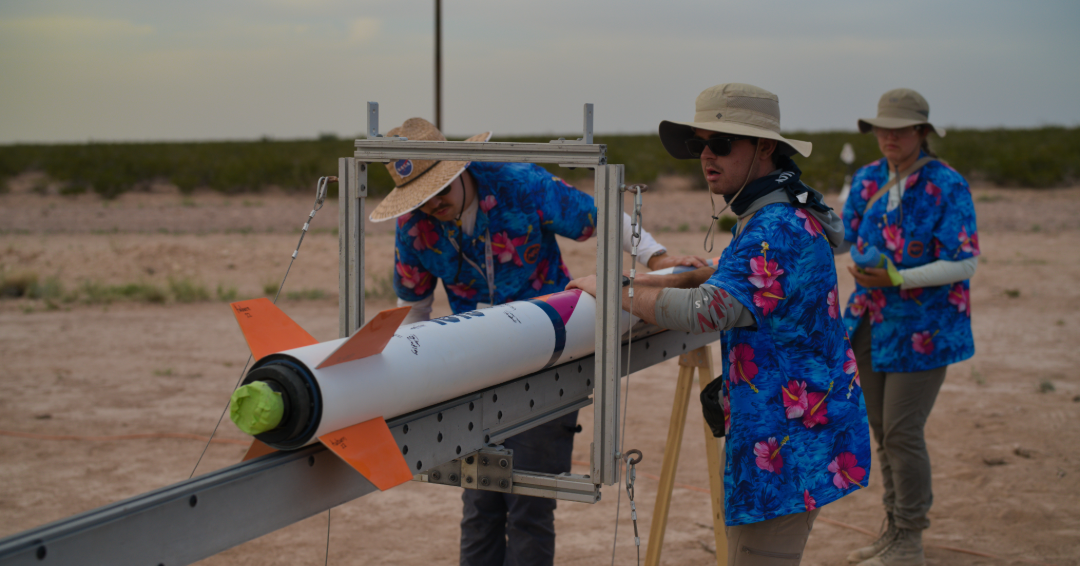 AURA team members work on their rocket at the IREC in Texas.
In early June, deep in the Permian Basin of west Texas, members of the Auburn University Rocketry Association (AURA) packed their 11-foot-long rocket into a box truck and began the 16-hour journey back home. It was quite an experience.
Brutal weather marred the 2026 International Rocket Engineering Competition (IREC), the team’s final competition this year. High winds caused frequent delays. Launch schedules became nebulous. University teams spent hours waiting for the weather to clear, for the dust storms to settle, for the OK to launch.
But AURA’s rocket flew well. The drive home was pleasant.
Launching a rocket team members named “Let It Ride,” AURA finished 25th in the 144-team competition that included squads from U.S. universities as well as entries from Thailand, Taiwan, Turkey, Italy, Australia, Canada, Mexico, Argentina, India, South Korea, Malaysia and Colombia. AURA also finished 17th in its division — 10K COTS (10,000-foot apogee with a commercial-off-the-shelf motor).
“I was happy with how it turned out,” said Elisabeth Bonnema, AURA’s recovery team leader. “Even though that Wednesday and Thursday were challenging and put us through the wringer, I couldn't be happier with how we placed and how the vehicle performed.”
With its international field and trying conditions, IREC served as a fitting culmination to AURA’s 2026 schedule. Competition in the world’s largest collegiate rocket event was as stiff as the Texas winds. Bonnema and her teammates returned to campus knowing the lessons learned will serve AURA well next year.
The biggest lesson: preparations matter.
Because the team couldn’t schedule a test flight for “Let It Ride” before heading west, AURA hoped its rocket and motor — a M2500 solid-propellant motor that featured 650 pounds of peak thrust and a burn time of 3.9 seconds — would ignite and lift the vehicle. But virgin flights are risky.
Once in Texas, the students’ trepidation rose.
“While watching some of the other flights, a few teams had the same motor as we did, and their motors exploded when they were lit,” said Abbey Ghelerter, AURA’s president. “We were afraid of that because we kept seeing bad things happen to the same motor we were using.”
“On the first launch day, there was someone who flew the same motor as us and it ‘CATO-ed’ (catastrophe on takeoff),” said Jackson Hicks, AURA’s structures team leader in Texas. “So I was nervous.”
“We were a little worried,” Bonnema said.

Two days of weather delays and scheduling headaches added to the stress. They also prevented the team from performing electronic payload tests beforehand and operating the electronics during flight. But IREC organizers finally sent AURA and two other teams — including one from the University of Alabama in Huntsville — to the launch site late on Thursday, June 18.
At 8:30 p.m., just as the sun was setting, a battery lit the nichrome wire affixed to the “Let It Ride” motor and ignited the 10 pounds of ammonium perchlorate composite propellant. AURA’s vehicle reached an altitude of 10,499 feet and a top speed of 974.5 feet per second — just under Mach 1. Overshooting the target apogee point kept AURA from finishing higher. “But we're still really happy because that's still really close,” Bonnema said. “That's a lot closer than we were last year.”
Landing proved routine. Two black-powder charges fired on schedule, the first jettisoning a small drogue parachute to slow descent to 100 feet per second so the rocket wouldn’t, as Bonnema described, “come down ballistic.” The second charge released the main parachute — an 11.5-foot diameter parachute made of orange-and-blue ripstop nylon — that dropped the rocket as designed.
“Recovery went perfectly,” Ghelerter said. “We got full points on that.”
The only post-launch hiccup was retrieval. AURA couldn’t collect “Let It Ride” because of rain and the “critters” prevalent at night, Bonnema said. An IREC representative fetched the rocket the following morning. It was wet, but otherwise in fine condition.
Back on campus, soon it will be on display in the Charles E. Davis Aerospace Engineering Hall.
“When the motor lights and you hear the big ‘whoosh,’ that's a sound like no other,” Bonnema said. “It gives me a thrill every time.”
Media Contact: , pot0004@auburn.edu, 334-844-3591