Undergraduates experience research opportunities through pair of Auburn Engineering-led summer programs
Published: Jul 29, 2026 3:45 PM
By Joe McAdory
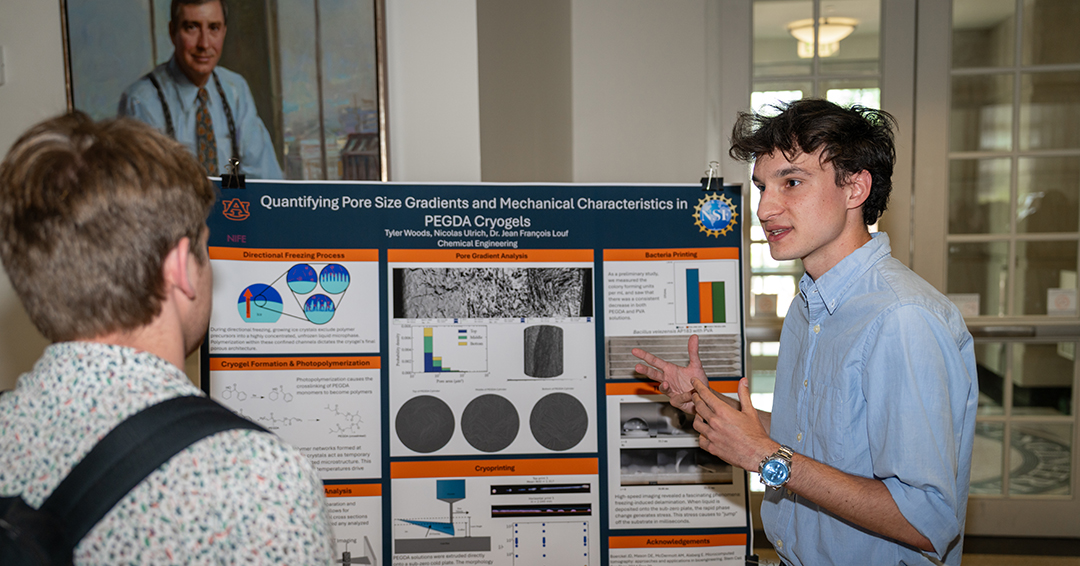 Tyler Woods, a junior in chemical engineering, explains his team's research project, "Quantifying Pore Size Gradients and Mechanical Characteristics in PEGDA Cryogels," during a poster presentation on Wednesday, July 22.
Hands-on research. Faculty mentorship. Career exploration.
That's what 33 undergraduate students from 12 universities — including Auburn — experienced at two 10-week summer research programs hosted by the Center for Polymers and Advanced Composites (CPAC) and the Department of Electrical and Computer Engineering (ECE).
What did they research? Transport phenomena. Morphing airfoils. Wearable technology. Drone detection. In-space manufacturing. Electromagnetics.
In other words, these Research Experience for Undergraduates (REU) programs weren’t your ordinary summer camps.
“Programs like these are excellent investments in students and the future of engineering,” said Dean Hendrix, associate dean for undergraduate studies and program assessment. “Students arrive curious, leave more confident and often discover career paths they hadn't considered. Whether they pursue graduate school or industry, they're better prepared to tackle the challenges our profession faces."
Hunter Burch, assistant professor of electrical and computer engineering who co-led the Summer Undergraduate Research Experience (SURE) program with ECE Assistant Professor Clint Snider, said many participants come from universities where research opportunities are limited because graduate programs do not exist.
“We can bring them in here and let them get hands-on research experience, and they take that back to their schools for the fall semester,” said Burch. “Another facet is we also have some of our students who either attend graduate school somewhere else or head directly into industry. We want them to be trained and prepared for wherever they go beyond Auburn.”
Russell Mailen, associate professor of aerospace engineering and principal investigator of the National Science Foundation-funded CPAC REU, said one of the biggest differences between undergraduate research and traditional coursework is that research rarely provides immediate answers.
“In a class, we give students assignments and say, 'You have a week to find the answer,’” he said. “Here we tell students, ‘You have 10 weeks. You might not get an answer, but you’ll keep working on it. You are setting the building blocks for beyond that first 10-week experience.’
“We hope this is a life-changing, trajectory-changing experience. We have some students barely into their engineering curricula, some entering their senior years, working on state-of-the-art research projects. This gives students an opportunity to see or preview a career in research, which may lead them down a career path they previously did not know was available to them.”
Creed Allen, a senior from Birmingham in electrical and computer engineering, spent the summer researching drone detection in Burch’s lab at Broun Hall.
“This program has helped as far as being competitive in the job market, and the assurance that I received in doing projects on my own,” he said. “I feel a lot more confident in my ability to do those things. It’s also given me insight into the kinds of industries I’d like to explore after graduation.
“Working closely with a faculty mentor on a project without a defined outcome gave me the confidence to tackle challenges on my own. It taught me how to approach a problem, figure out where to start and work toward a solution rather than waiting for someone else to provide the roadmap.”
Both programs concluded with poster presentations, where students showcased the results of their summer research before faculty members and fellow researchers. CPAC and REU participants presented together on Wednesday, June 22. CPAC’s REU cohort presented again on Thursday, June 23, at the Melton Student Center, joining the university’s CASE REU program.
SURE's poster presentation featured judges and awards. The top three presenters were, first place, Matthias McHale (Auburn), second place, Creed Allen (Auburn) and third place, Nikolas Moore (University of Florida.
“One of the most rewarding parts of the program is seeing students present their work at the end of the summer,” Burch said. “They come in with little or no research experience, and 10 weeks later they're discussing technical problems, explaining their results and answering questions like researchers. That’s a remarkable transformation.”
Media Contact: , jem0040@auburn.edu, 334.844.3447