Newly installed rheometer expands chemical engineering research capabilities
Published: Jul 1, 2026 10:30 AM
By Joe McAdory
 Negin Moaseri, a graduate student in chemical engineering, is using rheology to study the dispersion states of nanomaterials.
When Francis Mekunye fabricates microscopic devices using specialized inks, the materials experience intense forces as they pass through a tiny nozzle, forces that can dramatically change how they behave.
“3D printing involves a large amount of shear to the nanomaterial inks that we use,” said Mekunye, a graduate student and researcher in Chemical Engineering Professor Virginia Davis’ laboratory. “We need to understand how that deformation affects the material during the process.”
That understanding comes from the field of rheology or the science of how things flow. Rheology help researchers understand how soft materials ranging from aerospace composites to biomedical materials are structured and predict how they will behave during manufacturing processes such as additive manufacturing, film coating, and fiber spinning.
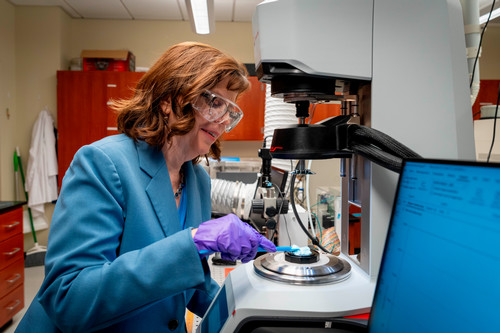
Davis' research group is internationally known for its ability to use rheology to understand self-assembly in nanomaterial inks and for connecting that understanding to manufacturing. As a result, Davis' lab was the first in the U.S. to have a new Anton Paar 503 modular compact rheometer installed.
“This is a great tool. It’s got new capabilities, and it’s redesigned with more sensitivity than the previous instruments,” said Davis, who was presented this past November with the Creative Research and Scholarship Award, among the university’s highest faculty honors, in the Sciences, Biomedical Sciences, Engineering and Agriculture category.
“This rheometer is going to help us advance our research and also give us the ability to get signals more quickly than on some of the older instrumentation.”
How does it work? Davis demonstrated the process using a small sample placed between two plates of the instrument.
“One would put the sample on this lower plate, then lower the top plate. The instrument spins the top and the sensors inside measure how fast it's moving and the torque,” Davis said, using toothpaste as a sample material. “Through mathematics and chemical engineering principles that we learn in transport phenomena, you can use those values to calculate things like viscosity or the resistance to flow or , how solid-like or liquid-like the material is.”
In practice, researchers place small samples between two precisely controlled plates. As the rheometer rotates the plates, sensors record how the material responds. Software then converts those measurements into data describing how easily the material flows and how strongly it resists deformation.
Chemical engineering graduate students in Davis’ lab are eager to use the rheometer to explore a wide range of applications. One of those students is Negin Moaseri, whose research focuses on nanocomposite materials used in aerospace applications.
“I’m working with nanomaterials like carbon and graphene oxide in epoxy, and I use rheology to study the dispersion states of those nanomaterials to have better properties like mechanical properties,” Moaseri said. “These nanocomposites can be used in aerospace applications for damage sensing and similar applications.”
Understanding how those nanoscale additives disperse and interact inside liquid epoxy before it cures is critical to achieving consistent mechanical performance, she said.
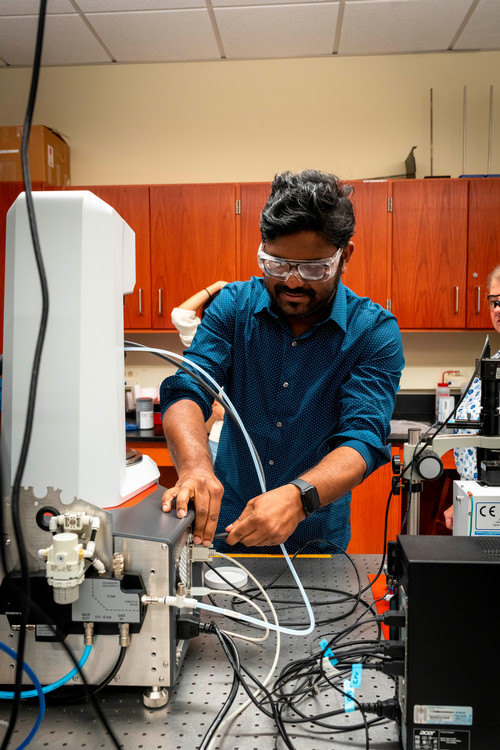
Graduate student Tanmay Rahman examines how polymers behave during recycling and processing.
“One of the main ways to understand polymer processability is understanding their melt behavior, because most polymers are processed when they are melted to give it a particular shape to make a final product like plastic bags or bottles,” he said.
Rahman also applies those techniques to hydrogels designed to mimic the mechanical behavior of biological tissues.
“Hydrogels can replicate the human cell behavior because it has elastic and viscous behaviors,” he said. “If you want to understand how the cells behave inside the body under different forces, you can replicate that by making a hydrogel and do some rheology to see how that would behave.”
Although the projects span additive manufacturing, aerospace materials and polymer recycling, Davis said they are connected by the same questions: What is a materials microstructure? How does that structure change during processing? How do those changes influence its final properties?
“What this all has in common is that we’re using rheology to understand the properties of a fluid, what we call a complex fluid, something that’s not just like water that’s going to flow readily, but something that has these viscoelastic properties,” Davis said. “The systems we’re working with are unusually complex, often multiple components… a liquid, a solid or a melt that might be changing with time. We use the rheometer to understand what the structure is at rest and then what happens as you apply shear.
“Because what we are interested in is fluid-phase manufacturing, things like coating, fiber spinning, additive manufacturing, bioprinting, asphalt, food and all these processes where the way the material flows affects what you end up with. We always talk about the structure of the starting fluid, the processing or manufacturing conditions and the final properties. Rheology helps us connect those three parts of the triangle. I started my lab with an Anton Paar rheometer 20 years ago and am excited to continue working with their excellent technical and customer support team.”
Media Contact: , jem0040@auburn.edu, 334.844.3447