Civil and environmental engineering assistant professor earns NSF CAREER Award to support adaptive foundation research for Alabama soils
Published: Jul 24, 2026 9:00 AM
By Dustin Duncan
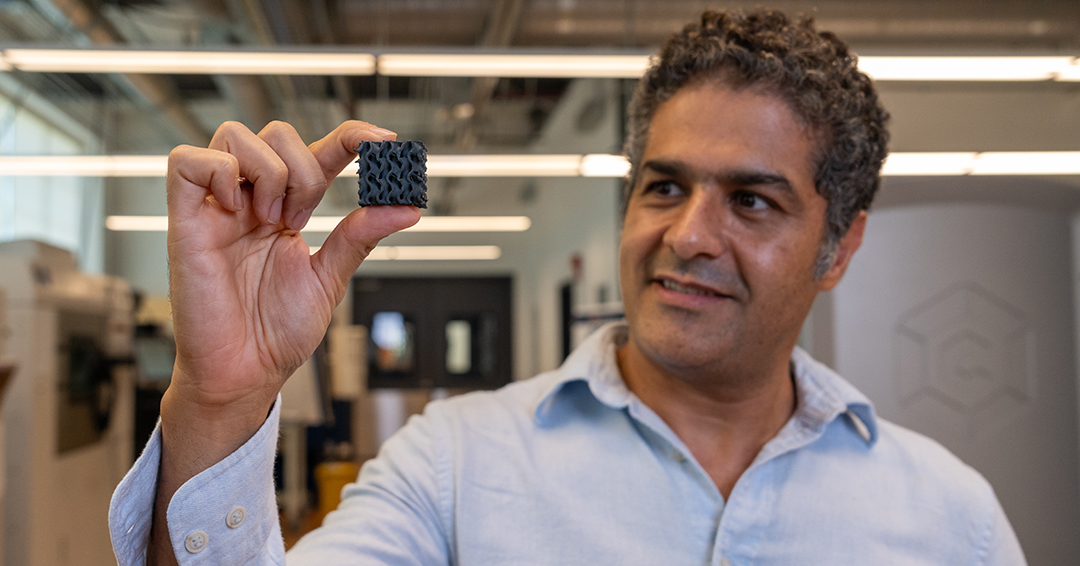 Ali Khosravi, assistant professor of civil and environmental engineering, examines a 3D-printed lattice structure similar to those his research team will test as part of an adaptive foundation system for expansive soils.
Alabama's red clay soils are excellent at retaining nutrients and resisting drought, but their expansion during wet conditions and contraction during dry periods can crack foundations, damage roads and shift underground infrastructure.
Ali Khosravi, assistant professor of civil and environmental engineering, earned a five-year, $599,940 National Science Foundation CAREER Award to combine geotechnical engineering, additive manufacturing and structural testing to develop adaptive foundation systems that accommodate soil movement before it damages structures.
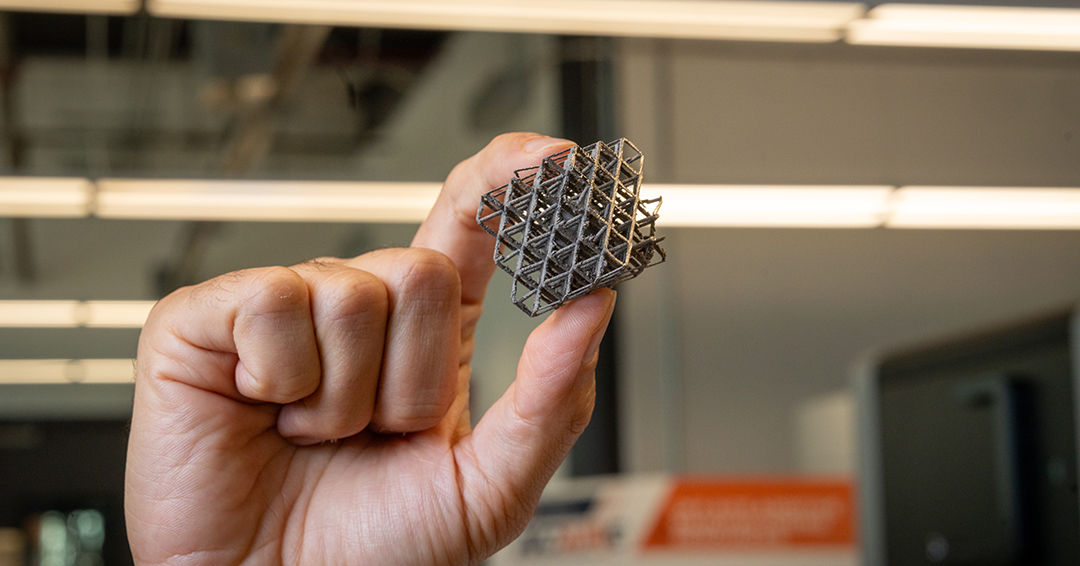
The project uses specialized 3D lattice structures to create a deformable buffer between the soil and the supported structure. The buffer changes shape in a controlled manner as the ground expands and contracts, reducing stress transferred to the structure.
Traditional approaches often rely on replacing or chemically stabilizing soil, installing moisture barriers or heavily reinforcing foundations. Those methods can be expensive or environmentally disruptive and may fail to fully adapt as moisture conditions change.
"Instead of trying to stop the soil from moving, we're asking how we can work with that movement," Khosravi said. "If we can create a system that adapts to changes in the soil, we can potentially reduce damage while making infrastructure more resilient."
Khosravi is partnering with the National Center for Additive Manufacturing Excellence (NCAME) to design and manufacture the lattice structures using advanced metal additive manufacturing techniques. Those components will then be evaluated under realistic soil conditions within the Advanced Structural Engineering Laboratory (ASEL), where Auburn's geotechnical testing facilities simulate the expansion and contraction of expansive soils.
Researchers will also use the PSX Macro CT machine, housed in Auburn Engineering's materials engineering program, to create 3D images of how the lattice structures and surrounding soil interact during testing. Those images reveal how the lattice deforms and interacts with the surrounding soil, helping researchers evaluate how stresses are distributed and validate computer models before the technology is tested at larger scales.
"The geotechnical chamber is unique to Auburn, and NCAME is one of the best additive manufacturing centers," Khosravi said. "The facilities there allow us to 3D print lattice structures in almost any size we need, and the CT machine is another unique capability that only a handful of schools have."
The research will progress from mechanical testing of the lattice structures to smaller experiments examining their interaction with expansive soil and, eventually, to full-scale testing under realistic loads and controlled soil conditions in ASEL's ECS geotechnical chamber.
Khosravi plans to use NCAME’s 3D printing capabilities to create complex lattice geometries that would be difficult or impossible to produce using conventional manufacturing methods. Rather than developing a new material, Khosravi's team is engineering the geometry of the lattice, enabling it to change shape under pressure while supporting the structure above.
"3D printing gives us the ability to try different approaches, using different shapes and materials to see what's the best approach to deal with this problem," Khosravi said.
As expansive soils swell, the engineered lattice compresses to absorb much of the resulting force before it reaches the foundation. When the soil dries and contracts, the lattice returns to its original shape, allowing the system to withstand repeated cycles of expansion and shrinkage. Khosravi said the approach represents one of the first efforts to use additive manufacturing to create adaptive lattice systems specifically for geotechnical applications.
The CAREER Award also supports an educational program that will provide undergraduate research opportunities, establish a graduate course featuring experts from multiple universities and expand K-12 outreach through hands-on demonstrations that help students visualize how expansive soils behave beneath the ground.
Additionally, the project gives Khosravi an opportunity to address a problem that affects communities across Alabama.
"I live in Alabama, and you always want to serve the society you're living in," Khosravi said. "Many people, especially in rural areas, are dealing with this problem. If we can come up with a solution, that's something I'm really excited about."
Media Contact: , dzd0065@auburn.edu, 334-844-2326