

Aerospace engineering student receives national award, fellowship
Published: Jul 30, 2026 11:40 AM
By Phillip Tutor
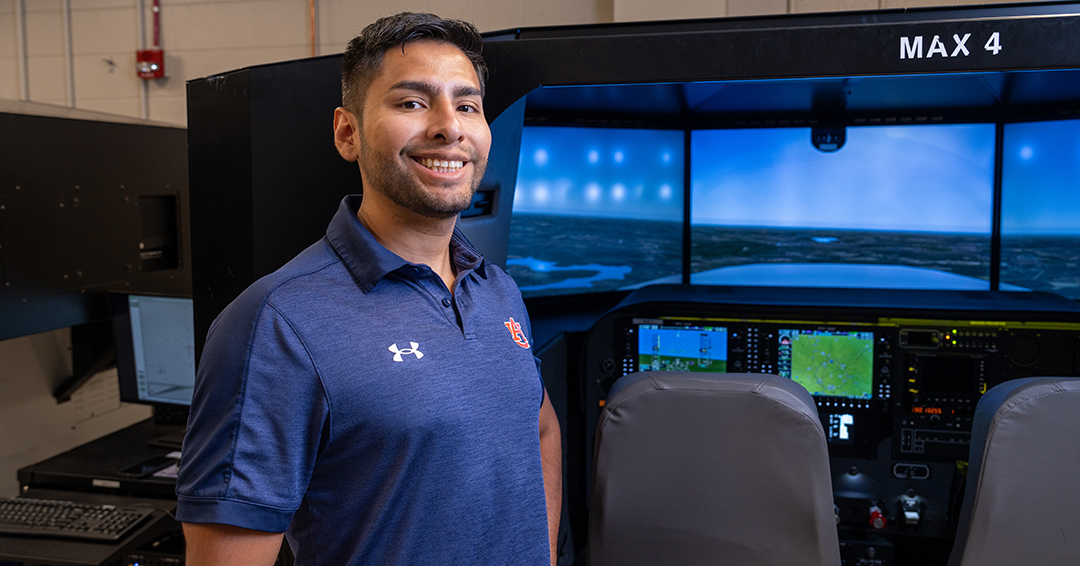 Luis Alarcon-Aneiva is researching ways to improve flight training for pilots and instructors.
The day may come when Luis Alarcon-Aneiva ascends toward the clouds, piloting an airplane above his native Bolivia or across America’s vastness.
But for now, his focus is on ground level: researching ways to dramatically improve training methods used by flight instructors and student pilots.
An Auburn aerospace engineering Ph.D. student, Alarcon-Aneiva received a double dose of heralded academic honors earlier this summer: the William T. Piper Sr. General Aviation Systems Graduate Student Award, given by the American Institute of Aeronautics and Astronautics (AIAA), and The Link Foundation’s Modelling, Simulation and Training Fellowship.
Alarcon-Aneiva isn’t prone to brag, but he does allow a polite smile.
“It has been a good year for me,” he said.
Named after William T. Piper, founder of the Piper Aircraft Corporation, the Piper Graduate Student Award recognizes graduate student members of the AIAA who are conducting outstanding research in the air and space sciences. Alarcon-Aneiva and Aayush Bhattarai, who won the award in 2025, have given Auburn Engineering back-to-back Piper Award winners.
Through significant financial and academic support, the Link Foundation fellowship offers qualified doctoral students opportunities to continue their research full time into flight simulation and training. The foundation was established by Edwin A. Link, of Binghamton, New York, whose 1929 creation of the first successful flight simulator revolutionized flight training, particularly for military pilots during World War II.
With its emphasis on simulation and training, the Link Foundation fellowship is uniquely matched with Alarcon-Aneiva’s research in Auburn’s high-tech Aviation/Engineering Operations Analysis Lab. Inside the Davis Hall research space, led by Nicoletta Fala, an assistant professor of aerospace engineering and a licensed pilot, Alarcon-Aneiva is searching for ways to improve flight training methods through virtual reality and real-time diagnostics.
Fala is an unabashed supporter of Alarcon-Aneiva and his laboratory leadership. When Fala brought her lab to Auburn from Oklahoma State University, Alarcon-Aneiva, then an OSU student, followed her from Stillwater and continued to work and learn under her tutelage. He has since earned his master’s degree in aerospace engineering from Auburn. “He’s a perfectionist,” Fala said. “He’s pretty great.
“I was really happy he got (the fellowship) because it's a testament that his research matters. It's going to be good for him so he can focus on his research, getting his thesis written and publishing papers. He doesn't have to do anything else.”
Put broadly, Fala describes Alarcon-Aneiva’s work as an attempt to solve the riddle of “bottlenecks” that are adversely affecting the flight training industry. It’s a case of too many student pilots and too few qualified flight instructors who “as soon as they have their experience, they go to the airlines.” The cost of traditional flight training — in the cockpit, with an instructor, for hundreds of hours — is also an expensive burden.
“His particular focus is on developing scoring algorithms,” Fala said. “If a student is flying a maneuver in the airplane, the instructor will say, ‘that was good’ or ‘that was not good; improve X or Y.’ Luis is trying to quantify that so we can track improvements.”
Specifically, Alarcon-Aneiva is researching steep-turn maneuvers that require specific thresholds and pinpoint precision. The goal, Fala said, is to help flight instructors score those maneuvers and track student pilots’ improvements over time, as well as quickly identifying deficiencies that need correction.
“The way to improve flight training is to use the available data in the flight lessons,” Alarcon-Aneiva said. “The instructors can say, ‘the data is telling me that you flew this kind of maneuver and you have to improve this here, here and here.’ The pilot can give feedback to the student pilot on mistakes so they can see where they can improve.”
The lab is also providing Alarcon-Aneiva opportunities to explore the use of virtual reality and mixed reality headsets in flight training. The advantages the headsets provide mix advanced technology with cost savings. “He's trying to develop tools that will help us remove burdens from the instructor, but also provide students with more outsourced ways to prepare,” Fala said.
For student pilots, the ability to practice and train at home with virtual reality headsets is a win-win, Fala said, “so that when you meet your instructor in the airplane — when you're actually paying a lot of money — you're already prepared. You're not going to waste time.”
Alarcon-Aneiva isn’t wasting his time, either. He chose to study aerospace engineering because of the academic rigor and the challenge of learning how flight training schools operated. He’s now dedicated to improving the way flight instructors interact with and train student pilots.
Soon, he’ll welcome another challenge.
“One of my goals after I get my Ph.D. is to get my private pilot’s license,” he said. “I know the theory. I know how an aircraft flies. I know the flight dynamics of the aircraft, but I want to be there flying it.”
Media Contact: , pot0004@auburn.edu, 334-844-3591