Tiny Steps, Big Discovery: Auburn materials engineers make high-profile breakthrough in nanophotonics
Published: Feb 5, 2026 8:00 AM
By Jeremy Henderson
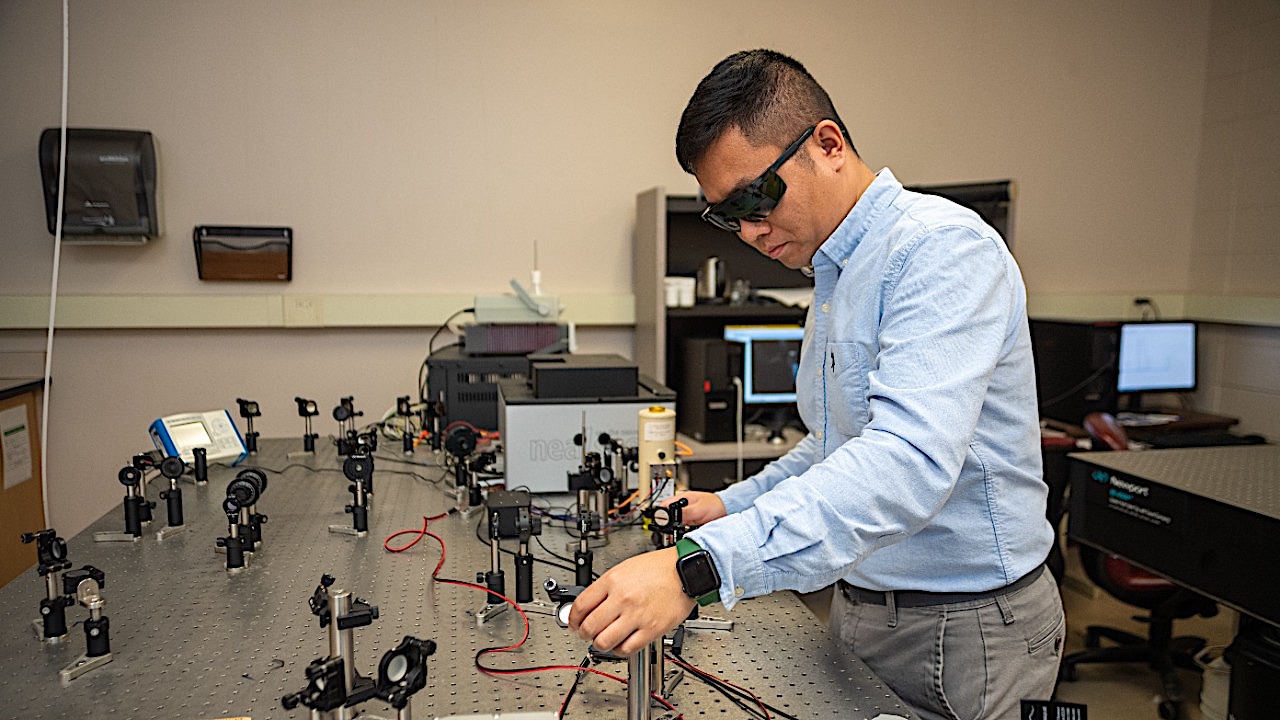 Siyuan Dai (pictured) leads an Auburn materials engineering team whose breakthrough nanophotonics research was recently published in the prestigious journal Nature Communications.
The National Science Foundation (NSF) continues to back the nation’s elite materials engineering programs as they plumb the depths of polaritons for nanoscale novelties that could support transformative technologies. Polaritons, quasiparticles which combine light and matter, are central to investigations into light's curious interactions with 2D materials that are practically invisible. Those investigations are known as nanophotonics, and researchers in Auburn's Materials Research and Education Center are revolutionizing the growing discipline one small step at a time — literally.
Thanks to significant NSF funding over the past five years, a research group led by Siyuan Dai, McWane Associate Professor in the Department of Mechanical Engineering, has developed a method for maneuvering and manipulating light by sculpting tiny staircases (called van der Waals terraces) that are thousands of times smaller than the width of a human hair.
"Our work shows, for the first time, that we can intentionally convert one wave into another, creating new ways to route and process light on extremely small scales," Dai said.
That kind of microscopic mastery is key to unlocking a polariton's potential for next-generation applications in everything from ultra-small optical circuits and highly sensitive chemical and biological sensors to advanced imaging tools and quantum computing.
But for such a small task — polaritons only operate in extremely thin materials, only several atoms thick — it was no small task.
"Until now, different types of nanoscale light waves inside these materials behaved like separate channels that could not easily interact," Dai said. "But we've discovered that simple step-shaped edges can act as powerful converters for light waves, scattering them in a precise way that changes their character. Using a specialized infrared microscope that can see details as small as 10 nanometers, we observed this conversion happening in real space."
Dai's team is now combining new physics, precise nanofabrication and advanced imaging to visualize how light waves transform and interfere with each other in ways previously undetectable.
“It was exciting to directly image how these light waves change when they encounter the step structures," said Byung-Il Noh, a doctoral candidate working in Dai's Nano-Optics and Light-Matter Interaction Lab. "Seeing the patterns appear so clearly confirmed that we were observing a new physical effect."
The breakthrough’s promise for moving the nano-light needle was more than enough for inclusion in Nature Communications, a highly prestigious journal known for promoting high-quality, high-impact research that advances the natural sciences. A paper on the phenomenon authored by Dai's team was published in the journal's December 2025 issue. In addition to Dai and Noh, authors included Pengyu Chen, Francis Family Associate Professor in the Department of Mechanical Engineering, and graduate teaching assistants Mingyuan Chen, Jialiang Shen and Lang Zhou; mechanical engineering faculty from the University of Houston and chemical engineering faculty from Kansas State University also contributed.
“This platform gives us powerful control over nanoscale light propagation,” Noh said. “Being able to directly see and control these waves helps us understand how light behaves inside quantum materials and opens new possibilities for future optical and quantum technologies.”