Graduate student in electrical and computer engineering becomes first AU winner of prestigious research paper competition
Published: Feb 2, 2026 8:30 AM
By Joe McAdory
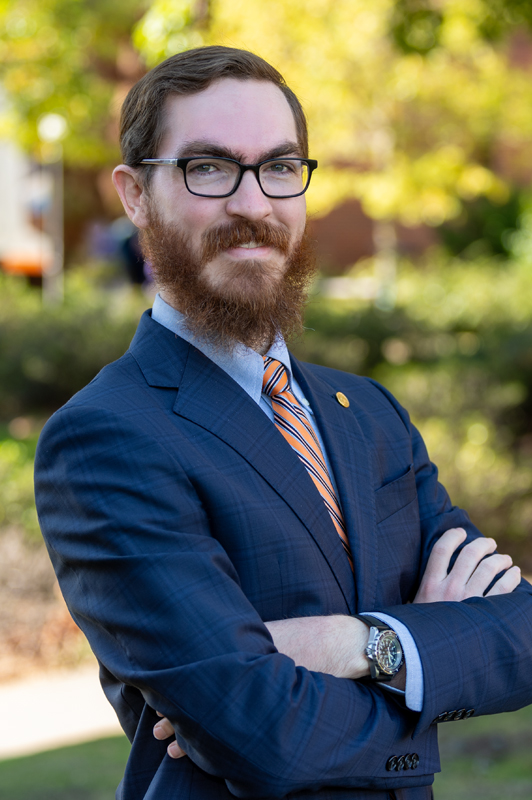
Mason Matrazzo, a first-year graduate student in the Department of Electrical and Computer Engineering (ECE), is the first Auburn University student to win the Ernest K. Smith Student Paper Competition.
Part of the National Radio Science Meeting, the competition was held Jan. 6–9 in Boulder, Colorado. The meeting was co-sponsored by the Institute of Electrical and Electronics Engineers Antennas and Propagation Society and the National Academies of Science, Engineeing and Medicine and organized by the U.S. National Committee for the International Union of Radio Science.
His study, “Parametric Modeling and Analysis of Lightning Sferic Waveforms for D-Region Remote Sensing,” demonstrated how radio waves generated by lightning can be used to track changes in the lowest region of the ionosphere — a layer of the atmosphere that affects long-distance communication.
This work could help scientists better determine the way the ionosphere varies over time and space, enhancing the understanding and prediction of how critical communication systems are affected by changes, including space weather events such as solar flares.
“When you have a lightning strike, it emits light, obviously, because you can see that. But it also will emit radio wave emissions over a wide range of frequencies,” said Matrazzo, who earned a bachelor’s degree in wireless engineering from Auburn in 2025 and is now a first-year graduate student mentored by Hunter Burch, assistant professor in the Department of Electrical and Computer Engineering and the department’s graduate program officer.
“Most of these emissions are concentrated in the very low frequency spectrum. The cool thing about those waves is when they propagate out from the lightning strike, they bounce back and forth between the Earth’s surface and a particular layer of the ionosphere and they’ll travel long distances. As those waveforms bounce along, their characteristics change based on the characteristics of the ionosphere that they’re interacting with, and you can look at those changes and infer what’s happening in that region of the atmosphere.”
Matrazzo’s prize was part of a strong week at the National Radio Science Meeting for Auburn engineering. The college sent 12 researchers, presenting 10 papers across three research areas focused on electromagnetic fields, ionospheric radio propagation and plasma waves.
Clint Snider, assistant professor of electrical and computer engineering, was elected an associate member of a technical commission focused on fields and waves and chaired a session on numerical methods for electromagnetic fields.
ECE students from Burch’s lab group attending the conference included graduate students Quinn Hunter-Gilbert, Grayson Shoub, Spencer Plep, Benjamin Smith and senior Christopher Latham. Attending from Snider’s lab group were graduate students Steven Perry, Henry Nance and Zachary Gayford.
Burch, who also serves as the department’s graduate program officer, was elected a full member and secretary of a commission focused on ionospheric radio and propagation for a three-year term and co-chaired a session on active experiments in ionospheric radio.
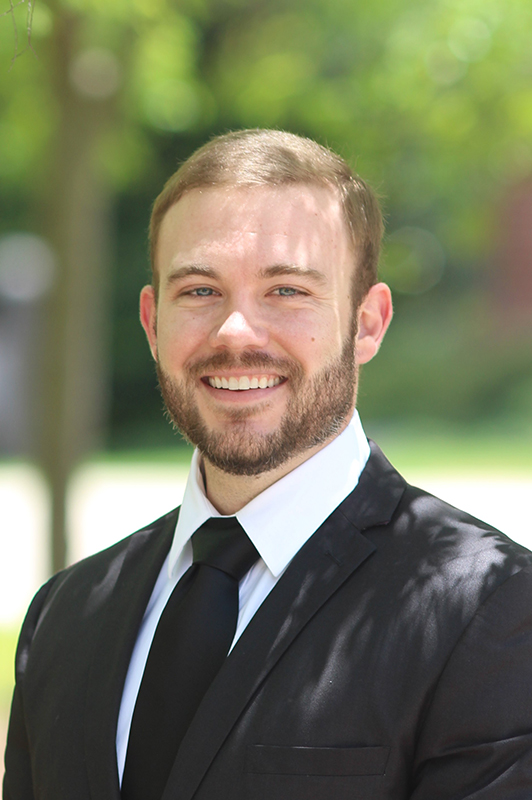
“Each of our students worked hard for this meeting and represented themselves and Auburn well on the national stage,” Burch said.
“We were also very excited to see Mason recognized. I was probably more excited than even he was, because for me this is recognition not just of his hard work and talent but also the quality of the research and education in our program. The fact that a first-year graduate student can compete against top schools and win at the national level says a lot of good things about him and it says a lot of good things about what we're doing here at Auburn.”
Media Contact: , jem0040@auburn.edu, 334.844.3447
Mason Matrazzo's paper, “Parametric Modeling and Analysis of Lightning Sferic Waveforms for D-Region Remote Sensing,” demonstrated how radio waves generated by lightning can be used to track changes in the lowest region of the ionosphere.