

Graduate student in computer science and software engineering designs the world's largest Urdo language model
Published: Jan 26, 2026 8:05 AM
By Joe McAdory
Urdu is spoken by more than 230 million people worldwide but remains poorly supported by artificial intelligence (AI).
Until now.
Taimoor Hassan, a second-year graduate student in the Department of Computer Science and Software Engineering, developed Qalb, the world’s largest Large Language Model (LLM) exclusively for the Urdu language, which generates fluent, natural and instruction-following responses.
Qalb — Arabic for “heart” — fills a critical void by giving Urdu speakers, including millions across South Asia, access to advanced language models with a reliability previously reserved for English users.
Rather than dispersing its training across dozens of languages, Qalb was built on an Urdu‑only dataset. That singular focus allows the model to internalize the linguistic nuance, idioms, and structural complexity that general-purpose systems routinely miss, resulting in a level of precision and cultural alignment that finally meets the needs of native Urdu speakers.
Goodbye, Chat-GPT. Hello, Qalb.
“An Urdu-only model enables fluent, contextually appropriate text generation that native speakers find natural something multilingual models can't do because they spread training data thin across many languages,” said Hassan, a serial entrepreneur with a track record of 15 startups and 13 acquisitions. “Qalb can capture Urdu's unique script, morphology and literary traditions by dedicating an extensive Urdu-only training dataset to the language, whereas general multilingual models lack sufficient exposure to truly master these nuances.”
The training data was curated across multiple domains to ensure the LLM could perform reliably across a range of real-world contexts.
“The decision to build Qalb exclusively for Urdu stemmed from a fundamental insight,” said Hassan, who also works as a software engineering and app developer at the Startup Studio, a university‑run creative agency embedded inside the Harbert College of Business' Horton-Hardgrave Hall that functions like an in‑house design and branding shop for early‑stage companies. “We trained Qalb on seven different niches/categories, including poetry, government data, local educational books, news sources, etc., to make it precise. This is a foundational model and is designed to support local businesses, startups, educational platforms, digital services and voice-based AI agents, you name it.”
Hassan’s creation has drawn international media attention, particularly from outlets covering technology and innovation in South Asia, including Arab News Pakistan, Geo News and The Nation-Pakistan, among others.
“What makes this special for me is that it wasn’t backed by funding. No grants. No sponsors. Just my own savings, time and good friends... all built to give back to the community opensource and keep it accessible for everyone. That’s success for me.”
Media Contact: , jem0040@auburn.edu, 334.844.3447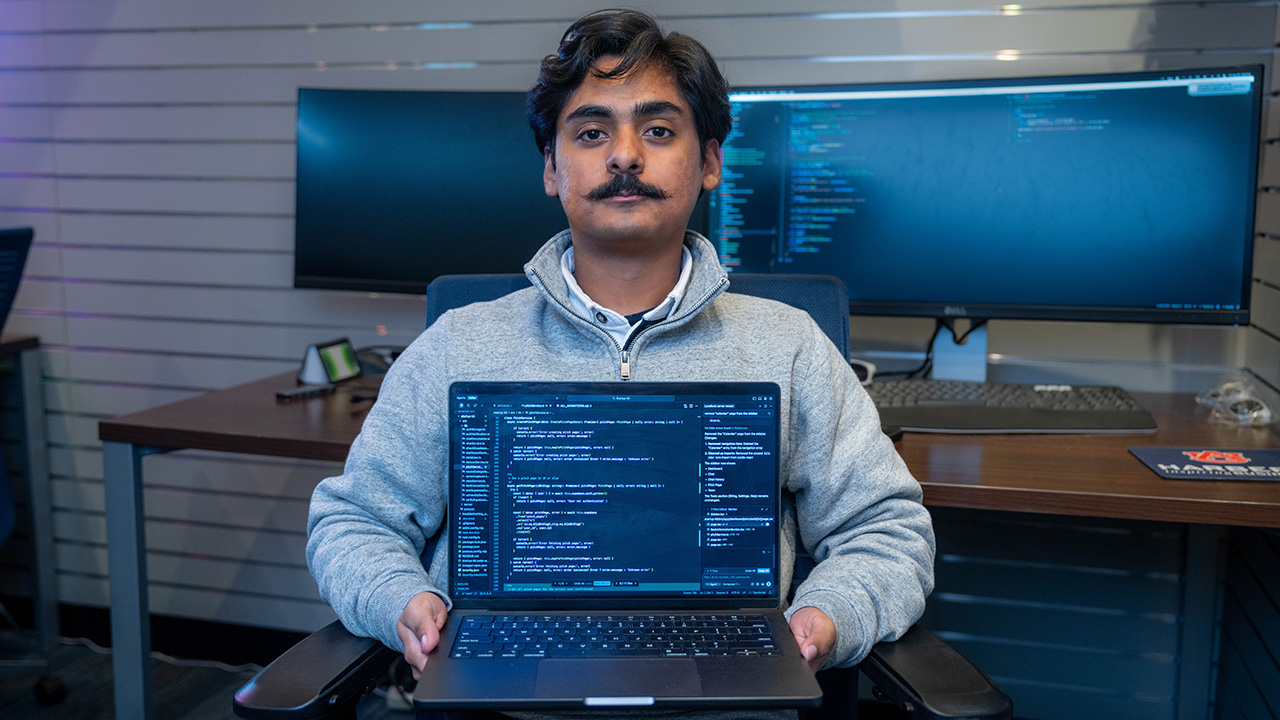
Taimoor Hassan is a second-year graduate student in the Department of Computer Science and Software Engineering.