

ISE professor awarded Toyota grant for vehicle interface study
Published: Sep 11, 2025 10:10 AM
By Carla Nelson
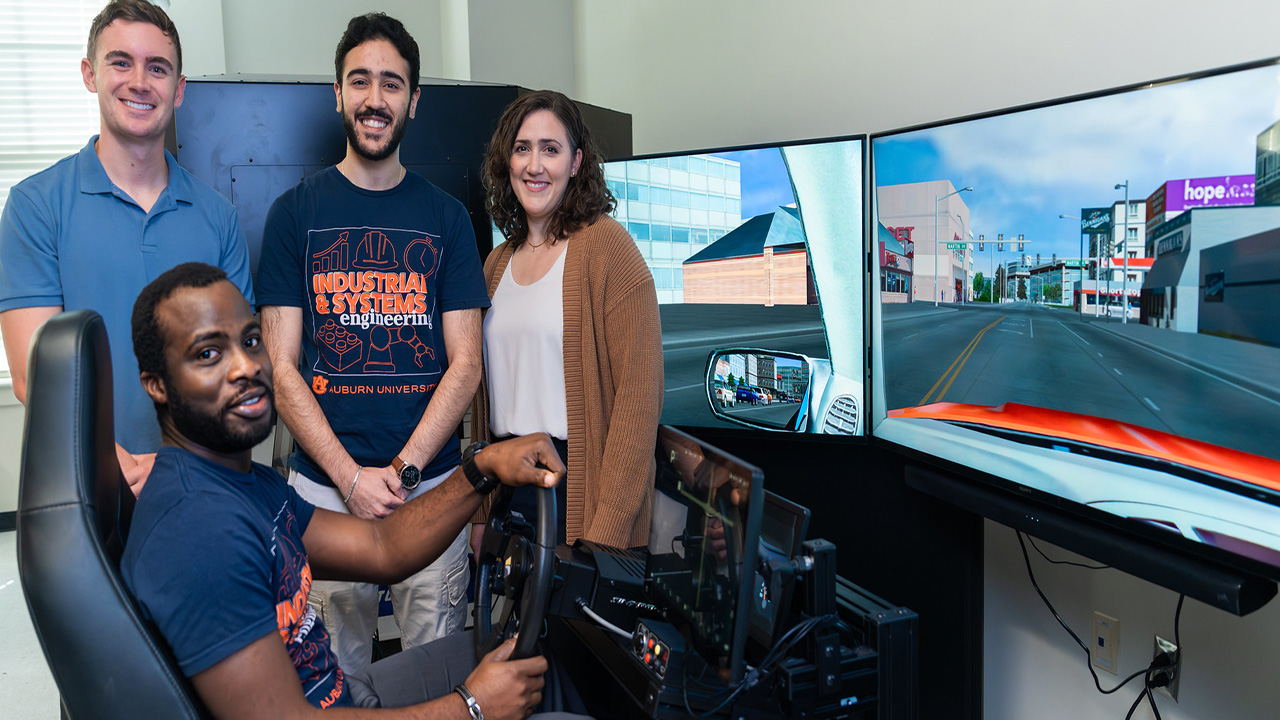 From left to right: Graduate students Weiss O'Connor, Malek Jaber, Assistant Professor Missie Smith, and graduate student Anthony Omoniyi working with the driving simulator.
Missie Smith, assistant professor in Auburn University’s Department of Industrial and Systems Engineering and the Center for Occupational Safety, Ergonomics, and Injury Prevention (OSEIP), has been awarded a nearly $100K research grant from Toyota’s Collaborative Safety Research Center (CSRC) to study the attentional demands of in-vehicle interfaces.
The research aims to develop a conceptual framework to guide in-vehicle interface design and enable a structured allocation of functions across different input types.
“We are seeing more and more touchscreens in cars,” Smith said. “We have capabilities for screens and different buttons, but we also know there are downsides to both. So, this research is about balancing how many buttons we should have to optimize for human capabilities and also deciding which functions should be accessible by button versus touchscreen.”
Smith cited a vehicle’s navigation map as an example of a function well-suited to a touchscreen display, while noting that amenities such as radio volume and air conditioning controls are often better managed through knobs or buttons.
In March 2024, the European New Car Assessment Program (EuroNCAP) announced that starting in January 2026, automakers must include physical controls for certain driving functions to earn a five-star safety rating. The new rules are intended to encourage manufacturers to use buttons, knobs or stalks to control essential tasks such as hazard lights, turn signals, windshield wipers and the horn. The EuroNCAP cited research showing that touchscreens can distract drivers and force them to take their eyes off the road for extended periods, increasing the risk of crashes. The program also reported that tactile buttons are faster and safer to use while driving.
“Touchscreens and buttons both have positive and negative aspects,” Smith said. “There’s a movement that vehicles can’t rely entirely on touchscreens, but nobody has really developed a systematic method for deciding how to allocate functions between different types of inputs for drivers.”
Smith’s research, which is funded through December, includes three phases: a systematic review of existing research, a task analysis of five current vehicle models and a user study conducted in a driving simulator.
“There are three major types of distraction: cognitive, manual and visual,” Smith said. “Up until now, decisions about interface design have mostly been made individually, and we hope this research produces ideas that might improve both the functionality and safety.”
John K. Lenneman, senior principal research scientist at CSRC, met Smith at a conference, where they discussed her background in industry and academia. He said she demonstrated a deep understanding of how research should be conducted to effectively support product development.
“Her proposal was professional and comprehensive, clearly articulating the relevance of theory and its application in providing guidance and insights to engineers as they strive to develop innovative products for end-users,” Lenneman said.
Lenneman noted that as new features and functions are incorporated into vehicles, it is essential to identify methods for integrating them into human-machine interfaces (HMIs) that minimize driver distraction while optimizing task performance. All CSRC research findings are published and shared with the broader scientific community to benefit others.
“We hope the outcomes of this work help inform the future development of HMIs for current and emerging in-vehicle features, including audio and climate controls, as well as advanced driver assistance systems and vehicle automation technologies,” Lenneman said. “We encourage anyone to use the insights from this research to enhance their product development processes, with the hope that it will ultimately benefit society as a whole.”
Media Contact: , carla@auburn.edu, 3347400221
