Auburn Engineering researchers advance to Stage 2 of NIH/NCATS Quantum Sensing Technology Challenge
Published: Aug 18, 2025 8:00 AM
By Joe McAdory
Traditional imaging techniques face fundamental limitations when it comes to detecting disease-related proteins on exosomes — nanoscale extracellular vesicles that serve as critical messengers between cells. Two Auburn Engineering researchers, however, have a solution.
Electrical and Computer Engineering Assistant Professor Zihe Gao and Pengyu Chen, the Francis Family Associate Professor and Ginn Faculty Achievement Fellow in materials engineering, collaborated to develop a novel imaging technique that merges quantum dot-based biosensing with quantum correlation imaging, enabling precise analysis of surface protein markers on individual exosomes. Their method reveals molecular-level details once hidden, including potential tumor-derived indicators that are critical for cancer detection, immune profiling and treatment monitoring.
A panel of technical reviewers recognized the strength of their work and selected it as one of just 10 nationwide to win $20,000 in research funding and advance to Stage 2 of the National Institutes of Health (NIH)/National Center for Advancing Translational Sciences Quantum Sensing Technology Challenge.
“We're incredibly honored,” Gao said. “Not only is this a validation of our research groups’ quality, but it also exemplifies the strength interdisciplinary collaboration between materials science and electrical and computer engineering.”
The Quantum Sensing Technology Challenge aims to address the limitations in technological development and adoption of quantum-enabled sensing technologies to solve translational biomedical problems. By leveraging quantum mechanical phenomena, these approaches are expected to outperform traditional methods and ultimately lead to better diagnostics, detection, and drug discovery tools, and better patient care.
Traditional imaging faces an insurmountable physical barrier: at 300 to 700 nanometers, visible light cannot resolve the proteins on these cellular messengers that could hold keys to early disease detection.
“Today’s imaging technologies can't resolve these structures because the surface proteins on these vesicles are much smaller than the wavelength of visible light,” said Chen, whose $1.9 million NIH grant in 2019 to develop next-generation rapid diagnostic tools for the health care industry was the single-largest NIH award in college history. “Previously, we couldn't resolve this level of detail. Now, with quantum imaging, we can.”
Chen said by attaching quantum dots to specific antibodies, they can target and visualize different exosomal proteins with unprecedented precision.
“For example, one surface protein might be labeled with a red-emitting quantum dot, and another can be tagged with a green-emitting dot,” Chen said. “Our imaging technique can simultaneously distinguish and quantify these biomarkers, nanometers, even on vesicles as small as 200 nanometers, enabling precise molecular profiling beyond the reach of conventional microscopy.”
Gao's quantum optics laboratory provides the technological foundation that makes this breakthrough possible. His research group works with chip-based devices that generate entangled photons and single-photon emitters – quantum light sources that operate according to principles fundamentally different from classical light and the characterization of these quantum emitters.
"The quantum correlation of these non-classical light sources arises from the quantization of electromagnetic fields, which can only be explained using quantum mechanics," Gao said. “The technology requires extreme precision. Experiments are conducted in completely dark environments using cameras capable of detecting individual photons, capturing at least a million images to extract quantum behavior patterns."
The implications for cancer research are profound. Exosomes released by cancer cells carry biological breadcrumbs that could signal disease long before symptoms appear.
“Vesicles released by cancer cells contain specific molecular fingerprints from their originating cells,” Chen said. "With our technique, we can detect and analyze these proteins at the single-vesicle level. By identifying and differentiating these proteins with quantum precision, we can obtain unprecedented insight into cellular behavior and health status.”
Gao said the recognition comes at a pivotal moment for quantum biomedical applications.
“Quantum optics itself isn't new but applying it to disease detection and treatment is very timely,” he said. “The research community is eager to see more in this area.”
Next steps for the team include building a working prototype and submitting a progress report by April 27, 2026. Five of the top-performing teams from Stage 2 will each receive $150,000 to move on to the final milestone stage, where one grand prize of $400,000 and a runner-up prize of $250,000 will be awarded.
“We're confident in our technology and are committed to delivering a robust quantum-enabled sensing platform within the one-year timeframe,” Chen said.
Media Contact: , jem0040@auburn.edu, 334.844.3447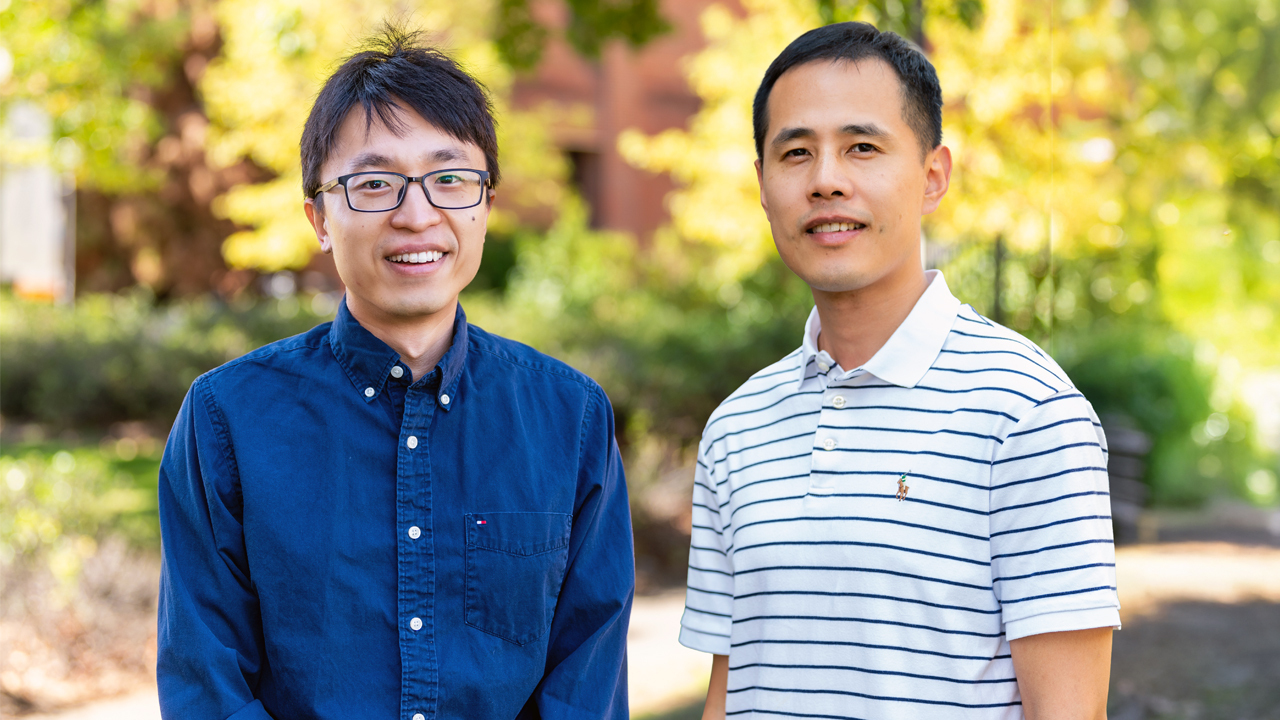
Zihe Gao, left, and Pengyu Chen are pioneering quantum imaging techniques to reveal hidden molecular details on exosomes—tiny cellular messengers—advancing cancer detection and earning national recognition in the NIH Quantum Sensing Technology Challenge.