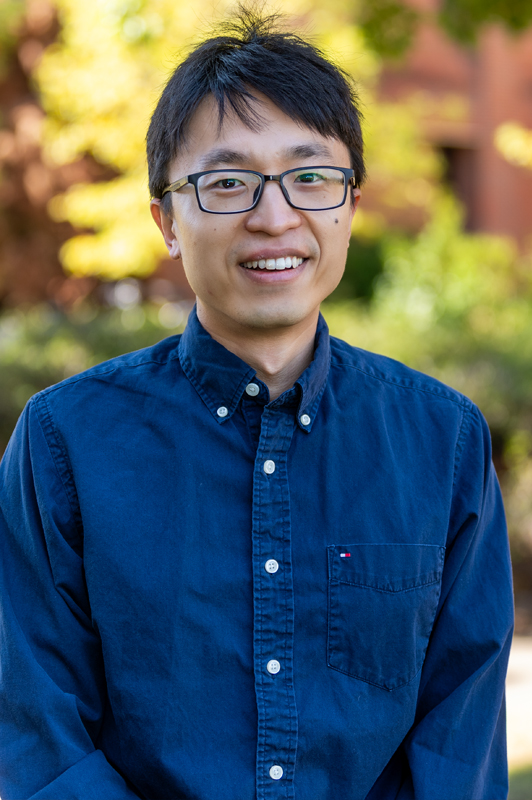
SURE program provides undergraduates with a taste of electrical and computer engineering graduate school
Published: Jul 25, 2025 8:10 AM
By Joe McAdory
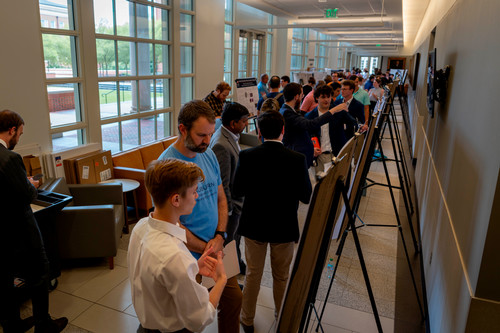
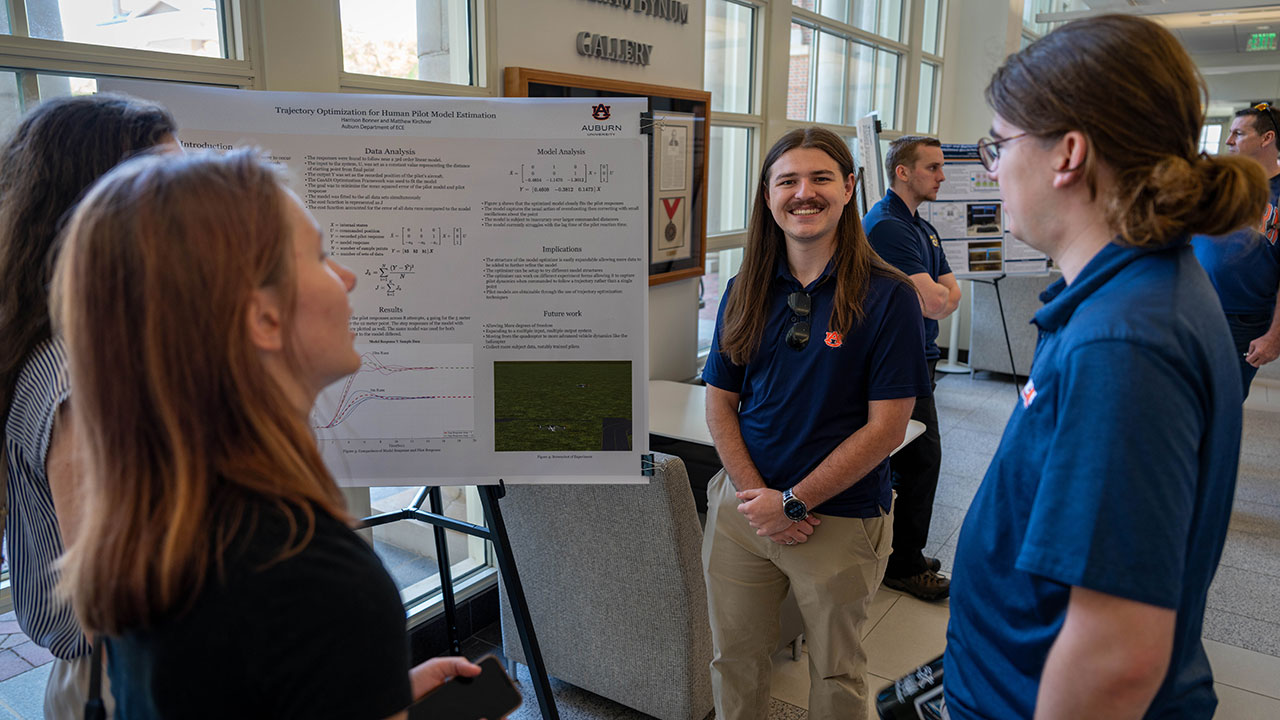 Twenty-four students spent nine weeks exploring research topics under the guidance of electrical and computer engineering faculty members, then presented their findings on July 18.
One student is studying how different materials and frequencies affect the efficiency of wireless charging systems. Another is analyzing whether magnetic train technology could disrupt sensitive electronics in nearby hospitals. A third is testing whether electromagnetic signatures from printed circuit boards could be used to spy on computing devices.
They’re not fifth-year graduate students. They’re undergraduates.
These projects are part of a nine-week, full-time research program, the Summer Undergraduate Research Experience (SURE), hosted by Auburn University’s Department of Electrical and Computer Engineering (ECE). Now in its second year, the program gives undergraduates the chance to conduct meaningful, faculty-guided research while simulating the experience of graduate school.
“We want students to get a real sense of what graduate research looks like — beyond the classroom,” said Hunter Burch, assistant professor and ECE graduate program co-officer. “The goal is to build their confidence in tackling complex problems, working through failures, and seeing how research evolves over time. Some students come in unsure of whether they belong in a research setting, but by the end, they’re presenting results, proposing next steps, and talking like seasoned researchers. That transformation is exactly what we hope to foster.”
For two months, 23 undergraduates from Auburn University and one from Cedarville University in Ohio worked 40 hours per week under the guidance of 11 ECE faculty members. Research topics included simulation tools for electromagnetic devices, sensor systems, quantum electronics and atmospheric radio waves.
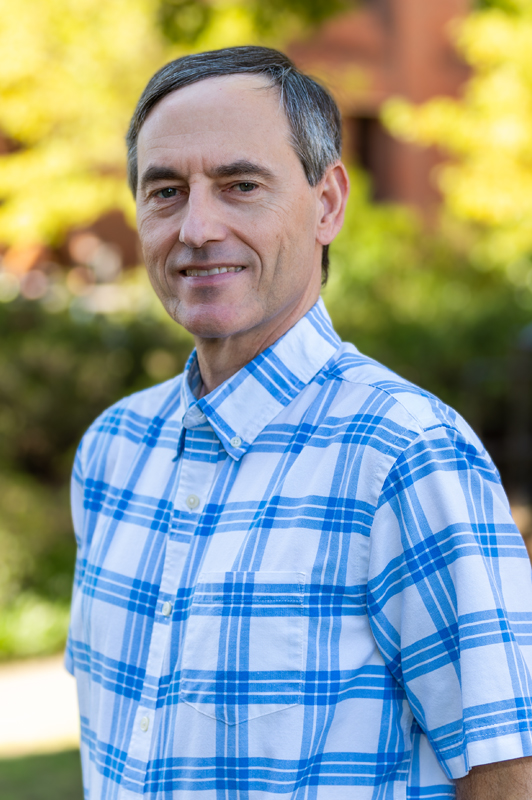
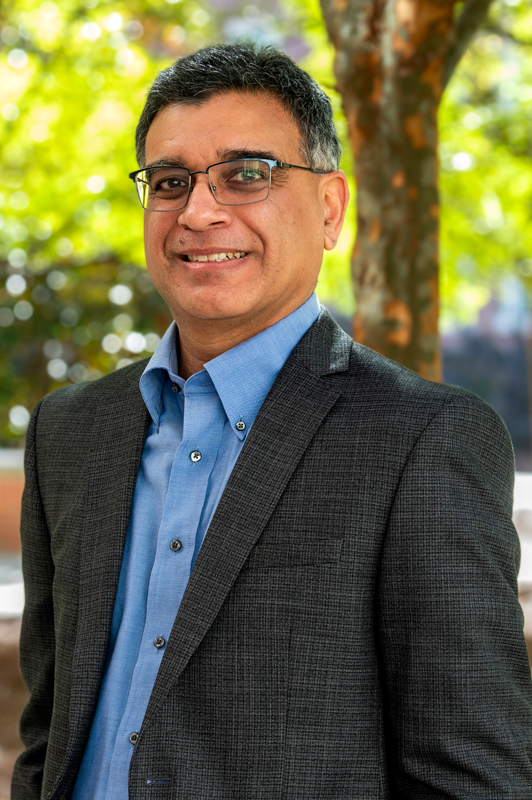
ECE faculty serving as student mentors included professors Robert Dean and Ed Muljadi, associate professors Ujjwal Guin, Yin Sun, Adil Bashir and Masoud Mahjouri-Samani, and assistant professors Clint Snider, Zihe Gao, Bosen Lian and Burch.
“We have them doing real research,” said Snider, who co-coordinates the SURE program with Burch. “It’s not like they come in and get a little useless project that isn’t real. We’re solving actual problems.
“My group works in computational methods and electromagnetics. One of my students is analyzing wireless charging topologies. If you make wireless chargers out of different materials or operate them with different frequencies, how efficient or inefficient are they? Another student investigated the potential impact of magnetic levitation trains on nearby infrastructure. If you have a hospital next to a magnetic train, does it end up affecting medical equipment? It’s a big source of electromagnetic energy.”
Students described the program as both rigorous and transformative.
“I’ve had a great time working with my professor, Dr. Robert Dean, developing cheaper and more efficient ways to manufacture planar and LC sensors for sensing environmental conditions,” said Nicholas Glennon, a sophomore in ECE. “It’s a great program. It’s paid work, so it’s a good alternative to taking the summer off. It’s academically challenging, but also very rewarding. You get a lot out of it.”
Glennon said the experience helped him think more seriously about what’s next.
“I wasn’t sure at all if grad school was something I’d want to pursue, but this program has definitely taught me that it’s something I want to look into,” he said.
Jacob Stevenson, a sophomore in ECE, had not yet taken an electrical engineering course before this summer. That didn’t stop him from jumping into the program.
“It was an amazing learning experience,” he said. “There’s just so much you wouldn’t otherwise get in normal classes. This is going to help me later.”
The program, he said, changed how he viewed graduate education.
“I hadn’t considered grad school as an option after finishing my undergrad, but now I’m definitely considering it,” Stevenson said. “This program has made it much more likely that I’ll go to grad school.”
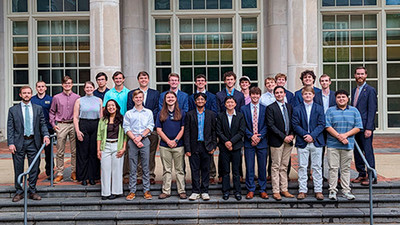
SURE has already become an important pipeline for ECE’s graduate program.
“We did entrance and exit surveys,” Snider said. “Last year, essentially all of them said they were going to apply to graduate school at Auburn. I think three, maybe four, are set to start this fall from having participated.”
The summer program’s value, according to students, went beyond building résumés.
“I’d absolutely recommend this to someone,” Stevenson said. “Real-world experience is so important because there are things you’ll never learn in class. You find all these little details that you’d never think about at first, but they can cause huge problems. The more experience you have, the better.”
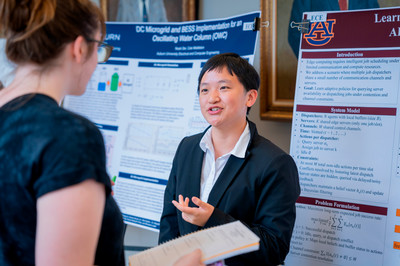
Open to students of all class levels, the program concluded on Friday, July 18, where students had the opportunity to showcase what they learned via poster presentations, and share work with faculty, peers and judges.
Poster presentations were judged on content and delivery. ECE student Chris Lathram took first place for his research, “VLF Wave Generation via Beat Wave High Frequency Heating.” Second place went to the ECE team of Nik Kandula and James Byard for “Designing an Autonomous Drone for Future Indoor Precision Navigation.” Third place was ECE senior Davis McKenzie for “The Generation of Amplitude Shift Keyed ELF Signals using a Rotating Permanent Magnet.”
Media Contact: , jem0040@auburn.edu, 334.844.3447