Auburn faculty uses 3D imaging to better understand sea ice behavior
Published: Jul 29, 2025 3:00 PM
By Dustin Duncan
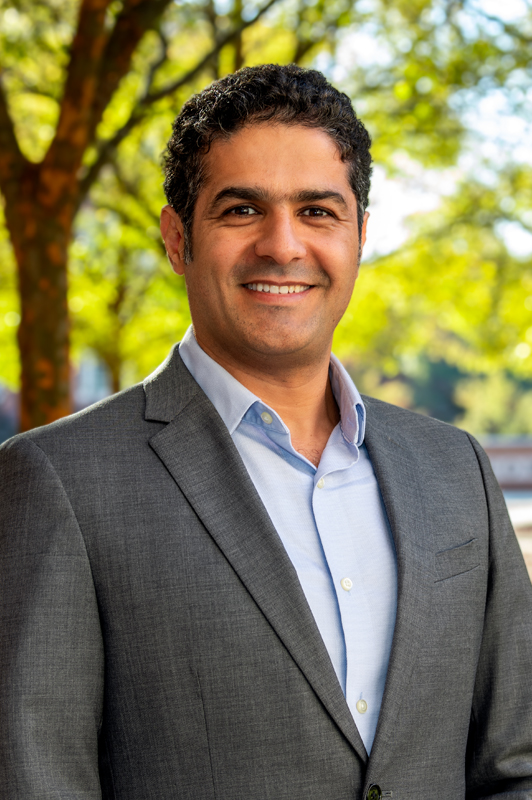
 Ali Khosravi, assistant professor in civil and environmental engineer (right), Bart Prorok, a materials engineering professor (middle), and Paul Bartley, an assistant professor in horticulture at Auburn University (left) stand in front of the PSX Macro CT machine in the X-ray Computed Tomography Lab.
Sea ice — frozen ocean water in the polar regions — is changing fast. As the Arctic warms, ice is thinning, breaking apart and becoming more unpredictable for ships, platforms and coastal systems.
To better understand the behavior of sea ice, Ali Khosravi, assistant professor of civil and environmental engineering, is leading a collaborative research project supported by the National Science Foundation. Working with co-principal investigators Bart Prorok, professor of materials engineering, and Paul Bartley, assistant professor of horticulture, the team is using high-resolution 3D imaging and advanced computational modeling to investigate the internal structure of sea ice. Their research focuses on how microstructural features such as tiny cracks, grain boundaries and crystal orientations, affect the ice’s mechanical response to pressure and warming temperatures.
“Understanding how sea ice breaks or melts helps us anticipate those changes and design safer, more resilient systems in the Arctic,” Khosravi said.
The project also involves collaboration with Jennifer Hutchings, a professor in the College of Earth, Ocean and Atmospheric Sciences, and Scott Durski, a senior scientist, both from Oregon State University. Geomechanica Inc., a modeling firm focused on physics-based simulation of rock and brittle material behavior, is supporting the modeling framework. Auburn’s share of the $763,887 project is more than $475,000.
Unlike many sea ice models that work from the top down, Khosravi’s team is starting from the inside out. By studying the ice’s microstructure — cracks, voids and grain patterns — they’re building large-scale models grounded in how the material behaves. To accomplish this, the team’s using Prorok’s PSX Macro CT machine, Discrete Element Modeling (DEM) and Finite Element Modeling.
“CT scanning gives us a detailed 3D view of the internal structure of sea ice — everything from brine pockets and air voids to grain boundaries and pre-existing cracks,” Bartley said. “It’s non-destructive, so we can monitor how that structure evolves under thermal or mechanical loading.”
Beyond observation, the team is using the data to build DEM models that reflect the actual internal structure of the ice.
“That means the simulations are grounded in real microstructure, not just idealized assumptions, making them much more accurate when it comes to predicting strength, cracking and post-failure behavior,” Khosravi said. “We’re simulating what the ice actually does — not just what a theory says it should. Our models don’t just capture overall strength; they show where and how the ice cracks and breaks apart.”
Inaccurate models can increase risks for ships and offshore infrastructure, especially if they underestimate how sea ice fractures.
“Bad predictions can lead to costly damage, or worse, safety failures,” Khosravi said. “Accurate modeling is key for decision-making in Arctic operations.”
Khosravi’s long-term goal is to change how sea ice is modeled.
“Long-term, this work could inform everything from ship routing to offshore design and climate modeling,” he said. “We’re also building a platform that can be adapted to other brittle materials like rock or concrete, so the impact could go well beyond sea ice.”
Media Contact: , dzd0065@auburn.edu, 334-844-2326