Auburn University Ethical Hacking Club notches first Top 10 at prestigious CyberForce competition
Published: Dec 8, 2025 9:30 AM
By Joe McAdory
How do you defend a wind‑energy grid when attackers are relentless? How do you keep turbines spinning, servers online, and employees connected while professional hackers are trying to break in?
Auburn University Ethical Hacking Club (AUEHC) team members have the answers.
Six AUEHC members — Matthew Pepe (computer science), Enoch Yang (computer science), Hemant Sherawat (cybersecurity engineering), James Weaver (computer science), Luke Robinson (cybersecurity engineering) and Will Nickolson (management information systems) — defended simulated energy systems, solved complex cybersecurity challenges and outperformed teams from across the country, earning a club-best eighth‑place finish out of 100 at the Department of Energy’s CyberForce Competition, hosted by Argonne National Laboratory in the Chicago area on Nov. 14–15. The Auburn University Center for Artificial Intelligence and Cybersecurity Engineering (AU-CAICE) sponsored AUEHC’s participation in this event.
Two other AUEHC teams secured 24th and 25th place, respectively, marking the first time the student organization placed three squads within the competition’s top quarter.
“Over the past year, our team underwent a major shift in people,” said Pepe, the top scoring team captain. “We lost about half of last year’s team to either graduation or scheduling conflicts, and we also had a leadership change from last year’s team captain Hemant Sherawat to me, so the pressure was high. But that didn’t stop us from pushing harder and even recruiting two additional teams to compete. These two additional teams were mostly fresh faces who had no competition experience, but that’s exactly what we were looking for — new people eager to learn. I had the pleasure of conducting all the trainings to get them prepped for this competition, and I am both extremely proud and impressed by their performance.”
CyberForce is not just about technical defense. Teams earn points for their ability to communicate with the entire industry workflow for cybersecurity.
“They test everything: your ability to communicate with a non‑technical C‑suite, your ability to document vulnerabilities in a professional manner and your technical skills, all in one competition,” Pepe said. “I find this competition to be a true benchmark of your abilities. CyberForce over the past two years has opened my eyes to areas of improvement I may not have otherwise recognized. That’s why I think it’s so crucial for students interested in cyber to do a competition at least once.”
Associate Research Professor in Computer Science and Software Engineering Samuel Mulder, who is taking over as AUEHC faculty advisor and coach, stressed the real-world value of competitions.
“These provide one of the few ways students can gain hands‑on experience in an adversarial environment,” he said. “Unlike most coursework, they face real opponents, dynamic challenges and unexpected scenarios. It’s a unique, real‑world experience.
“Students began preparing for this year’s competition immediately after last year’s competition. They studied and trained for months, which made a big difference. Looking at top teams like UCF (University of Central Florida), which has won repeatedly, our students realized the level of preparation that is required. They saw that year‑round training is what it takes to compete at the highest level and they’ve started moving in that direction.”
AUEHC’s CyberForce trajectory shows steady progress: 41st place in 2023, 15th in 2024 and now 8th in 2025, with those two additional teams in the top 25.
“Knowledge is passed down, and students actively mentor one another,” Mulder said. “That culture is what allows new competitors to succeed so quickly.”
AUEHC hosts an annual Department of Energy Cyber Fire Puzzles competition, presented by Los Alamos National Laboratory, each August, and participates in a variety of additional cyber competitions.
“AUEHC’s outstanding performance in Department of Energy cyber competitions is a testament to AU’s excellent cyber program, inspiring cyber faculty, and strongly engaged cyber students,” said Daniel Tauritz, the COLSA Corporation Cyber Security and Information Assurance Endowed Professor in the Department of Computer Science and Software Engineering, who also serves as Auburn University’s director for national laboratory relationships.
“Together with the Department of Energy and our partners at Los Alamos National Laboratory and other national laboratories, we are preparing the future national workforce in cybersecurity, thus contributing to national security.”
Media Contact: , jem0040@auburn.edu, 334.844.3447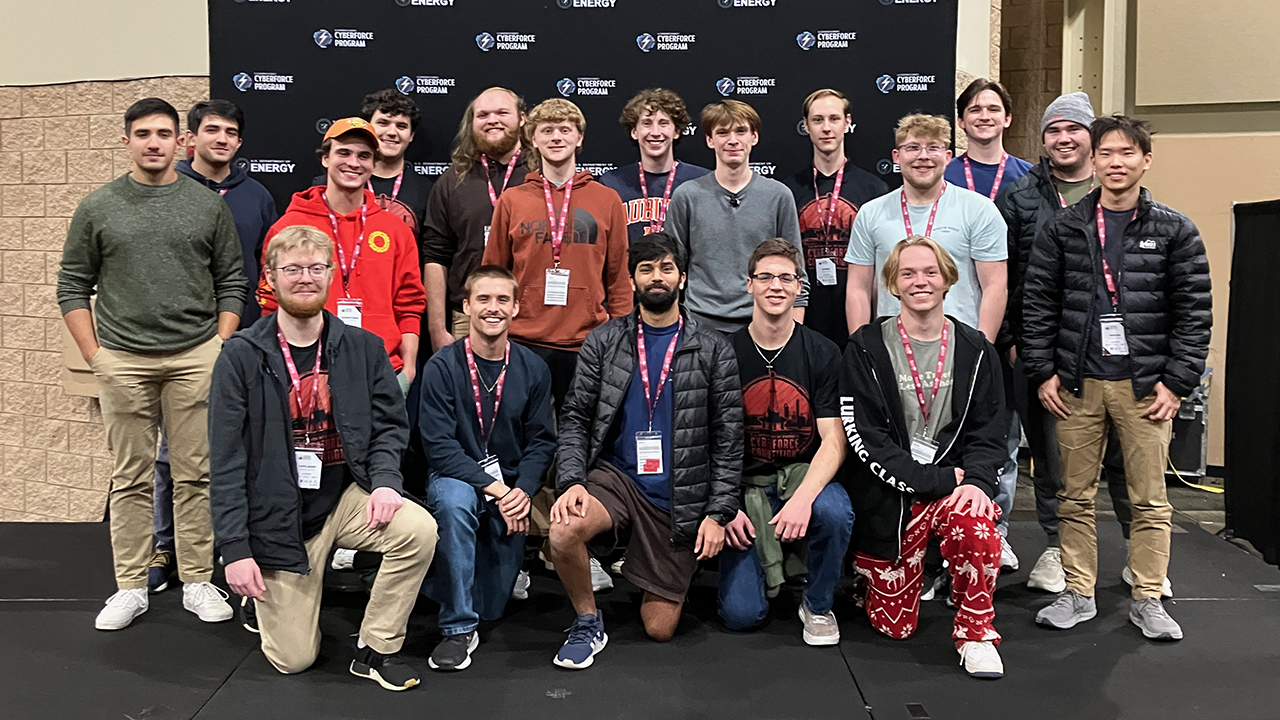
The student organization sent 18 competitors (three teams) to CyberForce, held Nov. 14-15 in the Chicago area.